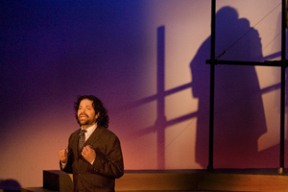
‘Jekyll & Hyde’ starts off the mainstage season this weekend at BPA.
Steven Fogell would like to get back the point of “Jekyll & Hyde, the Musical,” a sharp show that somehow managed to lose its edge en route from Seattle to Broadway.
“You’re going to see what Frank Wildhorn originally wanted it to be,” he said.
The Fogell-helmed production, which opens this weekend at Bainbridge Performing Arts, gives us Dr. Henry Jekyll, a conflicted Victorian visionary who in his avid desire to plumb the depths of the human psyche, invents a potion that slices apart its good and evil components. Enter his murderous and increasingly powerful alter ego, Edward Hyde.
Following in the footsteps of other literature-turned-modern-opera hits like “Les Miserables” and “Phantom of the Opera,” the original Wildhorn-scored show milked Robert Louis Stevenson’s 1886 novella “Strange Case of Dr. Jekyll and Mr. Hyde” for all it was melodramatically worth, presenting a visually exuberant, bright red take on human duality.
Fogell first became acquainted with the show in the mid-1990s when he worked on a pre-Broadway tryout run at Seattle’s 5th Avenue Theatre.
Entranced by the production, Fogell was surprised when he eventually saw the show on Broadway.
Toned-down blocking had muted the show’s gruesome essence, and two of the test production’s pivotal numbers, which Fogell says “had a darker, more sinister sound to them,” had been replaced by homogenized musical theater fare.
“It just became an easier score than what it originally was,” he said. “And I liked the more challenging original score.”
Although the Broadway show had the longest run in the Plymouth Theatre’s history, the New York Times called it “leaden” and “solemnly campy,” a fate surely sealed when David Hasselhoff took over in the lead.
At a recent director’s chat at BPA, Fogell referred to “Jekyll & Hyde” as “an opera trapped inside a melodrama trapped inside musical theater.”
And thanks to a flexible performance rights that made available all the songs from both the first productions and the Broadway show, Fogell was able to revisit Wildhorn’s edgier score and amp up the blocking to re-create the Seattle version’s intensity.
“It’s not that I’m trying to push the violence, but there are technical reasons you do certain things,” Fogell said. “And there is a shock value to this show.”
And he allows that these days, it takes more and more to shock us. From CSI to the Sci Fi Channel, Fogell says he’s consistently amazed at the amount of horror that audiences clamor to gobble up, and by our culture’s ongoing fascination with crime.
“We are compelled by all this information about what criminals do,” he said.
But why?
To explore the question with a bit of novel fun, BPA will bring in an expert. Fogell will moderate a pre-matinee discussion on Oct. 21 with Jacqueline Helfgott, chair of the University of Washington’s criminal justice department.
Helfgott will offer her own take on criminal psychology and behavior, and connect Stevenson’s Victorian setting with the modern fascination Fogell describes.
The director has his own theories about why we love to watch.
“It’s an escape thing for us. As long as we know it’s happening to us, we can view it as entertainment. I’m not saying that’s good or bad, but it’s part of our culture,” he said.
“We are a very curious society. I hate to say it, but we do turn and look at a car accident. We are very much voyeurs of life.”
Although Fogell’s staging will embrace the gore factor – prop mistress Sally Prangley performed an elaborate series of kitchen experiments to arrive at the perfect color of blood – he’s taking a minimalist approach with the sets.
Rather than weighing scenes down with heavy pieces, the show relies on rich costumes to nail the period, and on various tones and textures of lighting to create a range of moods and effects, from claustrophobic spaces to uncertain abysses.
When casting the show, particularly Mark Power in the title role, Fogell took a similar approach.
“I wanted somebody who would do it subtly,” he said. “I didn’t want this cartoony thing out there.”
So he asked Power, a singer first, to “let it just be (himself) going to this other place,” and conceptualize for Jekyll/Hyde not an overblown monster but instead a character who, like any other person, makes subtle moral compromises every day.
Otherwise, Fogell cautioned, the show could dissolve into an unbelievable fantasy, a risk it already ran by virtue of its melodramatic premise.
“It’s trapped in that area where you don’t want to go with that cheese factor,” Fogell said. “It’s a fine, fine line.”
Power, for his part, said he drew on observations of regular people’s everyday indifference and low-level bad behavior to tap into his inner Hyde.
“Their minds are so much on themselves, from their weight to their money…even to the point where they’re indifferent to little children,” Power said. “And how do they act?”
Fogell and Power are both intrigued to see how Bainbridge audiences respond to darker fare; Fogell thinks they’re up for it.
Besides, he jokes, there’s no nudity in this musical, only slashing.
“We have the Atomic bombshells coming in November,” he said. “We didn’t need to do it in this show.”
********************************************************************************
Seekin’ Hyde
“Jekyll & Hyde” runs Oct. 12-14, 19-21 and 26-28 at Bainbridge Performing Arts. Performances are Fridays and Saturdays at 7:30 p.m. and Sundays at 3 p.m., with a pay-what-you-can-preview at 7:30 p.m. Oct. 11 and an opening night reception at 6:30 p.m. Oct. 12 in the BPA Lobby. “Beyond the Script: Exploring the Dark Side of Jekyll & Hyde,” precedes the 3 p.m. performance on Oct. 21. Tickets, $20/$15 are available at BPA or by calling 842-8569. See www.bainbridgeperformingarts.org for more information.