Community provides input to WSDOT on 305/High School Rd. roundabout
Published 1:30 am Friday, February 13, 2026
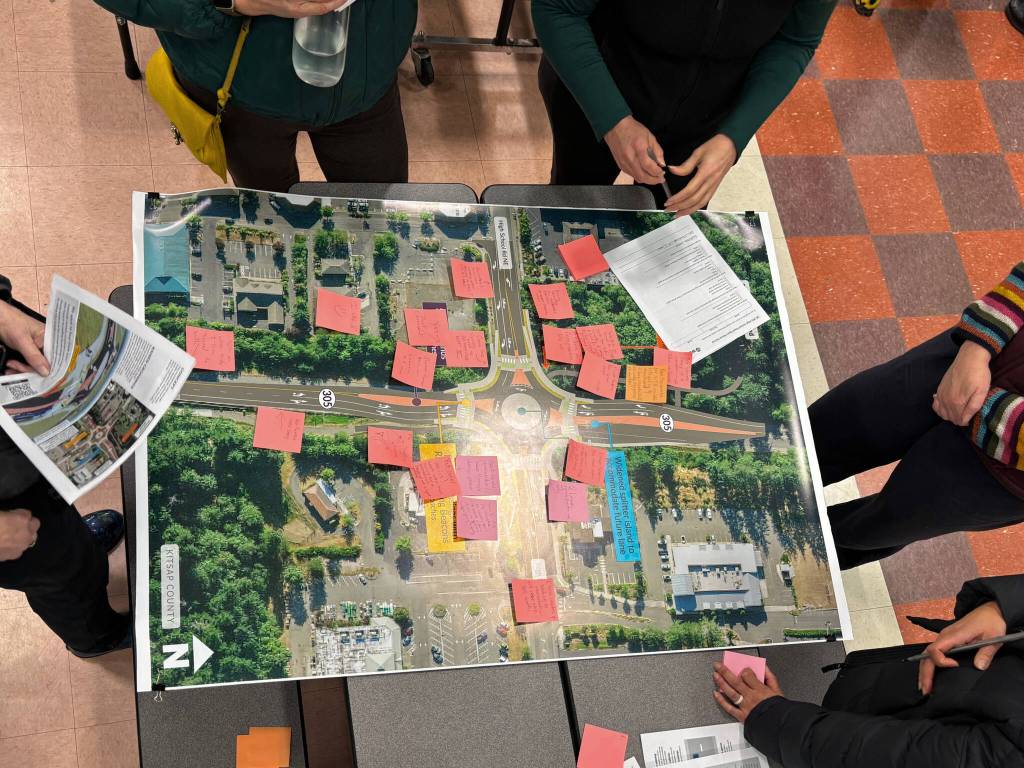
Over 100 people attended an open house held by the state Department of Transportation (WSDOT) Feb. 11 at Woodward Middle School, the first public opportunity to offer input on the agency’s upcoming Bainbridge Island roundabout project at the intersection of Highway 305 and High School Road NE.
Around a dozen or so WSDOT staffmembers were present to answer questions about the project, which is still in the pre-design phase, and participants were encouraged to submit a written public comment with their thoughts or suggestions. The online open house for the pre-design study will be available through Feb. 20.
WSDOT identified the major intersection on Bainbridge Island as a high priority for safety improvements following several crashes — one fatal collision and three collisions resulting in serious injuries — between 2015 and 202o. WSDOT reviewed crash data from 2015 to 2020 and found 29 intersection-related crashes.
The proposed roundabout would replace the existing signalized intersection, which serves four lanes of traffic from all directions, four crosswalks, and a bus stop, with a two-lane roundabout featuring raised crosswalks with flashing beacons and splitter island-medians from all approaches. The cost, about $4 million, is already earmarked in the agency’s budget.
WSDOT also reviewed data from 2020 to 2024 and reported 11 accidents at the intersection after previously reporting 24 accidents. The agency has updated the project website to reflect this change. “WSDOT conducted quality control and noticed that the milepost and junction relationship data for 2020 to 2024 was slightly broader than the data that was used from 2015 to 2019. We wanted an apples-to-apples comparison. The revised data for 2020 to 2024 doesn’t affect the priority of the project, and it’s not the data that got the project identified to start with,” WSDOT Olympic region communications manager Cara Mitchell said.
The design reflects WSDOT’s commitment to “complete streets,” a transportation philosophy that aims to make travel infrastructure just as convenient for pedestrians, cyclists and scooters, mobility device users and transit riders as for drivers.
Mark Krulish, WSDOT public information officer for the project, said that he heard “lots of good ideas” and “spirited discussion” at the event from participants.
“These events are important because we hear from people with boots on the ground, and they can see things that we can’t,” Krulish said.
It’s not uncommon for WSDOT to receive a large response from community members during infrastructure planning, Krulish explained; often projects in populated areas or with heavy traffic garner a commensurate amount of feedback. After WSDOT’s pre-design team solicits comments from the public, the team creates a report summarizing the input, then passes the information to WSDOT’s design team to incorporate into the project as needed.
“The ideal roundabout is what works for the intersection,” Krulish said. “‘Complete streets’ acknowledges that one size does not fit all.”
However, some attendees did not see a fit for a roundabout at the intersection at all.
BI resident Tom Winston expressed frustration with WSDOT’s decision-making process for the project, and with what he saw as a poor solution to ferry travel congestion. Most vehicle traffic headed to the BI ferry terminal must travel through the High School Rd. and Hwy 305 intersection, and during peak tourism season, the queue can stretch north and south on the highway for several miles. A roundabout at the proposed location would make east-west travel through the intersection very challenging during those times, he said.
“They came to us with ‘trust us,’ and it’s just not enough information to feel comfortable. We want to be safe — we live here, our children live here — so convince me, teach me,” said Winston. “I know they’re required to spend that funding for safety improvements in the Olympic region, but I would rather WSDOT spend that money in a community that wants it and needs it.”
The Bainbridge Island Fire Department fire chief, Jared Moravec, previously told the BIFD board of commissioners about the department’s concerns with the current preliminary design, including: cueing off of nearby roads, ferry queuing, and raised pedestrian crosswalks and high pedestrian traffic could all hinder emergency access. Moravec confirmed at the Feb. 11 board of commissioners meeting that BIFD sent a letter expressing their safety concerns to state representatives: Rep. Greg Nance, Sen. Drew Hansen, and Rep. Tarra Simmons.
Nance shared his concerns with the proposed roundabout.
“I am directing WSDOT to look at prospective low-cost enhancements before we go build a big roundabout. So think of things like rumble strips, a flashing light, or reduced speed limits in that corridor. So if there’s a safety issue, we should look at the cheapest ways to get the safety, not the most expensive ways to get the safety benefit we’re seeking,” he said. “I’ve gotten dozens and dozens of emails, calls, grocery store bump-ins, saying, ‘hey, like, what are you doing to cancel this roundabout? This is a terrible idea.’…I’ve yet to meet anyone to give me a big pitch about why this roundabout is so important. As a representative, it’s like, look, listen to your neighbors, (they are) making it pretty clear where they stand,” he said.
On a poster at the event, WSDOT officials offered a response to ferry traffic concerns.
“WSDOT is aware that there are times when the ferry queue reaches High School Road. These extended queues are infrequent. They tend to occur at times with service disruptions, smaller vessels on the route or peak ridership times such as the summer holidays,” the agency wrote.
Vicki Rauh, another Bainbridge resident, agreed with Winston, adding that reaching the Virginia Mason urgent care clinic on the east side of the intersection could be difficult, with a congested roundabout.
Other attendees saw the roundabout as an imperfect solution to a thorny problem.
Ross Hathaway, BI resident and former civic engineer, noted that given the amount of traffic of all kinds that the intersection already sees, adding a roundabout would not help streamline travel unless it is coupled with improvements like grade separations, which would remove intersection conflicts, and pedestrian or bicycle overpasses.
He advocated for a bridge connecting the southeast to northwest corner of the intersection, which would eliminate human-car interactions and unite two pieces of the Sound to Olympics Trail.
“I generally like roundabouts, but they need to be safe for all users, and WSDOT needs to be mitigating that risk. They can present significant challenges to pedestrian safety,” Hathaway said. “Roundabouts work best when traffic is balanced — not when you have a dominant leg, like what we see at this intersection. As growth on the island and in Poulsbo continues, traffic is just going to get worse. We need to design for future traffic.”
Additional safety measures for pedestrians and bicycles would be welcome, agreed BI resident Dan Feeney, particularly because of how many students travel through the intersection on their way to Bainbridge High School.
“I’m in favor of having a roundabout there; it reduces the eventuality of accidents, it lowers speeds, there’s no possibility for head-on collisions; it gets more cars through the intersection. But it should be much more apparent that pedestrians and bikers are there, especially with the [Sound to Olympics] Trail,” Feeney said. “A raised sidewalk is good, but there should be some physical warning system, like rumble strips, before the crosswalk.”