
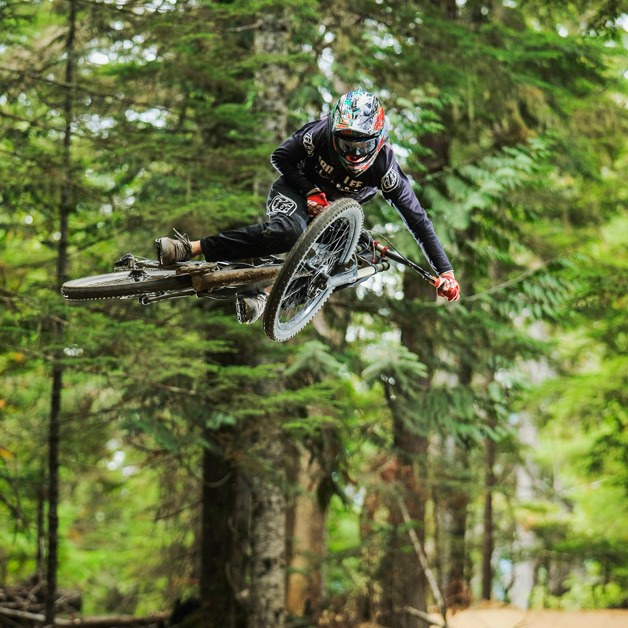
When most 14-year-olds hop on their bikes, they maybe grab a helmet and then they’re on their way.
Sebastian Belkin gears up like a gladiator.
Of course, his ride’s usually a little more intense than a quick jaunt ‘round the neighborhood.
Belkin, 14, a freshman at Bainbridge High School, is a rising star in the extreme sport of competitive downhill mountain bike racing. Recently, he concluded his first serious season on the competitive circuit by bringing home the first-place medal from the Northwest Cup, the premiere mountain bike racing event in the region, in Category 2, boys age 15 to 18, at Stevens Pass.
Downhill mountain biking — or “DH” — is a specific kind of bike race that is run on steep, rough tracks and pathways that incorporate jumps, rocks and other obstacles. Riders are timed and scored on their runs through the course, and winners are decided based on a points system after a series of races.
It’s more “Mad Max” than Tour de France.
“It’s a good feeling,” Belkin said of his big win. “Especially because it’s my first year racing downhill. I was nervous.”
Belkin said that he did not do very well in the first race of the cup series — placing 20th out of some 60 riders -— but added that once he got going and calmed down, he quickly improved.
His early hiccups didn’t matter in the end, as a win in the overall is based on a rider’s performance in the final races and total combined points, and cup officials drop each racer’s worst result.
“You have to be consistent to win the overall,” he said.
 Belkin first found the sport, he said, through a friend who introduced him to mountain biking and then, while researching different models of bikes and different courses, he stumbled on some online videos of downhill riding. He started riding seriously at courses around the state, especially at Duthie Hill Park in Issaquah and at Whistler Mountain, where he attended a training camp last year.
“That’s where I got introduced to racing,” he said.
It was a sports love at first site.
“Not a lot of people know about it,” Belkin said. “It’s more popular in Canada, especially in British Columbia. And, also, it’s pretty big in Europe.”
Belkin also credits his success to training with the Gear Grinders, Bainbridge Island’s high school-level and middle school-level competitive mountain bike racing team, and the encouragement he received there.
Still, accidents happen. Even to a NW Cup champ.
“It’s pretty scary sometimes,” Belkin laughed. “It’s really high speeds. And, obviously, if you crash you can have a serious injury.”
The young rider managed to escape this season unscathed, but last year saw him suffer his share of hard knocks.
“I’ve already broken my wrist,” he said. “[I’ve] torn my rotator cuff and had a number of stitches — I think 14.”
Wounds healed, scars begun to fade, Belkin said it wasn’t long before he was back on the bike again, undiscouraged.
“You have to be relaxed,” he said. “You kind of push that to the back of your mind. You don’t think about it when you’re racing.
“It’s really before your run where the nerves really kick in,” he added. “As soon as you drop in you kind of get into the zone.”
With this season coming to a close — the racing year runs May through September — Belkin is taking some time off. He’s back in school and running with the cross country team to stay in shape. Next year will see him competing in the Junior Pro bracket, which consists of riders younger than 18 who have obtained a certain number of top finishes.
“With a certain number of top five placements you can move up to Cat 1, which is what I’ll be racing next year,” Belkin explained.
Belkin said he hopes to continue in the sport, perhaps eventually riding in the World Cup like his favorite rider, Aaron Gwin, a two-time World Cup overall champ who is currently the top-ranked American rider on the international circuit.
“That would be awesome,” Belkin said.
If he finds he can’t make it as a rider, Belkin added, he still hopes to make a living in the mountain bike world somehow, perhaps designing his own line of bikes and continuing to advance the exposure and popularity of his newfound favorite sport throughout the country.
“A lot of people don’t really understand it,” he said. “You can’t really picture how big the jumps have gotten and how steep everything is and what the bikes actually feel like when you’re riding them.”
