Learn farming for fun (!) and profit (?)
Published 6:00 pm Wednesday, November 27, 2002
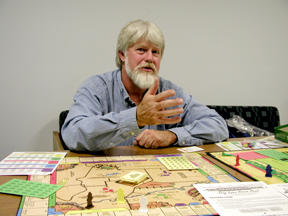
A farmer can spend a lot of time just thinking – particularly a farmer like George Rohrbacher, groomed for academia before the allure of rural life changed his plans.
When he wasn’t worrying about how to hold onto his Goldendale ranch in the face of record drought, Rohrbacher’s “mental exercise” was outlining a book.
And when a friend suggested that there ought to be a board game about agriculture, all that thinking came together in “The Farming Game.”
“This had been in gestation for several years and I didn’t know it,” Rohrbacher said. “Ninety-five percent of it was done in one day.”
The concept was a game that would “sketch what the family farm economy looks like at Ground Zero.” So unlike Monopoly, where each player starts with money, players would begin with 20 acres inherited from Grandpa, a bank line of credit – and $5,000 in debt.
As players move around the 52-space board, each space representing a week, they encounter the kind of opportunities and perils facing real farmers – the chance to expand operations using borrowed money, and unexpected fates like droughts, interest-rate increases and tax situations that hinder a player.
During spring, summer and fall, players have opportunities to harvest their crops. They draw “expense” cards telling them how much they must pay, then roll the dice to see what their income will be – said to replicate the degree of control real farmers have over crop prices and yields.
The winner is the first farmer to accumulate $250,000 – enough to quit the day job and farm full time.
“If you’ve borrowed a lot of money, a bad harvest can wipe you out,” Rohrbacher said. “The bad harvest is a matter of luck, but you’ve placed yourself in harm’s way by borrowing.
“On the other hand, it’s absolutely impossible to win without taking risks.”
Rohrbacher and wife Anne literally bet the ranch on their game, taking out a loan to go into production. “Born” in July 1979, it was in production by November. By Christmas, the game had received national news coverage, and had sold 10,000 copies. In 1980, “People” Magazine called it one of the previous year’s notable new games.
Since then, Rohrbacher has basically been a one-man sales force, marketing the game at agricultural expositions, independent toy stores and most recently through a web site.
“It’s counter-cyclical with farming,” he said. “Farming is dead in the late fall, which is the huge season for games, and the game business is dead in the late spring.”
The game has been a staple in the farm belt of the U.S. and Canada, but also has educational aspects. When the former Soviet Union began privatizing its agricultural sector, the World Bank used the game to teach Russian farmers about capitalism.
“We went to Russia with a staff of translators and introduced the game at newly privatized farms,” Rohrbacher said. “It portrayed a different face of capitalism.
“The picture that had been provided to them was that capitalism was the big eating the little. The picture provided by the game is that while you compete, you don’t have to hurt each other to win.”
With sales nearing half a million units, Rohrbacher acknowledges that the game has provided the family with far more income than its 1,800-acre ranching operation – “probably three quarters comes from the game,” he said.
One benefit of the game is a home on Bainbridge Island’s north end, where the Rohrbachers are spending more time.
“My wife grew up here,” he said, “and this has always been our second home.”
The couple met in Denver in the late ‘60s, where he was doing graduate work in anthropology and expected to become a professor.
But in 1970, he and Anne, formerly Anne Jenkins, spent 10 months touring the country, and decided they wanted to raise their family in a rural environment. They rented a small farm in Yakima, took other jobs, and built the spread to 100 acres, which they bought.
At the height of the market for farmland, they sold out and bought a cattle ranch in Goldendale, which has grown to 1,000 acres.
After the wide-open spaces of south-central Washington, with the nearest neighbor three miles away, Rohrbacher said he couldn’t live in a big city. He sees Bainbridge as “a wonderful blend of ruralness and access to culture.”
Rohrbacher’s new opportunity is “The Construction Game,” which tries to replicate the construction business. You win by making smart and well-timed equipment purchases, bidding on the right jobs, and being a little lucky.
As for the book idea, Rohrbacher said the games have allowed him to satisfy those creative urges.
“It’s still a book. The stories tell themselves each time you play,” he said. “A game plan that works for you one time might not work for you the next time, because history unfolds in a different way each time you try.”