‘Now accounted for’…Albert Arcand
Published 12:00 am Wednesday, December 24, 2008
Thought to be lost at Pearl Harbor, he went on to distinguished Navy career.
On Christmas day 67 years ago, Albert Arcand’s parents received the best gift they could have imagined: a telegram from the United States Navy Department. It read in part:
“The Navy Department is pleased to advise you that a report has been received that your son, Albert Alfred Arcand, Seaman First Class USN, previously reported as lost in action is now accounted for. …The Department regrets any unnecessary anxiety caused to you by its previous message.”
The “previous message,” dated two weeks earlier, was stark: Arcand “was lost in action in performance of his duty and in the service of his country.”
The confusion was understandable. Chaos reigned in the wake of the Japanese attack on Pearl Harbor on the morning of Dec. 7, 1941.
While it may seem a stretch to call a man who received two Purple Hearts while still in his teens as “lucky,” that word justifiably applies to Bainbridge resident Arcand, whose life was in serious peril several times during the early years of World War II.
For starters, take the fact that he was even alive, though badly burned, on the evening of Dec. 7. Sixty shipmates on the battleship USS Nevada were among the 2,400 servicemen who perished during or in the immediate aftermath of the attack.
Arcand, born in 1923, had no way of envisioning the horrors that lay in store for him that December morning when he joined the Navy at the age of 17 after dropping out of high school in his hometown of Sanford, Maine. The Nevada, which he joined in the summer of 1941 as a radioman, was his first ship.
Like so many other men, Arcand’s first thought when the shipboard alarms sounded just before 8 a.m. on that fateful day was, “What’s the Navy doing pulling this stunt on a Sunday morning? I thought it was a drill.”
The red circles on the wings of the planes flying just overhead soon suggested otherwise. A torpedo that slammed into Nevada removed any lingering doubts. Then the battleship Arizona, moored directly ahead of the Nevada, blew up. A bomb struck the vessel’s foredeck, penetrated several decks and exploded in the ship’s ammunition magazine.
Soon afterward, Arcand was helping the crew of an anti-aircraft gun. He looked up to see several Japanese planes heading toward his ship. A bomb struck a few feet from Arcand, who instinctively threw his hands in front of his face.
“I was just wearing skivvy shorts and shirt,” he said. “Everything exposed was burned. I screamed and screamed.”
He was the only man to survive the blast.
“I didn’t know where to go, what to do,” he continued. “I wanted to jump off the ship but I didn’t know how to swim.”
Finally he found shelter in an empty gun tub, where he endured strafing attacks that killed a number of Nevada crewmen.
Arcand was fortunate that Nevada had off-loaded the ammunition for her 14-inch main battery guns the previous day, perhaps sparing her Arizona’s fate. Because she had steam up in two of her boilers, Nevada was the only one of the seven battleships on Battleship Row able to get under way. Seeing the ship heading toward the narrow channel that linked Pearl Harbor with the sea, the Japanese concentrated on her. If they could sink the ship in the channel, the hulk would effectively seal the harbor for months.
Five more bombs struck the ship and ignited several fires during this time, though the empty magazines precluded anything catastrophic. But the damage was severe enough to cause the Nevada to deliberate running aground on Hospital Point, at the eastern tip of the channel, rather than risk further passage. The grounding site was fortunate for Arcand, who was quickly taken from the ship to the nearby naval hospital.
He didn’t stay there long. With hundreds of casualties being rushed ashore, he was hoisted onto a stretcher and trucked to a receiving station, and from there to a mobile base hospital on the hill overlooking the harbor. The multiple moves may have been the source of the erroneous account of his early demise.
He remained in the hospital for about two weeks; then, with his legs not fully recovered and still bleeding, he was ordered to the USS Lamberton, a World War I-era destroyer that was a far cry from the broad and stable platform of the Nevada.
“I was seasick for two days, but never again after that,” he said.
Following several months of duty on the Lamberton as she patrolled the waters off Pearl Harbor, Arcand reported for duty on a new destroyer, the USS Barton. Barton arrived in the South Pacific in mid-September and quickly found herself in the thick of the action revolving around the U.S. invasion of Guadalcanal the previous month.
The invasion forces had been quickly cobbled together after American intelligence discovered that the Japanese were building an airfield on Guadalcanal, which would threaten the tenuous sea link to Australia. The Marines quickly captured the airfield, but had to repel continuous Japanese attacks. The waters off Guadalcanal quickly acquired the grim nickname of Ironbottom Sound because of the toll of warships on both sides that the fighting exacted.
In November, the Japanese assembled a group of transports to carry thousands of reinforcements to the island and launch a major offensive. A naval force centered on two battleships preceded the transports.
Desperate for ships, the Americans put together five cruisers and eight destroyers, one of which was the Barton. The two sides made contact shortly after midnight on Nov. 13, 1942. Confusion reigned on the American side, and the patchwork force soon became disoriented. Ships fired on each other at virtually point-blank range. One officer later described the battle as “a barroom brawl after the lights had been shot out.”
Groping her way through the pitch blackness, the Barton had to come to a sudden stop to avoid a collision with another American vessel. At that point a Japanese destroyer pumped two torpedoes into the ship. To a crewman on the USS Fletcher, another American destroyer, the Barton “simply disappeared in fragments.” The ship broke in half and sank in 40 seconds.
Once again Arcand’s luck held. The Barton’s main radio room was above the blast area and no one there survived. Arcand, on the other hand, was stationed in the emergency radio room, located in the after part of the ship. When the torpedoes hit, he quickly stepped outside. Even that was almost not enough to save him.
“I went down with the ship,” he said. But the buoyancy of his life jacket soon popped him back to the surface. Even then his luck continued. The Fletcher roared through the clump of survivors at high speed as the battle continued, probably inadvertently killing a few of them but sparing Arcand. He drifted for nine hours in the midst of an oil slick – which protected him from marauding sharks – before being rescued.
He was one of just 68 survivors. One hundred sixty-four men were killed. Once again Arcand found himself in a hospital, this one on the nearby island of Tulagi, where he remained for several weeks.
The action – the First Naval Battle of Guadalcanal – left just two battle-worthy American vessels in its aftermath. But the Japanese commander didn’t press his advantage, choosing to withdraw. He was immediately sacked.
Two nights later, the Japanese attacked again. Once again the Americans hastily assembled a defensive force. Though three more American destroyers went down, once again the Japanese were thwarted. That was the tipping point. The Japanese never made another major attempt to reinforce Guadalcanal. Several months later, the starving and disease-ridden survivors were withdrawn. From that point on, the Japanese were on the defensive in the Pacific.
After recovering, Arcand served on yet another destroyer and spent six months in the Aleutians as part of the American effort to recover the islands of Kiska and Attu. When the ship returned to Pearl Harbor, Arcand was assigned to the Cassin Young. There was a certain irony. The ship was named for the captain of the USS San Francisco, who had been killed during the same engagement in which the Barton had been sunk.
Once again Arcand’s luck held. After being involved in heavy fighting during the invasions of Saipan, Tinian and Iwo Jima, Cassin Young sailed to Okinawa, the scene of massive kamikaze attacks. Arcand transferred from the ship a week before it was struck by a kamikaze. More than 20 crew members died, including a few of Arcand’s buddies.
At that point, Arcand’s war ended. He left the Navy soon after returning to San Diego and – taking advantage of the GI Bill – enrolled at the University of Maine. He returned to the Navy, where he served another 17 years, eventually rising to the rank of commander. His final duty station was at Keyport, with Bainbridge visible from his office window. He moved to the island after leaving the Navy in the 1960s and raised his family here.
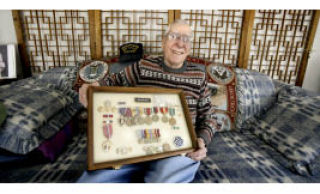
Arcand currently lives at the Madison Avenue Retirement Center, where a view box near the front door of his apartment holds his Purple Hearts and other Navy memorabilia. And likely reminds him of how close he came to dying on that December morning so many years ago.