
Harvesting community: How one farmer cultivates connection on BI
Published 1:30 am Wednesday, April 22, 2026
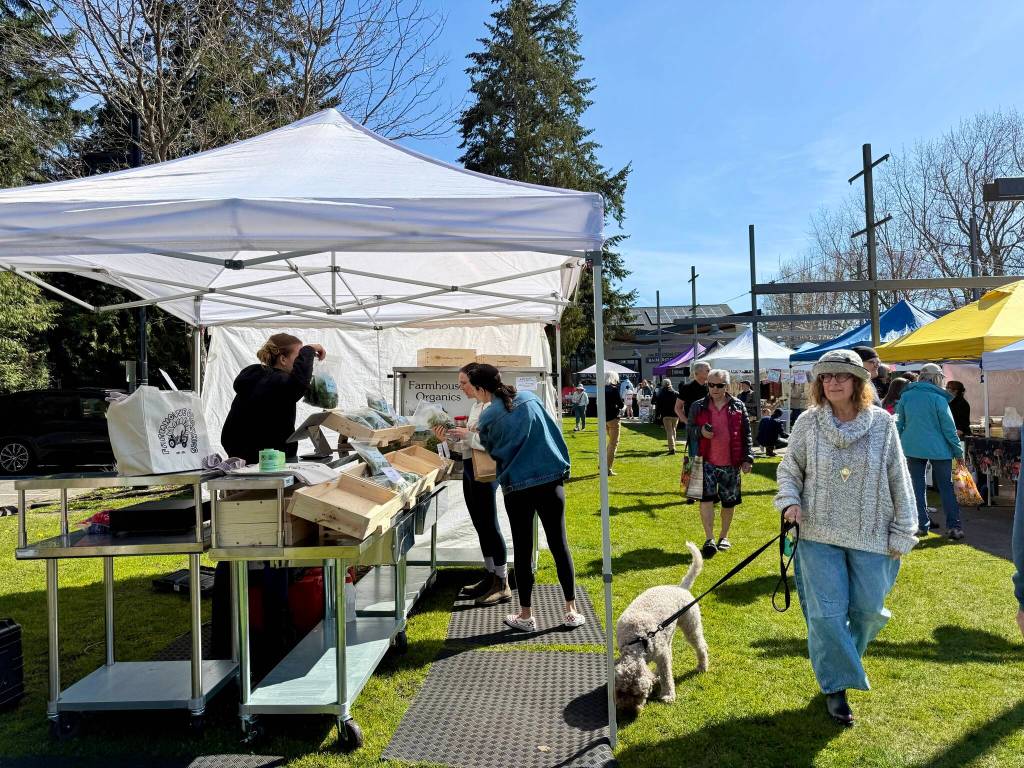
Every Saturday morning, long before the crowds arrive, Betsey Wittick is already at work—unloading crates, arranging produce, and preparing for another day at the Bainbridge Island Farmer’s Market.
For Wittick, the market is more than a place to sell food. It’s where community happens.
“Selling produce each Saturday is my social time,” she says. “It’s a lot of work for us vendors to set up a market each week. But it’s how we engage with the community.”
Wittick has lived on Bainbridge Island for more than 40 years, building deep roots both in the soil and in the relationships that sustain her work. Through Laughing Crow Farm and Bainbridge Vineyards, she has created a farming operation that reflects both practicality and passion.
“I care deeply about this community,” she says. “Providing healthy, organic, locally grown produce and wine is the best way I can give back.”
At Laughing Crow Farm, Wittick grows a variety of crops—but her approach is shaped by the realities of running both a farm and a vineyard. Because much of her time is spent tending grapes and making wine, she focuses on crops that can be harvested ahead of time and stored without refrigeration: potatoes, onions, garlic, and other root vegetables.
It’s a system built on efficiency, but also resilience.
Most of her produce is sold directly at the farmer’s market, as well as through local outlets like Bay Hay and Feed. And while the vegetables sustain the farm’s weekly rhythm, the vineyard tells a longer, more uncertain story.
At Bainbridge Vineyards, Wittick grows her own wine grapes and produces the wine on-site—an intentional choice in an industry where many rely on imported fruit.
“It would be a lot easier if I bought grapes from other vineyards,” she says. “But I feel committed to growing them here, to having wines that reflect the soil and climate where I live and work.”
That commitment comes with risk. Farming grapes in the Pacific Northwest means navigating frost, insects, birds, and the constant uncertainty of each growing season.
“Sometimes I don’t know if we’ll get the next crop,” she admits.
Even the soil presents challenges. Bainbridge Island’s glacial till—rocky and uneven—adds difficulty to working the land. To work with the land rather than against it, Wittick uses no-till methods and draft horses for plowing and cultivating, an uncommon but effective approach that reflects her low-impact philosophy.
For Wittick, farming has always been about connection—to the land, to food, and people.
She traces that connection back to childhood, when she first discovered a love for growing things. “I used to rip out the grass at my family’s home just to plant vegetables,” she recalls. “I’ve always loved being outside and growing plants.”
That early passion has grown into a lifelong commitment—not just to farming, but to education.
Wittick has long supported farm-based learning, creating opportunities for young people to step outside the classroom and into the fields, such as EduCulture, a Bainbridge Island-based education program that connects local farms, schools and the community.
Over the years, Wittick has hosted field classes for hundreds of school children on her farms each year. She believes that understanding where food comes from is essential, especially as farming becomes more expensive and access to land becomes more limited. For the past 21 years, she has shared her knowledge by sponsoring farm interns in a work/educational program.
“We need to help the next generation have access to land and housing,” she says. “They need the opportunity to grow locally.”
At the heart of her work is a desire to help people see the bigger picture.
“I want people to understand the continuum,” she says. “To connect with their source of food.”


Best of Bainbridge