A boon for Bainbridge salmon
Published 3:08 pm Thursday, February 5, 2009
Cooper Creek supplementation project goes live.
You could describe it as a fiberglass canoe – or the best chance the island has of reviving a native salmon population.
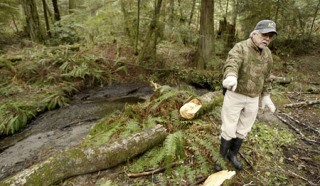
The installment of the 20-foot trough on Cooper Creek this weekend is the culmination of years of restoration work and salmon monitoring at the head of Eagle Harbor.
More than 10,000 fingerlings will call this trough home for up to six weeks while volunteers feed them before they are released into the wild, giving the small fish a better chance of surviving in the harsh saltwater world.
“With salmon it’s a numbers game… you are always talking about small returns,” said Debbie Rudnick of the Bainbridge Island Watershed Council.
The typical survival rate of chum fry is about one-tenth of a percent. Volunteers are hoping that in three or four years between 50 and 100 chum will make the journey back up Cooper Creek enough to sustain an annual return.
Spearheaded by the Bainbridge Island Watershed Council and assisted by the city and Suquamish Tribe, Cooper Creek has been a story of promise and dedication to salmon recovery.
According to the city’s shoreline planner, Peter Namtvedt Best, Cooper Creek is unique, and symbolic of citizen efforts to restore island salmon populations.
“This is probably the most in-depth series of projects for salmon in one particular stream,” Namtvedt Best said. “We haven’t done a project, monitored, and had a long-term plan for recovery before, so this is special.”
One of the largest projects on the creek removed an abandoned dam system that once collected water for the city of Winslow. That concrete structure was replaced with a culvert in 2004. The creek now runs, unimpeded, about a mile inland – almost unheard of on Bainbridge, according to Namtvedt Best.
It also provides one of the most promising habitats for island salmon.
Since the barrier to fish passage was removed in 2004, the Watershed Council has been monitoring the stream for signs of natural recovery.
“We have seen very few return, some resident cutthroat and a few returning chum,” Rudnick said. “We have good fish passage, and we knew this stream historically supported a healthy population.”
Based on the advice of independent and tribal fishery consultants, activists began the lengthy process of approving a supplementation scheme for the stream.
“We decided we could take a long-term natural approach, which could take decades to build back a population,” Namtvedt Best said. “Or we could kick it off and boost the population in a four-year period and then stop and let that population naturalize.”
It has taken the Watershed Council two years to obtain the permits it needed to begin the supplementation program.
This year, local salmon fry were supplied by the Suquamish. Next year, that system will be replaced with an egg box that will house thousands of fertilized chum eggs over the next three years.
However, while releasing tens of thousands of fish into the creek may help overcome the numbers game that hampers fish survival, many obstacles still face these small salmon.
Cooper Creek was singled out by the Watershed Council, in part, because it offers an abundance of protection, free from development.
But late last year, the Bainbridge City Council decided to begin a process to sell most of the city-owned property that encompasses the creek.
According to City Administrator Mark Dombroski, the property would have a conservation easement to protect the stream before it is sold, but it is not known what type of development could occur on the property or how it will affect the stream.
The fish also have to survive the trip through Eagle Harbor, in which shoreline recovery efforts are still ongoing.
This is only the second time a stream on Bainbridge has recovered to a point where biologists believe it can support a native population of salmon.
Springridge Brook, which runs from the man-made pond located at the intersection of High School Road and Fletcher Bay Road into Puget Sound, was the first to get a boost of salmon in the 1990s.
It took years of effort to replace culverts, remove obstructive vegetation and re-route the stream to avoid vehicle run-off.
Largely thanks to the efforts of independent fisheries consultant, Wayne Daley, and Eagle Scouts who toiled on the stream, Springridge Brook was supplemented with 5,000 coho fingerlings, which created a healthy returning population for some years.
However, the return of coho to that stream has sharply declined recently, according to Daley.
“The problem has been in the last two years. We haven’t seen very many coho anywhere on the island… we’ve seen a significant decline in fish,” Daley said. “We don’t have a strong groundwater flow into most of the streams, it’s significantly lower than in the ‘80s and ‘90s, so the adults have a lot more trouble getting into the streams.
“It’s a bit frustrating, but the fish are there and we need to see what we can do to improve habitat and making.”
Daley is advising on another Eagle Scout project that will see demolition crews using explosives to create a new route for fish to travel up Springridge Brook. Currently, invasive plants have made Springridge Brook all but impassible.
Though there are no concrete plans to supplement other island streams, the Watershed Council will continue to monitor for fish and work with the city to identify fish-passage barriers around the island.
The hope is that other watersheds will show just as much promise as Cooper Creek and could one day be supplemented as well.
“Right now, we’re concentrating on this project and making sure we do it well,” Rudnick said. “The goal is to establish enough genetic diversity to ensure a healthy return of salmon for years to come.”
To learn more about salmon restoration projects visit: