
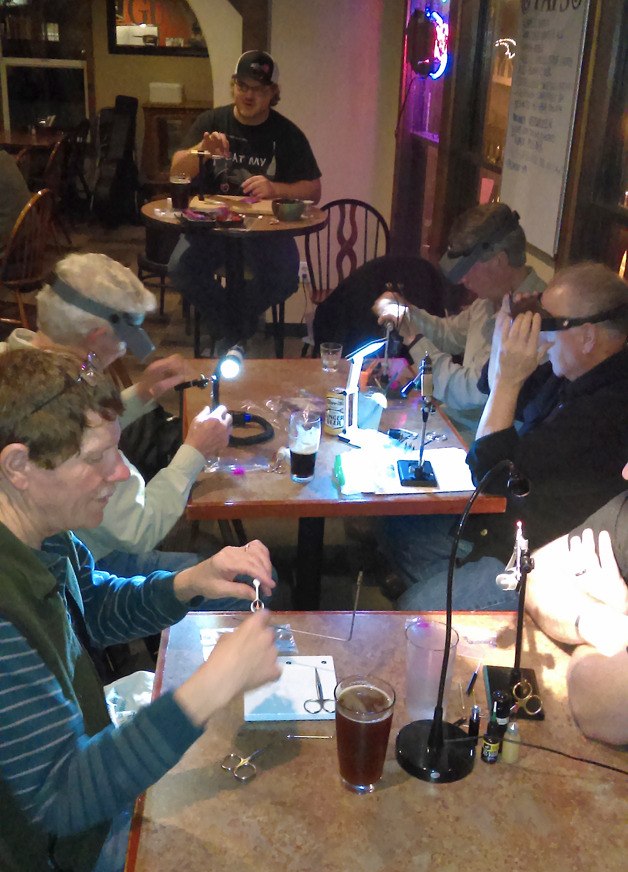
Fish stories go best with beer.
They’re often better told — and almost always better enjoyed — with a pint or two. They definitely get more believable anyway.
Rarely, however, do educational events afford participants the opportunity to imbibe, even amidst a beer culture as happening as Kitsap County.
Therefore “Barflies,” a monthly get together for Kitsap County fly fishing enthusiasts, is a unique forum. The meetings, hosted by the Kitsap-Olympic Peninsula Chapter of Trout Unlimited, a national fly fishing promotion and conservation advocacy group, gives anglers a chance to swap stories and techniques, seek help and advice from those with more experience and enjoy special guest speakers — including some industry pros — all while sipping a sampling of local brews in a friendly, informal fashion which chapter president Chris Taylor said makes all the difference.
“It’s something we started as kind of something fun besides all of the conservation work we do,” Taylor explained.
At first, he said, the monthly meetings were held in a conference room, but that quickly got boring and “just wasn’t any fun.”
Fly fishing — let alone tying your own flies — can seem daunting to newbies, Taylor said. It looks complicated and technical and it puts off would-be anglers. So the mission became a way to make the meetings and tying as fun as the fishing.
“We wanted to find a place that had personality, where we could drink beer and just kind of let loose and have some laughs,” Taylor said.
The gathering, which convenes at 7 p.m. on the last Wednesday of every month, is held at a local brewery or bar — most often Tizley’s Europub in Poulsbo (18928 Front St. NE) — with decent light, enough table space for fly tying and plenty of top-notch brews.
Visit the events section of www.kop.tu.org to learn more and check future venues. All anglers of all skill levels are welcome. Bring stories, curiosity, fly tying gear and beer money.
 The art of fly tying, Taylor explained, tends to break down into two schools of thought: those who seek to create an imitator pattern (matching as closely as possible the natural prey of the fish an angler is after) or an attractor pattern (a more abstract or surprising design meant to make the fish curious enough to take a bite).
Both styles are made and discussed at the Barflies meetings. Each meeting also features a brief talk and demonstration by a guest speaker — guest tyer, actually. Last month’s guest was Thomas Lamphere, owner of Beach-Men Fly Tying, a professional fly tyer who sells his work to retail and wholesale outlets.
“It’s more intimate,” Lamphere said of fly fishing’s unique appeal.
“You’re not sitting there waiting for a bobber to move or something to smash a lure. You have different variables that you’re working with. You’re actually trying to imitate an actual food source.”
Research, he said, and a real knowledge of a particular environment, is necessary in fly fishing, making it a more rewarding experience.
“If you’re going to fish a river for trout,” he explained, “you’re bringing an entomology aspect into it. You have to learn your bugs. You have to learn the rivers that you fish.”
Though long thought of as a bit of a boys’ club, Taylor said that fly fishing today is enjoyed by a broader, more diverse group of outdoor enthusiasts than ever before, including many female and younger anglers.
“Those barriers are breaking down so fast,” Taylor said, adding that local TU members range in age from age 15 to 80. “More and more women are getting into it.
“Sometimes, I’ll step back and look at it, look at these guys, and it’s just like a women’s knitting group,” Taylor laughed. “It’s got the same dynamics.”
Children are instinctively attracted to fly fishing, Taylor said, as evidenced by the ever-increasing participation in the chapter’s annual youth event, which is slated to return to the pond at Battle Point Park on May 1.
“We get a hundred or so youth who come to that,” he said. “It’s one thing to actually fool a fish with a fly. It’s so rewarding to get that take and feel and to trigger that instinct you’re targeting. But to do it with something you tied is a whole other thing.”
Anglers lucky enough to live in the Pacific Northwest, Taylor said, enjoy year-round fishing opportunities.
