Men in America are in a state of crisis.
Numerous factors are to blame, and typically, the left and right have targeted opposing factors. Liberals have highlighted toxic masculinity, while conservatives point to feminism and wokeness. But both sides increasingly agree something is awry and amiss, and that male despair and isolation have been amplified because of radical social, cultural, and economic transformations in society, leaving many feeling frantically disoriented, isolated, and worthless.
Things are far from gloom and doom. Men make up more than 70% of law firm partners, 72% of Congress, 86% of tech founders, 90% of Fortune 500 CEOs, and every president America has had. Men are much more likely than women to occupy the highest-paying professions in the United States, including doctors, dentists, and attorneys, despite the fact women have been securing advanced degrees in such fields in comparative or greater numbers. Men without college degrees outearn women with the same educational attainment. Women obtain more college degrees than men, but men with college degrees outearn women with the same degrees.
So yes, it’s still largely a man’s world.
Despite those numbers, a notable segment of men is enduring considerable challenges. They are in less robust health than their female counterparts, regardless of employment status. This is largely because men are more inclined to drug and alcohol addiction, and they are less inclined to pursue medical help. As a result, they tend to die earlier. More than one out of 10 working-age men in America are not in the labor force or even pursuing gainful employment. When combined with the 3.5% of men who are unemployed, roughly 12.5% of American men between the ages of 25 and 54 are not working.
Suicide has become an epidemic among young people, and it is more commonplace among men than women. In 2023, the suicide rate for males ages 15 to 24 was 21 per 100,000, a more than 10% increase since the late 1960s, according to an analysis of CDC data by the American Institute for Boys and Men. The suicide rate for young women was five per 100,000.
Among men aged 25 to 34, 19% still live with their parents, up from 14% in 1983, according to census data. Regarding women, 13% live with their parents, up from 11% four decades ago. “The data is clear. Men aren’t super healthy,” said Matt Englar-Carlson, a professor and founder of the Center for Boys and Men at Cal State Fullerton. “Young people in general are taking longer to reach the traditional milestones of adulthood; it’s particularly true of young men.”
Interestingly, men in rural America’s red states tend to struggle even more than those who reside in the bluest ones. Deaths of despair, for example, are worse in rural America, despite the fact it is hardly affected by the “wokeness poison” the right-wing shock jocks and blogosphere love to hate. Men in these states are dying by suicide at rates much greater than women.
Historically, this is hardly a new phenomenon. In the inaugural years of the 20th century, America had what was referred to as a “boy problem.” Boys on the street, making trouble. Boys getting caught up in crime. The problem spread across the United States amid the disruptions caused by technological change, immigration, and growing socioeconomic inequality. Policymakers intervened with, among other things, universal public schooling. The public reaction to such efforts was inspiring. Within a decade, the majority of today’s major child-serving organizations were established: Big Brothers (1904), the Federated Boys’ Clubs (1906), Boy Scouts (1910), Girl Scouts (1912) and 4-H (1912).
A century later, boys and men are once again struggling in a nation challenged by technological transformations, immigration, widening inequality, and other problems.
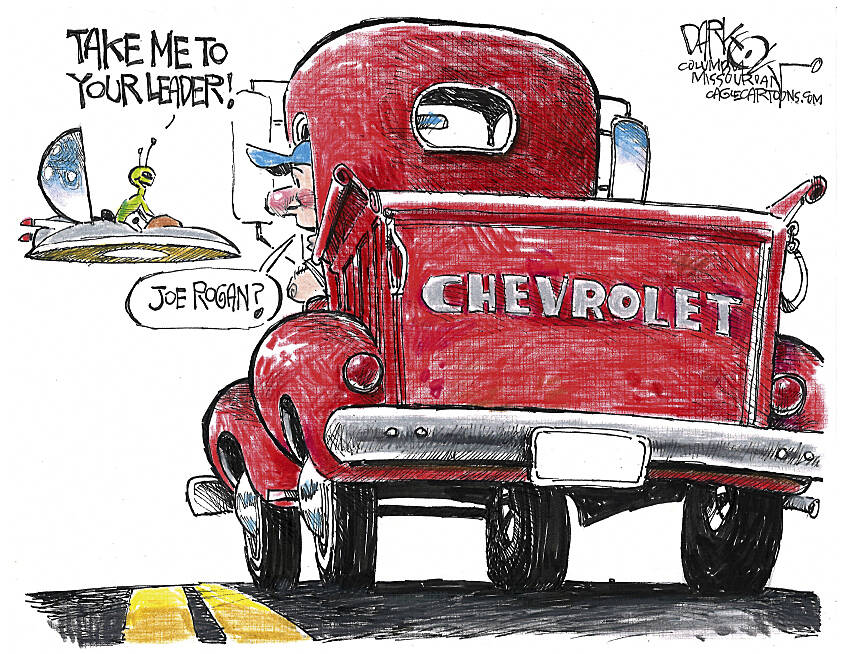
The crisis facing men is legitimate and deserves serious and genuine attention. The “manosphere” is saturated with opportunists vying to be the next Joe Rogan or the next Tate brothers. We need to work feverishly to combat, shame, and call out the fraudsters and charlatans who are all too willing to prey upon men’s need for connection by promoting and selling bravado that is as deficient and disingenuous as their moral values.
Onward, soldiers, onward.
Copyright 2025 Elwood Watson, distributed by Cagle Cartoons newspaper syndicate. Elwood Watson is a professor of history, Black studies, and gender and sexuality studies at East Tennessee State University. He is also an author and public speaker.