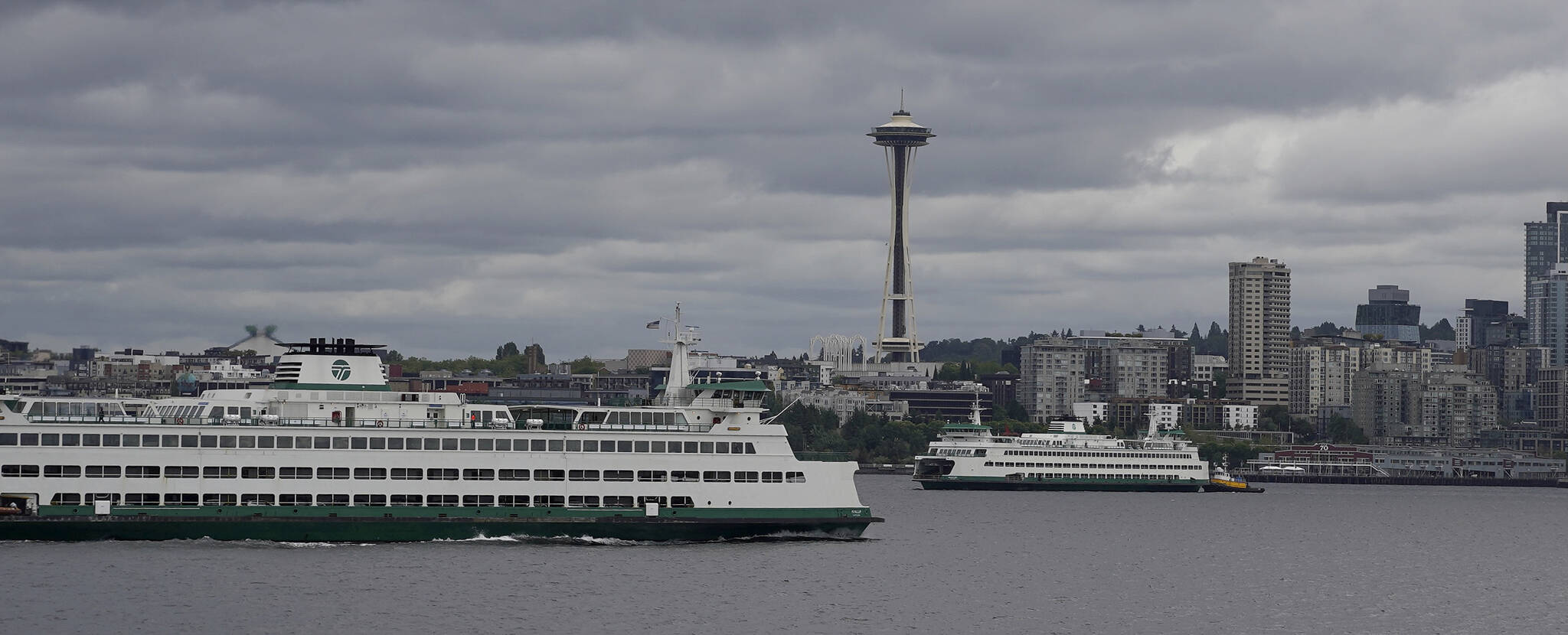
The Washington State Ferries held its first community meetings of the year Jan. 21, sharing updates about the budget, anticipated new vessels, and terminal upgrades.
Between the midday and evening sessions, about 148 people attended the meetings, both of which occurred online and covered the same material.
Steve Nevey, Department of Transportation deputy secretary for WSF, explained that while the ferry system improved along several metrics in 2025 — mainly ridership and reliability — some growing pains will continue into 2026 until more vessels and infrastructure updates are completed.
Per WSF data, the ferries completed all but 2,000 of scheduled sailings in 2025, or over 150,000 total — 7,000 more than were scheduled in 2024 — largely due to a more stable staffing pool and more hands on deck, Nevey explained. Over 20 million passengers rode the ferry, including over 9.5 million vehicles and 10.6 million walk-ons, leaders said, and the galleys sold over 172,000 soft pretzels and over 120,000 bowls of chowder.
However, Nevey and other WSF leaders gave some concrete dates that riders may expect to see changes to the system and outlined some new programs on the horizon.
“We’re really happy that we’ve been able to stabilize service. The direction that we’re heading in is positive, and we feel pretty good about it. The main challenge now is that we don’t have enough vessels,” he said. “The average age of the fleet is 35 years old. Many of the vessels are in their 50s and pushing into their 60s, and we have to expect unplanned outages more and more. [These ferries] are just as complex as oceangoing vessels […] What we pledge to you is that we’re going to be as open and honest and transparent as we can be when those breakdowns happen about which boats we have to move where, and why.”
Budget
WSF is operating under a $770 million biennial budget, focused on stabilizing service, winter reliability, terminal safety, and workforce retention, explained Nevey. Governor Bob Ferguson’s proposed supplemental budget includes $1 billion for up to three additional ferries and $150 million to extend the life of the system’s three oldest vessels.
“We have the funding to build the first three new ferries. The governor’s budget requests another $1 billion to build vessels four, five, and six. So, if approved, we would have funding for six new vessels,” Nevey explained.
If approved, this funding would eventually expand the fleet to 24 vessels, improve resilience, and support one of WSF’s biggest goals: the restoration of international service from Anacortes to Sidney, British Columbia.
New vessels, fleet electrification
As the state moves toward its climate goals by curbing emissions, an all-electric ferry fleet is slowly becoming a reality — and a necessity, as the boats begin to show their age.
With 21 vessels and three operational spares serving 12 routes systemwide, WSF leaders said electrification is the most efficient way to modernize the aging fleet. In 2025, the Wenatchee became the first-ever vessel to be converted to a hybrid-electric power system, but integrating new tech into the vessel’s 30-year-old hardware was not always smooth sailing.
The vessel experienced several outages over the year, the most recent of which Nevey attributed to routine mechanical issues such as shaft seal failures common across the fleet. Nevey explained that Wenatchee’s reliability will continue to improve, while acknowledging that intermittent breakdowns remain unavoidable given vessel age and complexity.
Conversions of the Tacoma and Puyallup have been delayed until after the 2026 FIFA World Cup, allowing WSF to maintain maximum service during the event.
Vessel electrification will start in the central Puget Sound routes and move outward as funding becomes available. Electrification for the San Juan Island routes and the triangle route between South Kitsap and South Seattle is not currently funded through the legislative package, though WSF indicated that improving battery technology and redeploying newer Olympic-class vessels northward are part of the long-term plan.
By 2030, two new vessels will join the Wenatchee as unique electric vessels, both of which will likely be added to the Clinton-Mukilteo corridor, added John Vezina, assistant secretary at WSF. Both new boats will be of a new mid-size class of ship, able to carry up to 160 vehicles — 16 more than the Olympic-class ferries like the Tokitae, Samish, Chimacum and Suquamish vessels, but 28 fewer than the Jumbo-class vessels like the Walla Walla or Jumbo Mark-II-class Tacoma, with a 202-vehicle capacity.
“When the legislature appropriated funding for new ferries, they hoped it would be five vessels. With the cost of steel, tariffs, other things, it’s more likely we’ll get three boats out of that $1.3 billion,” said Vezina. “We’ve contracted with the first two, and then we have an option for the third.”
Leadership stressed that switching back to diesel propulsion would delay new vessel delivery, not accelerate it, because it would require an entirely new design and divert engineering resources. The maritime industry as a whole is moving toward decarbonization, explained Nevey, and it’s key that WSF follow suit in order to maintain a resilient fleet.
Terminal updates
Electrification at Seattle’s newly renovated Colman Dock will come online in approximately 2028–2029, with charging designed to occur within normal vessel tie-up times to avoid schedule delays, explained Nevey.
While updates like charging ports will be required once more vessels are electrified, those are farther down the line, Nevey went on. The Fauntleroy terminal is the agency’s highest priority for renovations due to climate and safety risks, as well as outdated capacity. The dock, built in the 1950s, is the lowest in the system and increasingly vulnerable to storm surges, sea-level rise, and seismic events.
The goal is to shift the dock offshore to reduce traffic and construction impacts on the neighborhood, which could allow an increased vehicle holding capacity of 124 to 150 vehicles, up from 80. Construction is likely to be completed by 2031, and while Fauntleroy will not be electrified as part of this project, conduits are being preserved to allow future electrification.
Meanwhile, at Anacortes, full terminal replacement is not planned in the near term due to cost and systemwide priorities, but WSF is studying modest renovations to improve restrooms, heating, and overall rider experience.
Updates to rider experience, Kitsap Routes
Public input is underway for a new schedule for the Seattle-Bainbridge and Seattle-Bremerton routes, said Jenna Forty, WSF director of external relations. Three-boat service on the Southworth-Vashon-Fauntleroy route will remain limited to eight hours per day on summer weekends, due to funding, crewing, and ridership demand.
WSF has also begun a pilot program to bring WiFi to the Bremerton terminal and the Chimacum vessel, which serves the Seattle-Bremerton route. Depending on user traffic, the program could be adopted and expanded to a larger portion of the system.
2026 could also see changes to the ferry ticketing systems, including a new reservation and online ticket portal and an expanded validity period for multi-ride passes — up to 90 days — in May.