These students really know their way around
Published 6:00 pm Wednesday, February 22, 2006
The new Sakai program spurs math and science with submarines.
Measuring angles and learning buoyancy and density can be dry and dull, until you have to navigate a submarine.
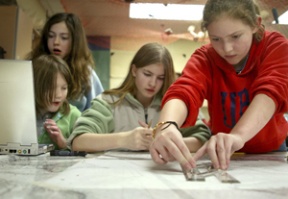
Each group of three to five students in Ric Moore’s sixth-grade science class at Sakai Intermediate School is steering a simulated submarine off Bainbridge shores.
Their mission is to head off a group of whales in Rich Passage that are headed straight toward an oil slick they can’t see.
The trick is knowing where your own sub is to start with.
“Since you’re not sure where you are, pick somewhere you won’t crash and can take bearings off (navigational aids numbers) six and three,†Moore advises one team. “Where do you think you should start turning?â€
“It’s hard because you have to triangulate your position,†sixth-grader Dillion Byron said. “But it’s fun.â€
“Last time we beached our whale,†said Emma Marshall, officer of the deck for her sub, “because we thought the whale was going in a different direction.â€
The program, NavOps, is an innovative approach to getting students excited about math and science.
Sakai science teachers Doug Olson, Ric Moore and Amy Evans lead their classes on the six-week program that teach students basic navigational skills, about buoyancy and density to raise or submerge the sub, angles and range (distance) to figure out the sub’s positions and even military protocol for giving and receiving orders.
Providing the data and realistic sub controls is a software program called NavOps, designed by Fred Huddleston, formerly in the submarine service, of Gary, Ind. He built the sub simulator at first for submarine reservists like himself, but the focus quickly changed to kids.
In the middle of an early NavOps run with kids in Gary’s inner-city school system, Huddleston brought in pizza for lunch, but “I couldn’t get anyone to come have lunch.â€
As he put it, to teach math or science, “Do we go to page 20 and do the odd problems or do we go on a sea adventure? It’s bringing the real world to the classroom.â€
Huddleston was struck that both the Navy’s community liaison and Purdue University’s dean of school told him that “if kids don’t have good math and science experience by the time they leave fifth grade, then they don’t go into those fields.â€
Huddleston provides the software free of charge to schools. For him the reward was seeing one of his original NavOps kids in Gary’s inner city many years later as a graduating senior enrolled in an electronics apprenticeship program.
Sakai was an early adopter of NavOps, starting with Olson trying a pilot curriculum in 2003-04.
This year, all Sakai sixth-graders are going through the program, which is supported by a $32,000 grant through the Science Education Alliance Program of the Naval Undersea Museum Foundation in Keyport and Bainbridge Island Public Schools Trust.
The funds allowed the school to purchase 24 laptops with Windows XP able to run the NavOps software.
“Sakai is doing us a favor to see what they like. If there’s a weakness in the software, they’ll tell me,†Huddleston said. “It’s a real team effort. They’re my cutting-edge lab.â€
Although students may eventually settle into a role they like best – whether it’s the quartermaster recording position, the “big picture†officer of the deck or the computationally intensive navigator – everyone has to qualify on all the roles, Evans said.
NavOps gives each team its position based on navigational aids like buoys and towers in the vicinity; the “bearing†or direction is given in degrees with north as zero and east as 90.
The “range†from the navigational aid is given in miles along the bearing. And since the sub is always moving, calculations have to be nimble.
Calculating position from three different navigational aids is “triangulating.†The three lines ideally intersect in a dot but more often form a triangle, of which the ship is deemed to be at the center.
Working on NavOps motivates students.
“Students at this age want something concrete. They couldn’t do it yesterday (but can now). They can easily look back four weeks and say I went from couldn’t do that to now,†Moore said.
The curriculum also brings in language arts through readings about whales and writing directions to a treasure they “drop†in an arbitrary spot in the sound.
“TechnoÂlogy is solving human problems with science,†Olson said. “The bigger skill is learning to collaborate.â€
As early as some time this year, Sakai students and other students in Indiana, Ohio or Kentucky may each be driving their own sub and collaborating on missions over the Internet, much as multi-player video games have them do.
“Kids need to think globally, have more ownership and (know) that what they do really affects kids elsewhere,†Olson said.
“One of our jobs is to get kids excited about science, so they want to learn more and want to study science,†Evans said.