
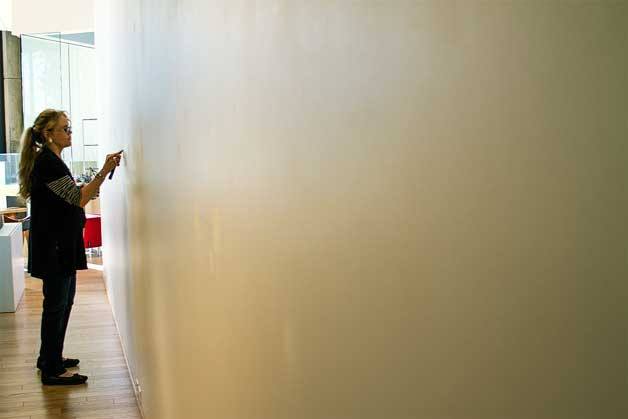
A lot of hard work, sweat and creativity is on display on the walls at the Bainbridge Island Museum of Art, and that’s before any artwork is even hung.
Behind every show, and for days before every reception, the hardworking museum staff and volunteer members of a small speciality unit paint, sand, spackle, pack, unpack, adjust the lights and even move the walls to ensure the best possible viewing of the works to be on display there.
They are called the BIMA Exhibition Assembly Crew, and, if they’ve done their job right, guests never even notice all of their work behind and around the art.
 The use and ready availability of quality volunteers is something unique and extremely beneficial to BIMA, explained the museum’s executive director Greg Robinson, adding that very few museums are able to use and depend on such quality community support.
“On the installation crew we work as a group to solve a lot of problems and look at different options,” Robinson said. “It’s not like as the curator I come in with one single view of how [the show] should be hung. We get all the work here, and then the team has a lot of great ideas too.”
“We sort of play around with different options,” he added.
The crew consists of more than 12 volunteers who work different schedules during exhibition set up and take down as they are available. Many have artistic backgrounds, but nearly as many do not. Some are students; others are retired.
“We’re a little unusual for an art museum in that we do use volunteers,” Robinson said, adding that the practice had worked so well at his previous job — executive director of the Museum of Northwest Art in La Conner, Washington — that he decided to implement it on Bainbridge.
The volunteers are trained to “museum standards” regarding the movement and handling of the artworks, he explained, and they are supervised by several key museum staff members including executive and curatorial assistant Charlie Gore, a former BIMA volunteer himself.
“Usually there’s only one or two people on hand for each gallery and they sort of outsource if they need the extra help,” Gore explained of the typical art museum’s exhibition set-up. “But here at BIMA, we just always have the help available when we need it.”
“It’s working out very well for us, actually,” he said with a hint of disbelief. “We’ve been able to get through each show with very little hassle.”
That admission makes things sound easier than they are, though, and most people would probably be very surprised to truly learn what goes into the preparation of each show, Gore added.
“There is a ton of background logistics,” Gore explained. “We have to prepare months in advance. We’re already planning stuff out for the show after this in the summer, as well as the winter.”
Running beneath the controlled chaos of exhibition hanging is the slightly absurdist knowledge amongst the crew that, if they’ve done their job right, guests never notice all of their work, according to Gore.
“Everybody sees the face, you don’t see the body behind the work,” he said.
That may be true, but it has not dampened the spirits of the crew one bit, and they continue through the work with the same enthusiastic mix of reverence, carefully handling and considering each work of art, and with elation, unwrapping each piece with the wonder and excitement of children tackling a Christmas present.
The museum could not manage the quick and professional turnaround that it does (and ensure the public the most time with each show) without the tireless efforts of the volunteers on the assembly crew, Gore said.
Volunteers seek out work with the assembly crew for a number of reasons, and everybody has their favorite jobs and technical strengths.
Marci Williams, who has lived on Bainbridge Island for three years and been a BIMA volunteer since the museum’s opening, said that she was intimidated at first to handle the art, but now finds her work at BIMA even affects her decorating decisions at home.
“I have put more art up on the walls, actually,” she said. “A lot of people, even the volunteers, have some kind of art background, which I don’t. I just like art; I go to museums all the time. So I think maybe I was a little intimidated about putting things up and, ‘How do you frame them? How do you group them?’ and all this kind of stuff.”
Having retired and only recently moved to the island when the museum initially opened, Williams said she had hoped her work at BIMA would help her to make new friends and become more involved in the community.
It has, she said, but it also helped her find her own capacity for artistic creation, quite unexpectedly.
“Coming here and doing this has made me more confident about what I can do at home,” she added, saying that she has begun a personal project to repurpose old family photos into artful framing arrangements for better display.
It can be easy to forget, surrounded by walls adorned with so much great art, that the walls themselves are a kind of artwork in a good museum, and the display is an interactive experience designed by artists whose names won’t necessarily be found on an informational card or plaque within the show.
