
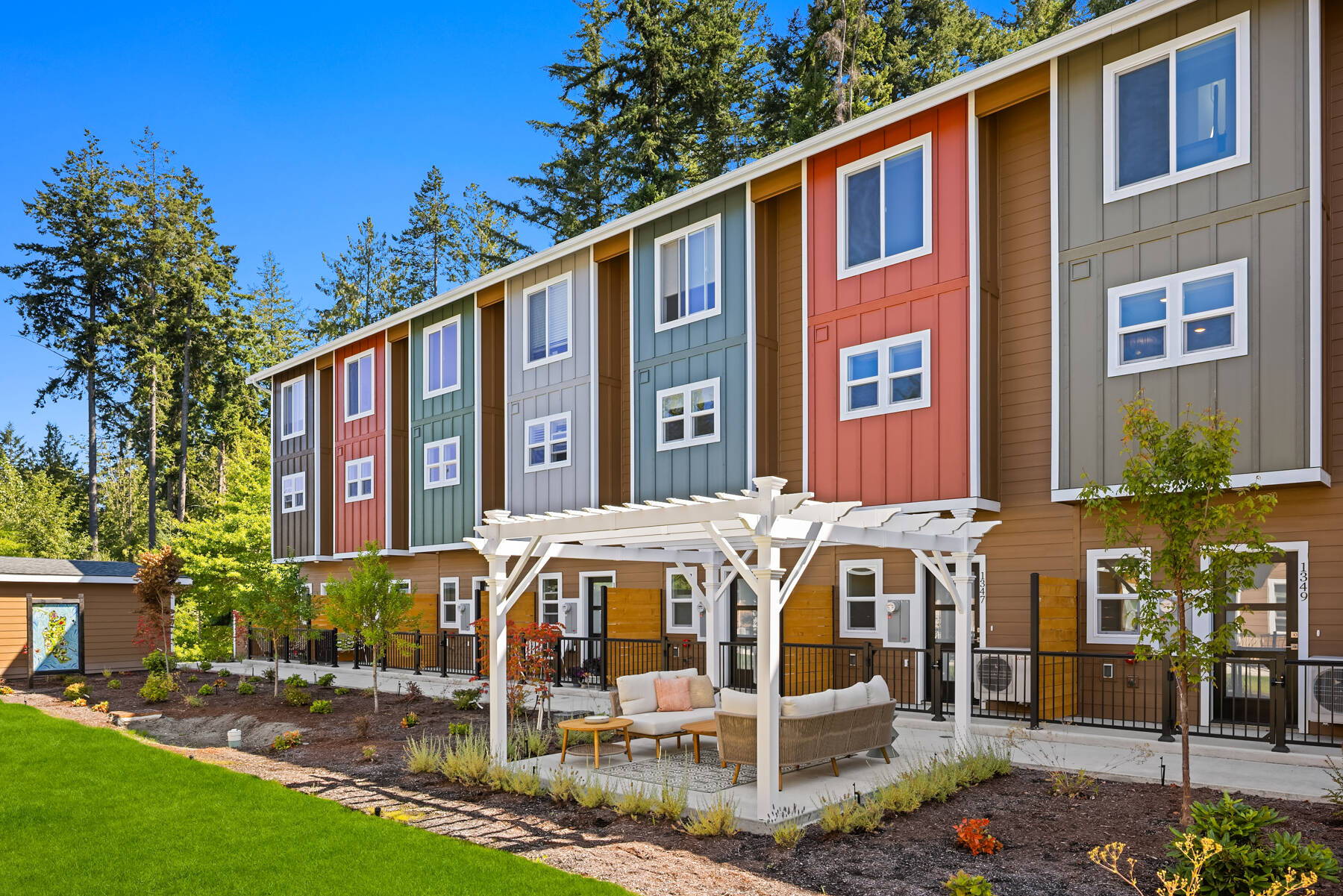
The last half of Bainbridge Island’s first mixed-income development of single-family homes is ready to move forward, almost exactly three years since the project first broke ground in August 2022.
At the Aug. 12 City Council meeting, the governing body approved plans for phase two of the Wintergreen neighborhood off of High School Road NE, which will include 43 new townhomes. All units of the development will be multi-bedroom, market-rate homes, for buyers making up to 80% of the county Area Median Income, or about $70,000 a year for a one-person household.
25 people are already on the waitlist for the 14 affordable units, which developer David Smith hopes will be completed and sold by the end of the year.
It’s been a long time coming. Roadblocks in planning, missed funding deadlines, market fluctuations and conflict between the developer and city officials hindered progress, resulting in a delayed start, more expensive market-rate units and a higher price tag on construction, explained Smith.
During the planning phase of the second chunk of homes, the project stalled for about nine months while Smith and the city debated whether the townhomes qualify as single or multi-family units when it comes to water meter usage. Connecting each unit individually costs at least $15,000, Smith argued, a cost which could be avoided if the city approved the use of multi-family water meters.
“We prevailed on the RCW, where it says [Wintergreen] has the same fixtures and water usage as an apartment building. If you look at the layout of our project, they’re effectively apartments with lot lines drawn in between, but the Bainbridge code calls that a single-family unit. The RCW says that doesn’t make a difference — they pay the same,” Smith said.
Conflict also resulted in a less-than-perfect project, said Deputy Mayor Jon Quitslund.
Quitslund served on the Planning Commission for much of the review process for Wintergreen, which he described as “laborious.” Personalities clashed between members of the commission and Smith of Central Highland Inc., the developer for Wintergreen, Quitslund recalled, especially over the design standards of the plans; there was little room for dialogue with Smith about ideas or details.
“It was a tight fit, with the highway and the lumberyard … It was really not a good-looking project. David Smith knew what he needed and how to get it, but that was not the right approach … But we decided we had to approve it. Various things had been decided by that time, and it was just time to say, ‘Yeah, okay,’” Quitslund said. “The fact that Housing Resources Bainbridge supported the project, in spite of everything that was iffy about it — that helped me.”
One such source of contention was the sound-dampening structure used to protect the new units from noise pollution created by nearby Highway 305.
At the March 11 council meeting, the Wintergreen phase two plans were nearly ready for prime time. There was one issue: Central Highlands was required to create a 10-foot-tall, 40-foot-wide vegetated berm between homes and the highway, but that presented a risk of mudslides, explained city planning director Patty Charnas. Instead, the developer opted for a smaller berm and a 10-foot-tall fence with noise-attenuating material packed inside.
Some councilmembers were perturbed at the perceived diminished aesthetic value of a fence, rather than a large berm, and requested images or renderings of the structure. Quitslund and Mayor Ashley Mathews disagreed, pointing out that the fence represented an established and cheaper solution, and going back to the drawing board would cost valuable staff time.
The fence was approved in a 4-3 vote.
Project reviews were not the only hitch. Initially, the budget for Wintergreen was $1.12 million, not including the utility and stormwater hookups — but when Central Highlands missed a critical state grant deadline in October 2024, the project was unable to collect about $890,000 in subsidies that could cover the fees for sewer and water meter hookups.
At the time, Central Highland attorney Hayes Gori cited arduous civic permitting leading to construction delays, which meant a higher pricetag for the project. The developer sought grant funding to fill the gap in the budget, Gori added, but was unable to complete the proposal before the submission deadline, leaving Central Highland to eat the cost.
Just before the deadline fell Oct. 31, Central Highland leaders requested administrative assistance from the city to complete the grant proposal, but their request was rejected. For one, city staff had little capacity for extra work, explained Councilmembers Joe Deets, Kirsten Hytopolous, Clarence Moriwaki and Quitslund — but above all, the request came far too late in the grant writing process.
Smith said that Central Highland will be re-applying for the grant this fall, which, if attained, will cover the water and sewer connections for the second phase of construction.
In total, Wintergreen will contain 73 townhomes — 42 units at market rate and 31 affordable units. HRB collaborated with Central Highland to subsidize the cost of the affordable units.
Out of a $369,000 price tag for an affordable unit, HRB anticipates saving buyers about $95,000 through both subsidies and “sweat equity” — meaning the buyer would help finish construction on their home for about 60 hours over three months. HRB was awarded $2.5 million in state grants and $15,000 per buyer from federal housing programs to support the project.
“This lower price point will allow our buyers more flexibility in their life — when their housing costs are lower, then all the other financial decisions in life are a little easier, especially when groceries, childcare, education, and everything else is so expensive right now,” said HRB homeownership program director Jackie Brasefield.