
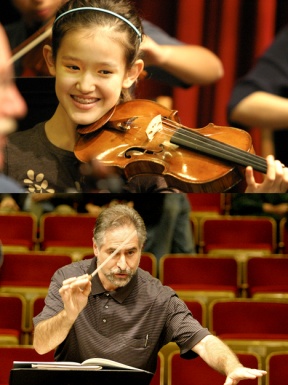
Alan Futterman raises the baton in his debut season with the Bainbridge ensemble.
Mostly Mozart?
No. More than Mozart. Beyond Brahms.
Bainbridge Symphony Orchestra’s 2006-2007 season begins on a new note with Alan Futterman’s premier as music director.
He steps into his role with all of the enthusiasm and artistic vision that a community can hope for in their “maestro.â€
“I would never bore my audience,†Futterman said.
The November performances, entitled “Romantic Voices,†will reflect the director’s influence – a larger orchestra and a more involved, difficult repertoire.
“Beethoven’s Fifth Symphony is great, (but) we’ve heard it millions of times,†Futterman said. “I think it’s more interesting to do other works that might not be so familiar, but are equally great in many ways.â€
Futterman brings a wealth of talent and experience to his new position. Prolific composer, conductor, musician, professor, linguist, world traveler – he is many things, but predictable is certainly not one of them.
His selections for the inaugural concerts include Grieg’s well-known Peer Gynt Suites, written as an accompaniment for Ibsen’s well-known work.
However, Futterman has added an exciting twist by collaborating with the Bainbridge Chorale to present the original choral music, which has not been performed in Washington for 100 years.
Expect the dramatic.
“It was a revelation that there is a lot more in Peer Gynt than we’re used to,†Futterman said. “It is a much more important part of music history than we give it credit for.â€
The program will also feature Futterman’s latest additions to his World Beat Dance Suites, the Japanese Vignettes and a New Slavonic Dance.
The pieces follow last season’s performance of Futterman’s Romanian Medley, which was received so graciously that it even elicited cheering from the audience – a gesture usually reserved for sports, not symphony.
“It’s entertainment. It should be fun for the orchestra, it should be fun for the audience,†Futterman said. “There is a little bit of education going on too – I would like for people to hear what Japanese music sounds like, and the music from Slavonia and Eastern Europe, but whenever I compose pieces, I have the audience in mind.â€
Futterman’s love for world music and eagerness to share new sounds is so palpable, it would not come as a surprise if he were to compose music from every country before completing the series.
He fell in love with world music during his time at the Juilliard School of Music, where he studied classical Indian music under a sitar master.
Even though he could read notes before he could read words, Futterman did not always know that he wanted a career in music.
“I thought I wanted to be a chemist,†he said.
A musical world
Futterman focused on biochemistry and linguistics in college, until he realized that he wanted to pursue his favorite language – music. He went on to receive degrees from the Manhattan School of Music and Juilliard.
While in school, Futterman performed professionally as an orchestral musician with the New York City Ballet Orchestra, the Chamber Orchestra of New England, the New Jersey State Opera and the Philharmonia Virtuosi under world-renowned directors.
After he caught the conducting bug, he served as music director of the Dover Symphony Orchestra; principal conductor for the Weierstrass Society Concerts of Contemporary Music in New York; music director of the Zaccho Ballet Orchestra in Brussels; and conductor in residence for Jeunesse Musicale of Europe in Croatia.
Futterman also had a parallel career in foreign languages and cultures.
Employed by the American Cultural Exchange, he trained interpreters and served as a cultural liaison for visits from foreign governments and universities. This led in turn to three years of work with the television series “Northern Exposure,†as a technical advisor, foreign language scriptwriter and language coach.
While touring Eastern Europe, the regional music captured Futterman’s interest, but not in the concert halls.
“If you want to hear folk music you have to go to village dances or pubs, and I found the music in the pubs being played by incredible musicians,†he said.
Futterman’s goal was to learn the instruments that they were playing, and then broaden the appreciation for the unique sounds.
“I thought, people should hear this music, but they’re not going to hear it unless we get it into the concert hall,†he said, “so my idea was to take that, and use it as the base for symphonic pieces.â€
Futterman put his ideas to effect during his 10-year tenure on the Music Faculty of Central Washington University.
For an ethnomusicology assignment, his students listened to field recordings of music from different regions of the world, and then wrote 10 measures of music in the same style.
“I did the assignment myself,†Futterman said, “but instead of 10 measures, I’d write a whole piece.â€
He turned each assignment into full symphonic music, which eventually grew into the World Beat Dance Suites. The suites capture the ethos of the chosen culture’s traditional music through Futterman’s application of fitting notes and rhythms.
For the opening concerts, Futterman has chosen pieces that will provide a perfect contrast.
“I really think it’s interesting to balance the Western European tradition with other music from around the world,†he said.
In addition to the performance of Peer Gynt, the chorale will join the symphony in Agnus Dei from George Bizet’s portrait of Provence, the L’Arlésienne Suite No. 2.
Mendelssohn’s popular Violin Concerto, featuring 12-year-old sensation Maria Rossano, will be a stimulating showpiece for both orchestra and soloist.
“The finale is incredible – the audience watches the soloist fiddle away frantically,†Futterman said. “It’s quite different from the World Music and almost overblown concept of Peer Gynt, which is what Grieg asks for.â€
While the symphony warms up for the approaching season, Futterman is already envisioning big, bold plans for future programs. He looks forward to a gala concert of opera arias and opera choruses that would use the full chorale and orchestra.
“Some of the great opera scenes which are so much fun to hear live, you hear them on CD, and the sound quality is great,†Futterman said. “But there is nothing quite like hearing the energy and power of a live full orchestra and chorus.â€
For now, Futterman is enjoying the beginning measures of a great movement.
“We’re learning as we go along,†he said, “and it’s been wonderful.â€
************
Le baton du monde
The Bainbridge Symphony Orchestra presents “Romantic Voices†with new director Alan Futterman at 7:30 p.m. Nov. 18 and 3 p.m. Nov. 19 at Bainbridge Performing Arts. Call 842-8578 or see www.theplayhouse.org.