
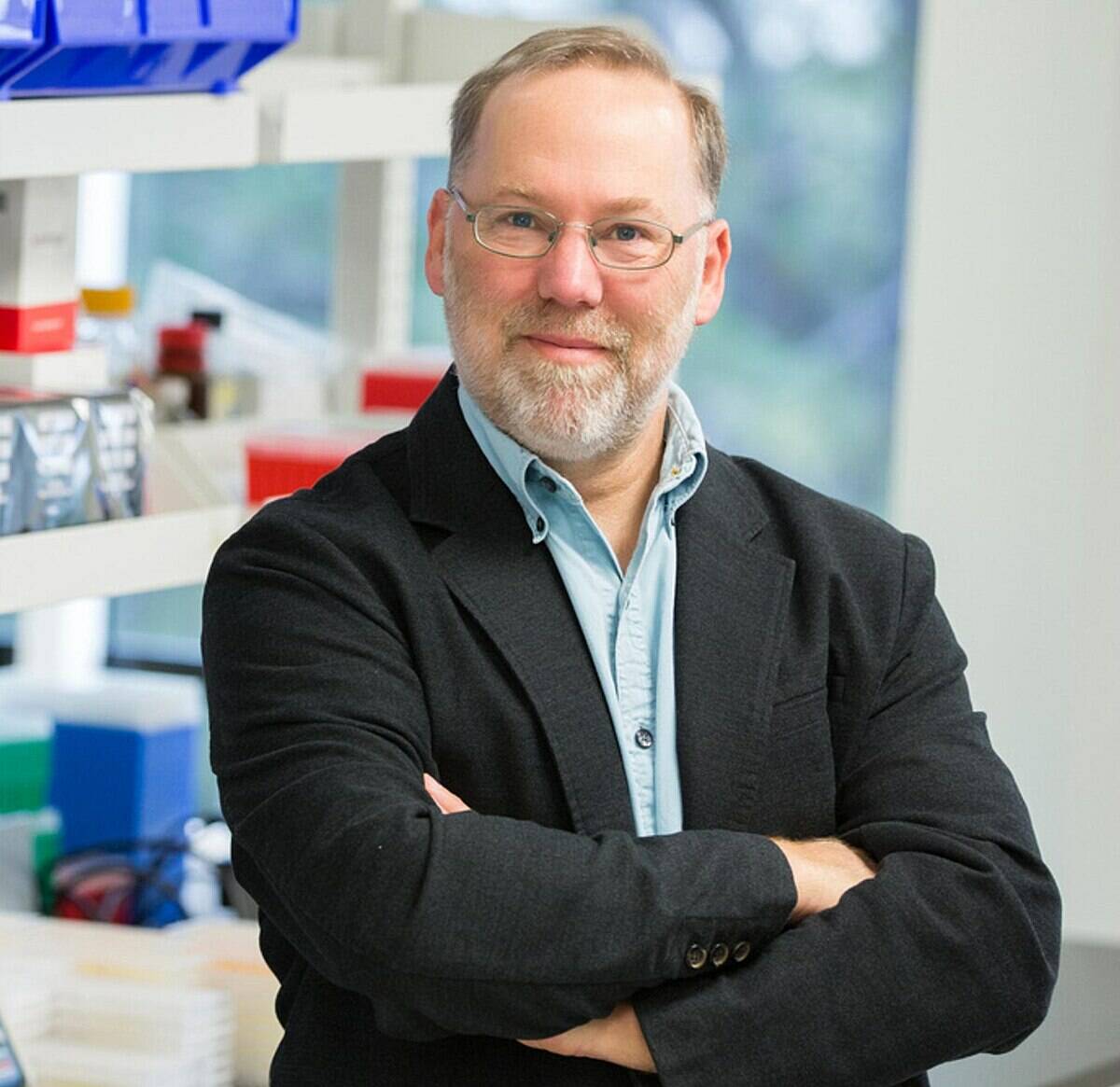
Immunologist Dr. Frederick Ramsdell jointly received a Nobel Prize in Medicine Oct. 6 with researchers Dr. Mary Brunkow and Dr. Shimon Sakaguchi for a discovery in cell biology that revolutionized the field of preventative medicine.
Bainbridge residents may know the internationally acclaimed scientist as their neighbor, Fred.
Dr. Ramsdell and his family have lived on Bainbridge Island for over 20 years. As a leader in his field, his work has taken him up and down the biotechnology hubs of the U.S. West Coast, but the collaborative and hardworking nature of Seattle’s industry, and BI’s quiet charm, are what keep him here.
Ramsdell has been “totally hooked” on the immune response system since he was an undergraduate student at the University of California, San Diego. While he wasn’t initially planning on pursuing a doctorate degree, the field and the research he was interested in required one, so he earned his PhD at UCLA and held a postdoctoral fellowship at the National Institute of Health in Maryland.
When it came time to take the next step in his career in the early 1990s, he had a multitude of options in both academic roles and industry roles all over the nation, but a company called Immunex captured his interest.
“When I came to Seattle, I went to Immunex, and I just loved it. There were so many really talented people who all had very small groups — one, two, three people — but were incredibly good at what they did, incredibly collaborative and interactive, and incredibly smart,” Ramsdell said. “It was the lowest salary of all the job offers I got, which is kind of funny, and it’s still the one I took.”
He recalled returning to Maryland and discussing the move with his wife, Laura O’Neill.
“We literally pull up a Rand McNally map of Seattle, and she’s like, ‘I wonder if anyone lives on these islands over here?’ So when I came out, I spent a weekend and I took a ferry out to Bainbridge on a Saturday morning in early October — a beautiful, crystal clear day […] There’s no one on the ferry, it’s idyllic and calm. And I’m like, ‘This is cool,’” Ramsdell said. “It turned out, at that point, Immunex was located down on the waterfront, and so a bunch of my friends and colleagues lived on Bainbridge — still do. And I bike everywhere, all the time, and I could ride my bike on the ferry. I was like, ‘Okay, so that’s feasible.’”
The role with Immunex jump-started Ramsdell’s career in biotechnology and laid the groundwork for his Nobel Prize-winning research with Dr. Brunkow.
In 2001, while working together at a firm in Bothell, the two scientists identified a link between regulatory T-cells, a “security guard” of the immune system that helps prevent the body from attacking itself, and autoimmune disorders. Their discovery, along with studies by Dr. Sakaguchi in 1995, have since sparked a new field of preventative healthcare research that has created new potential treatments for cancer and several autoimmune diseases.
“[A collaborative work culture] is common in the field, but I think it is far more pronounced in Seattle than almost anywhere else I’ve ever been. Seattle, San Diego and San Francisco all have an element of that, but particularly San Francisco also has a more competitive element because there’s Big Pharma there,” Ramsdell said. “I think Seattle is a shining example of that. And I’ll highlight that in the sense that, I told people, the ‘Kevin Bacon principle’ in Seattle is about three [degrees of separation], at least in immunology. If I don’t know you, I probably know someone who knows you, and if I don’t know someone who knows someone who knows you, by three, I’m definitely going to find someone who knows you.”
While he has now assumed an advisory role, Ramsdell’s company, Sonoma Biotherapeutics, is still hard at work harnessing regulatory T-cells for healthcare. The California- and Seattle–based company is working on treatments for rheumatoid arthritis, Crohn’s disease, inflammatory bowel disease, and more, along with partner organization Regeneron.
As the field advances, treatments for chronic conditions and diseases are increasingly targeting the immune system, Ramsdell explained. Being able to understand immune responses and control them through immunotherapy can open windows to cures, he said, and he sees a future where it is a prominent part of preventative healthcare, despite an uncertain economic climate.
“The U.S. has been a shining example of innovation in general — certainly in my field, biomedical innovation, for 50-60 years […] Finding the right balance that gives investors and scientists and everyone else enough confidence to continue to support the work that people do is, to me, the challenge in the current environment,” said Ramsdell. “Whatever side of the political spectrum you’re on, I think everyone wants to see progress in medicine. And so the question is, how do you actually provide an environment that does that?”
Public health is a crucial part of that. Ramsdell encouraged island residents to take advantage of the options available to them. The island may not have its own cancer clinic, but “world-class healthcare” is just a 30-minute boat ride away.
“I would love to see people be their own advocates as much as possible, and to ensure that they understand what they’re getting. The reason I say that is, if you have something that’s complicated or severe, that’s a pretty big red flag. 30 minutes away, you have some of the best health care in the world, whether it’s for cancer, autoimmunity, or anything else,” said Ramsdell. “I am really a big advocate for people to get as many opinions and as much information as they possibly can. I think people need to be as open to that sort of opportunity as they can.”