
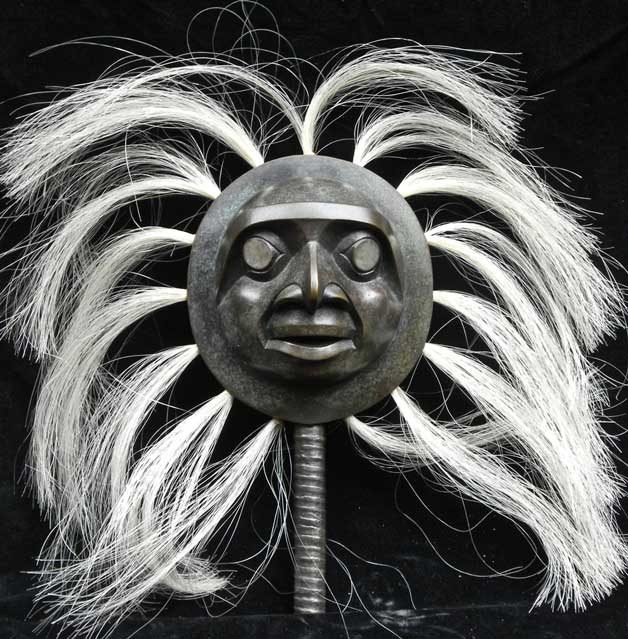
 Despite living just on the other side of the Agate Pass Bridge, it took Duane Pasco nearly 50 years to get to downtown Winslow.
It is there, however, at Bainbridge Arts & Crafts, that the widely renowned Poulsbo-based craftsman will have his first-ever show on Bainbridge Island, opening with a special artist’s reception at 6 p.m. Friday, March 6.
The exhibition, “Duane Pasco & Friends: Respecting Traditions,” contains approximately 20 relatively new works by the master carver and will also feature the work of several of the artist’s friends and colleagues, including David Franklin, Marvin Oliver, Loren White and Joe David.
Pasco is nationally recognized for his Northwest Native Coastal-style carvings. He is, in fact, credited with much of the aesthetic’s popular revival from nearly total cultural extinction in the late 1960s, and for his tireless work done to ensure the tradition’s continuance through his teaching efforts and numerous lectures held around the country.
Despite the accolades, Pasco remains very much the humble, matter-of-fact, everyday type of guy who one could easily envision working as a machinist, a house framer or a cabinet maker — all of which are occupations he has held at one time or another.
“I didn’t realize when I was fooling around with it as a hobby that it was actually a serious art form,” Pasco said of his early carving attempts, done to emulate the Native works he had seen. “I’d seen it, but I didn’t know how to read it.
“There are a lot of art forms in the world that you don’t really appreciate them for what they are until you study and learn [or] somebody shows you how to see it,” he added.
For Pasco, that person was noted artist and historian Bill Holm, whose groundbreaking book “Northwest Coast Indian Art: An Analysis of the Form” remains the standard text on the subject.
“[The book] was very detailed, showing the structure and rules and all that,” Pasco remembered of the book. “I had been trying to figure it out myself, but when I saw this I was like, ‘Here it is: A, B, C, D.’ So I studied it.”
He used the book’s examples and diagrams, Pasco explained, to test his own abilities in those early days of exploration.
“I would do art and then read the book and test myself,” he said.
“I flunked most of the time,” he confided with a laugh.
Of course, the occasionally bombed test was nothing new for Pasco, who admits to being a poor student in his early life and having very little patience for structured education.
He even, ironically, harbored a deep distrust of galleries and museums.
“‘Museum’ to me was like ‘mausoleum,’” Pasco said. “I was afraid to go into museums. I don’t want to go there; creepy people go there.”
It was a childhood ignorance he said he is glad he overcame while still young. In school, he said, he especially enjoyed history, science and art, but found the school’s library painfully bare of interesting books on the subjects.
So he went hunting.
“I’d skip school and go to the Seattle Public Library and go research the art and read all this wonderful stuff,” he remembered, saying that then he felt, having read about so much great art and history, he had to go see some for himself.
“Once I broke that door it was wonderful; [I] couldn’t get enough of them,” he said of his first trips to galleries and museums.
Today, Pasco and his work spend a great deal of time in galleries and museums, when he isn’t working in his studio or teaching. He is almost as proud of his education efforts as he is of his actual art, he said.
It is imperative for the survival and advancement of any medium that those who are experienced and more learned work to pass on what they know, he said. It’s not a obligation or a responsibility, it should be a desire.
Pasco cites an overall decrease in the Native population of the region as well as pressure from the federal government and various religious groups with the decline of Northwest Native art by the mid-20th century.
“It had died out, the traditional stuff had died out,” he said. “Any art that was done was done for ceremony. There was no other reason to do it. Then, when the ceremony was outlawed, there went the art.”
By the time he became aware of the craft that would come to dominate his creative life, Pasco said there was a bit of a Native art renaissance going on.
“In the ‘60s it started a revival, slow coming, and by the early ’70s it was growing fast,” he remembered.
Since then, of course, the art form has received the official and widespread recognition it deserves, as has Pasco himself.
To learn more about Pasco and his work, visit www.duanepasco.com/wp.
BAC is located at 151 Winslow Way East. Gallery hours are 10 a.m. to 6 p.m. Monday through Saturday, and 11 a.m. to 5 p.m. Sunday.
From deep in the woods
What: Exhibition features renowned carver of Northwest Coast Native Art.
When: Friday, March 6 through Monday, March 30, with a special artist’s reception from 6 to 8 p.m. Friday, March 6.
Where: Bainbridge Arts & Crafts in downtown Winslow.
Admission: Free.
