Intersection is at a crossroads
Published 3:00 pm Wednesday, December 6, 2006
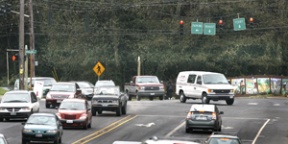
There’s no easy fix to the gnarl of traffic where Winslow Way meets Highway 305.
To the chuckles of those gathered at Saturday’s ferry district workshop, Jim Charlier playfully roasted the island’s proclivity for pedestrians and pedals.
On the screen behind him flashed a doctored image of a wide road relegating car traffic to a narrow strip near the shoulder. Meanwhile, rows upon rows of bicycle lanes consumed the bulk of the pavement.
“This one seems about right,†the transportation consultant said, glancing over his shoulder.
Funny, except that attendees – who later in the meeting would overwhelmingly urge ferry district planners to favor walkers and bicyclists over cars – ultimately proved Charlier’s hyperbole to be a fairly accurate indication of island sentiment.
After his icebreaking photograph, Charlier abandoned humor to probe serious problems riddling the ferry district, among them the troubling intersection of Winslow Way and State Route 305.
In response to calls for a tunnel or overpass to help ease congestion there, Charlier didn’t bother using any visual aids.
“It would be very, very, very expensive,†he said, estimating costs in the tens of millions, before echoing the crowd’s preference to focus on pedestrian safety. “All of us need to be thinking of this intersection not just as a traffic facility alone, but also as a pedestrian facility.â€
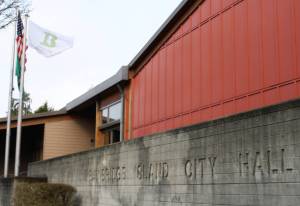
The 50 some people in attendance at City Hall did just that after hearing presentations from Charlier and others charged with improving connectivity to the terminal, which along with the surrounding neighborhoods and the entire 305 corridor is slated for a massive transformation in the coming decade.
Planners from the city, Washington State Ferries and the state Department of Transportation – all busy crafting separate visions for the area – have stressed the need to collaborate so that plans will be cohesive.
The city’s team last week said the differing visions should mesh by early February, when the next public meeting is scheduled to take place. Saturday’s meeting focused mostly on transportation and connectivity around the terminal, rather than on the building itself.
Following presentations, attendees discussed open space, neighborhood planning and possible transit solutions – presented earlier by planner Tom Brennan – that include Bus Rapid Transit, “reversible†transit lanes, light rail and LevX, an emerging “elevated guideway†technology.
Traffic already clogs at several points along 305 during rush hour and will only get worse, Brennan said, if nothing is done to reduce it.
Brennan is part of a team crafting the 305 Corridor Vision, a study sponsored by Kitsap Transit, the city and various interests along the highway between Winslow and Poulsbo.
Having begun work earlier this year, the group will finish the study – which aims to identify long-term transit solutions – sometime next spring. Detailed analysis and funding would then take place based on the group’s recommendations.
Under consideration are both long- and short-term options.
For example, reversible transit lanes – a center lane for bus use that would flow in the direction of the heaviest traffic during peak commute hours – could ultimately become the footprint for a LevX system, should LevX be deemed a viable solution.
Regarding local connectivity, one much-discussed idea was the construction of an east-west connector across 305.
Charlier said connecting Wyatt Way to Ferncliff was the most “logical†possibility.
City-commissioned architect Rick Williams said the 305/Winslow Way intersection has been the subject of about 75 percent of all public comments received thus far, citing it as one of the biggest headaches facing planners.
Though many suggestions for the intersection were skewered on Saturday, no solutions moved to the forefront.
At-grade possibilities include a roundabout, something Charlier strongly discouraged, saying it would “ruin†pedestrian access.
“That would be the single most hostile thing we could do at that location,†he said.
Some continued to push for a grade separation, arguing that a tunnel wouldn’t be any more expensive than building an east-west connector across 305.
Also up for debate was eliminating Harborview Drive and building a new road between Bjune Drive and the condominiums just west of the terminal. Planners contend that doing so would help divert at least some local traffic from the terminal area, though the plan would likely face several hurdles, including compliance with environmental code.
Planners said they hope to begin a more in-depth study of the ravine to determine how to best incorporate it into the overall scheme.
Many participants were interested in exploring different uses for the ravine, but urged caution to avoid upsetting the environment.
A common theme throughout the day was retaining the character of nearby neighborhoods – those surrounding Cave and Ferncliff avenues – as growth continues.
Officials said design alternatives for the Winslow Way/305 intersection would likely be presented at the next public meeting in early February. WSF, whose terminal designs took a back seat for the day, will hold public meetings this week to discuss the scope of the environmental review for the terminal project.
There will be two more meetings tomorrow, the first on the 4:40 p.m. sailing from Seattle to Bainbridge and again between 6 and 8 p.m. at the Bainbridge ferry terminal. Written comments can be submitted until Jan. 12.
WSF will host another public meeting in the spring before selecting a preferred alternative for the terminal sometime next summer. Construction is set to begin in 2009.
But on Saturday, it was all about transportation, with most, including Debbi Lester, spokesperson for one of the discussion groups, recognizing a need for regional cooperation.
“If we could somehow share in commuter traffic,†she said, “that would be a great thing.â€