Her artistic career lies in shards
Published 7:00 am Wednesday, January 19, 2005
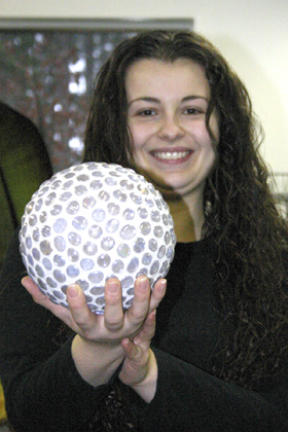
People can’t accuse Raquel Stanek of having too many balls in the air.
They are all in the water.
Since she began making floating, glass-and-grout “pond balls†five years ago, when she was just 17, mosaic artist Stanek has seen her works launched on a variety of local waterways.
The young artist’s career appears similarly buoyant; her reputation may ripple far beyond the shores of her long-time island home.
But rather than leaving like so many young people do to find cheaper digs or a more populous art scene, she is determined to build her career here.
“I hope I will always be able to stay on this island and create my works,†Stanek said. “This is a great community for artists.â€
So far, she’s succeeded; Stanek began selling her art before she was out of her teens. Today her north island studio features fantasy furniture and feathered friends in mosaic tile – but the finished works don’t linger and the pace of production is brisk.
“I start in the afternoon and work until two or three in the morning,†she said. “It’s how I like to work.â€
Although she prizes her “alone time,†Stanek has come to enjoy interaction with people who enroll in her workshops so much that she will offer full classes this spring, after her exhibit at Seattle’s prestigious Northwest Flower and Garden show next month.
Stanek discovered mosaic when, in the summer after her sophomore year at Bainbridge High School, she took a mosaic class offered by the Bainbridge Island Park and Recreation District.
“I just fell in love with it,†she said. “It was just fun, it was colorful. It was fairly simple. I just kept making things and making things.â€
Stanek enrolled in the Contract Studies program for the last two years of high school, and used its flexibility to learn more about her chosen medium.
She studied technique and history, discovering that contemporary mosaic artists can trace roots to the fourth millennium B.C.E, when Mesopotamian artisans pressed bits of shell, stone and clay into temple walls.
The Greeks and then the Romans adopted the technique, and simple designs evolved into complex forms that create an illusion of dimensionality with thousands of glass shards building gradated shades.
Stanek’s own work soon evolved from a simple hurricane lamp covered in grout and glass to grout and glass bead over foam ball.
“I started making these little balls to have around for fun,†she said. “I started to have a lot of them. And my mom said, ‘you have to do something with these. You can’t just have, like, piles in the house.’â€
In the summer of 1999, Stanek offered the pond balls at the Bainbridge Island Arts and Humanities Council’s annual garden tour, and joined the Bainbridge Island Studio Tour in 2000.
“We started selling them, (and) people just loved them,†she said.
Since then, Stanek has had to find a middle road, between making only the tried-and-true pond spheres she calls “gazing balls†and experimenting so freely that works don’t sell.
Her studio features mounds of the ubiquitous spheres ranging from baseball to bowling ball-size, and a dozen unique works-in-progress that include a two-dimensional depiction in glass of a rooster that hangs on a wall above a school of cheerful goldfish whose scales are scores of tiny glass leaves.
Furniture runs the gamut from the zany to the zingy, with mosaic bubbles in white and black blowing across a lime-green coffee table and an oversize welded steel throne awaiting tile culled from the many glass jars that line the studio walls.
Stanek has worked with a variety of glass that has included everything from stained glass to commercially produced vitreous tiles and broken china.
“Anything can be incorporated into a mosaic,†she said. “It’s how you do it.â€
Last year she began working with Italian smalti glass that costs from $16 to $50 per square foot. But the results Stanek gets with the supersaturated pigments, which make finished works seem to glow, is worth paying more, she believes.
“It’s made in Venice by only two families,†she said. “It’s a super-secret recipe. But it can be hard to cut. Sometimes it just shatters for no apparent reason.â€
The beauty of the material doesn’t disguise the risk; working with glass means getting wounded in the line of duty, from time to time. Stanek is philosophical, even as she counts the scars.
“Its’ glass,†she said. “It’s sharp.â€
* * * * *
For information about Raquel Mosaic Creations call 842-7504 or see www.pondball.com.