
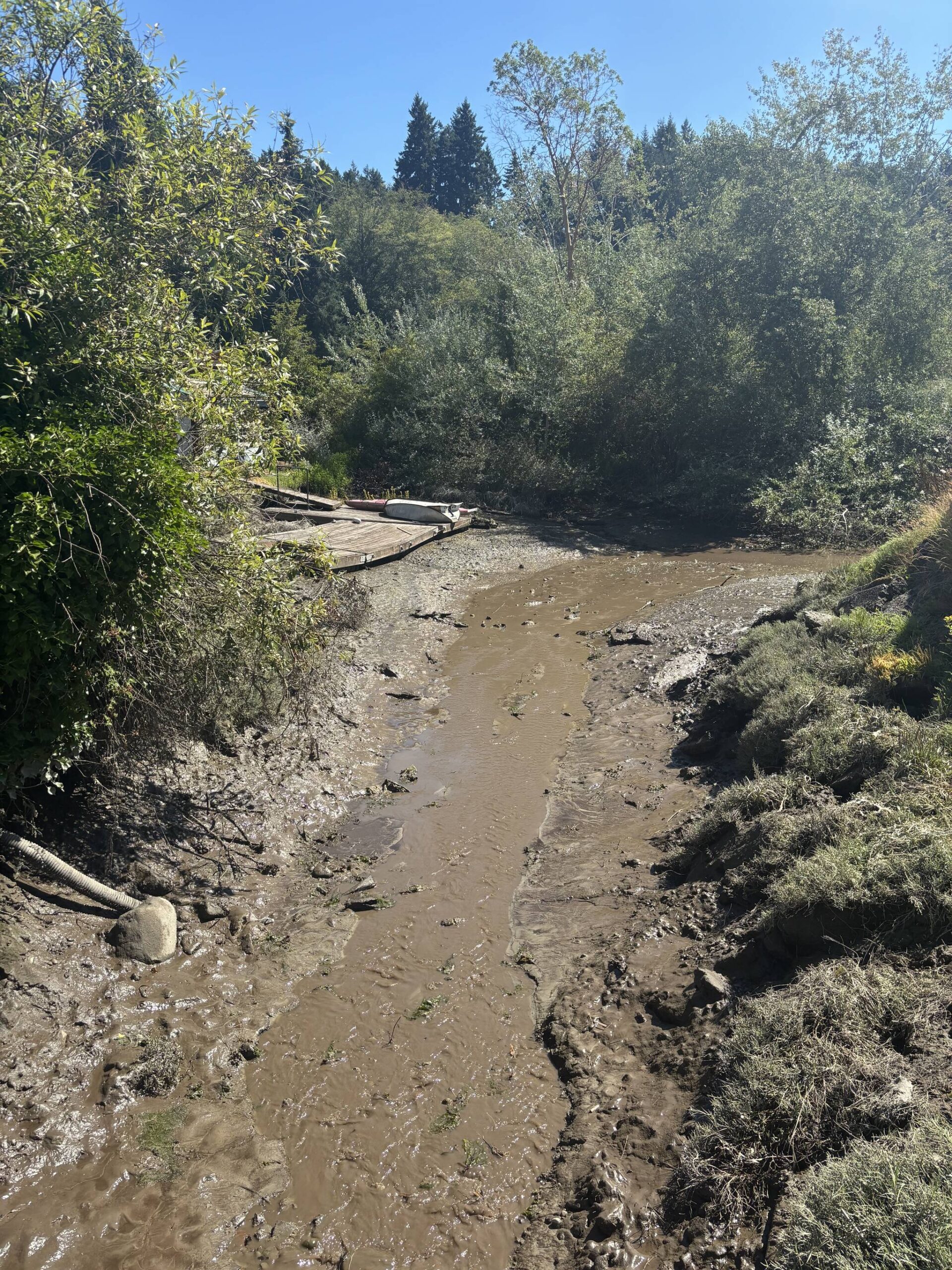
Bainbridge Island’s Public Works department shut down about 1,500 feet of Eagle Harbor Drive NE for around two months July 16 to perform infrastructure updates that will widen the road for non-motorized transportation and add migratory passage for salmon and trout.
But the road is a major artery for traffic from the south end of BI, and stakeholders have been voicing concerns about the timing and scope of the project online and in City Council chambers.
BI Fire Department Commissioner Fritz von Ibsch and former commissioner and first responder Jay Rosenberg talked about how the closures were affecting response times.
BI fire chief Jared Morevac confirmed that the closure added five minutes or more to response times from the Madison Avenue station, which is about one to two minutes over the city’s estimated time delay — and “when it comes to saving lives, seconds count,” said Ibsch.
“I do not think [the city] and the citizens realize the significance of how these projects have affected emergency response times. This is not about inconvenience; this is potentially about life and death,” Rosenberg added.
BI resident and former Salesforce executive Rakesh Bharania echoed those concerns. His family lives within the road closure area, and the potential loss of power and delay to emergency services is worrisome, he said.
“This is important and personal to me because my family has had to use Bainbridge fire for EMS twice in the last year, one of which involved a helicopter emergency transfer for my children to a Seattle hospital,” Bharania said. “When the comment came up earlier about how seconds count, that was us about eight months ago — so this is a very personal issue for our family.”
Bharania also noted that with the approach of wildfire season, a severe drought in Western Washington and further burn bans in Kitsap County in mind, there is a lack of clarity around emergency planning at the city level.
“Our family is in support of this project — we like salmon too — and yes, there is no perfect time to do what is necessary; as pragmatists, we just have to acknowledge that,” Bharania said. “I do ask that the council continue to keep its focus and accountability on this project to smooth out the bumps in the project that we’re experiencing as a community.”
But it’s not just the Eagle Harbor project that concerns the firefighting community, Ibsch and Rosenberg said. The city also failed to solicit adequate input from BIFD for two other recent traffic-disrupting projects: the redesign of Madison Ave and traffic calming measures on Grow Avenue.
Public Works installed flexible plastic bollards on Grow Avenue in June 2024 to slow traffic for the safety of pedestrians and cyclists.
While the city conducted a test drive of both a full-size fire engine and school bus through the calmed areas to determine a “suitable traffic circle size that will not significantly reduce level of service and emergency vehicle response times compared to other traffic calming measures, such as speed humps,” Ibsch digressed at the July 22 council meeting, saying that BIFD vehicles’ response times were slowed by the bollards and had “only about four inches of clearance remaining between the barricades and the apparatus.”
Rosenberg and Ibsch both alerted council to the impracticality of raised crosswalks on the north end of Madison Avenue near the main BIFD station, which were included as a safety and accessibility measure in the project. When responding to an emergency along Madison, the bumps could damage the underside of a fire engine vehicle, and the narrowed lanes make it difficult for drivers to pull over to avoid large fire trucks, they said.
“This discrepancy highlights how these roadway changes are counterproductive and potentially dangerous. The lack of ongoing engagement is concerning,” Ibsch said. “It’s frustrating that we excel in so many areas but fall short in others, especially when lives and safety are at stake. It’s important that we as a community prioritize collaboration and ensure road projects are designed with emergency response operations in mind from the start.”
Morevac noted that the city did engage the fire department in advance of construction, and allowed the agency to review the plans and add comments. There were some issues with final design elements, such as on Grow Avenue, but the city made an effort to adjust the additions after the project was completed.
“I think it’s important to note that any road project that includes traffic calming measures to slow traffic will almost always result in slower emergency response times,” Morevac said. “The city is often in a tough position to balance those conflicting priorities.”
City manager Blair King spoke to the council about the Eagle Harbor project’s progress and some traffic mitigation measures that Public Works has undertaken to alleviate issues for residents traveling to the south end.
King said that aside from some construction in the right-of-way at the intersection of High School Road and Fletcher Bay Road July 17, up until the July 22 meeting, he had not received reports of traffic congestion or backup in the area. He added that a traffic study undertaken by Public Works observed that congestion seemed to increase consistently around 4 p.m., which the department will continue to investigate.
”We also are reviewing internally how we got here, and we want to answer the questions, ‘Why were we and the public surprised?’” King said. “As you know, being predictable is an important value that we talk about, and in this case, we weren’t predictable — so we want to figure that out.”
King added that the city is discussing an inter-local agreement with BIFD to reimburse the district for some personnel costs at Fire Station 23, which serves the south end of BI.
Not all comments that night were critical. Kathleen Peters, a resident of the Hawley Cove neighborhood and natural resources professional, commended council’s leadership in taking action to close Eagle Harbor Drive for the health of salmon and Puget Sound.
”The widening of this stream, from 30 inches to 15 feet, reconnects the freshwater and marine ecosystems along our shorelines. This is one of the most impactful actions you can take for the health of Puget Sound, and that is in addition to opening up truly beautiful upstream freshwater habitat for salmonids,” Peters said.
“There is never a good time to close a public road other than when you have the funding, the permits, and a contractor who can do the work. That is magic! That is now! This work directly, and immediately, with every…tide, improves the health of Eagle Harbor and of Puget Sound central basin, and all of us who live here benefit as well.”

