The vision of the population-dense Winslow of the future took a step closer to reality at the special meeting of the Bainbridge Island Planning Commission Sept. 3.
In one of the city advisory group’s longest-ever meetings, members of the planning commission met for eight hours to review the types of homes the city of Bainbridge may allow going forward in seven of the eight micro-neighborhoods within Winslow.
Housing concepts ranged from mid-rise apartment buildings; townhomes with and without live-work amenities; various arrangements of duplexes, triplexes and fourplexes; Accessory Dwelling Units (ADUs); cottage courts and single-family homes. While the city cannot explicitly encourage or discourage certain housing typologies in an area, it can delineate requirements for new construction via planning codes, such as floor-area ratios, height limits on buildings, or open space requirements.
The Ferry and newly expanded High School Road districts received the densest versions of permitted housing, per recent recommendations from city council.
Commissioners decided the two areas may see mid-sized multifamily housing (usually apartments or condos with upwards of nine units); stacked triplexes (usually three stories tall); small multifamily housing (apartment buildings with five to eight units), courtyard buildings and townhomes. All of the given options may either be mixed-use or purely residential.
New single-family units, ADUs, duplexes, fourplexes and cottage courts will not be encouraged by building codes in the High School Road or Ferry zones.
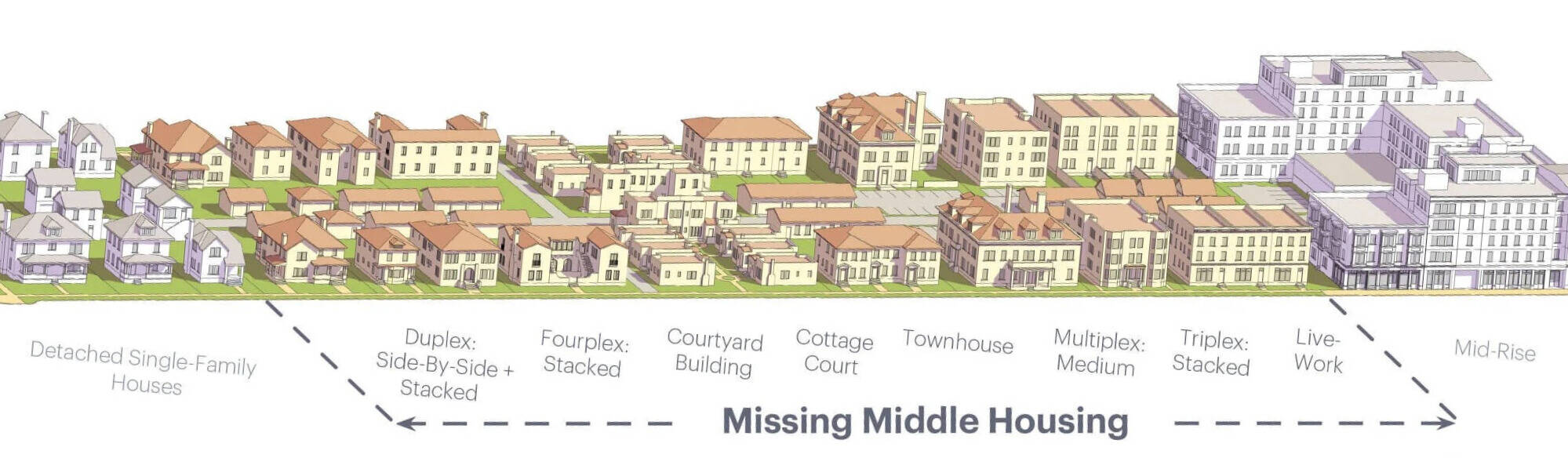
“It gets back to the question of block-scale versus house-scale,” explained commissioner Alex Preudhomme at the meeting. Preudhomme presented a chart displaying how various types of housing compare from the street level, increasing in density from left to right. He drew a line between cottage courts and townhomes.
“[To the left of the line,] these are all house-compatible, meaning if they appeared side-by-side next to a house, they would be types that weren’t extreme enough to destroy the neighborhood fabric,” Preudhomme said. “As soon as you get to townhouses, these are all block-scale.”
The new high-density standard in the two neighborhoods reflects changing priorities for the area.
Over the course of the city’s Winslow Subarea Update, part of the islandwide Comprehensive Plan, several micro-neighborhoods saw their boundaries redrawn to reflect city development policy. At the Sept. 3 meeting, commissioners followed “character statements” defining the community vision for each district to determine which forms of housing were the best fit for each zone.
The character statements for the Ferry and High School Road designate them as the first and second “most intensely developed” districts on the island, respectively, while also noting each area’s unique role. Both statements also indicate that new development, specifically multi-family and mixed-use development, “should replace large areas of surface parking wherever possible.”
“The Ferry district is a gateway to Bainbridge Island, the Kitsap and Olympic Peninsulas for residents, commuters and tourists […] This district is intended as a pedestrian and transit-oriented hub with multifamily mixed-use buildings that complement the character and vitality of the Core district,” the statement reads. “Higher density housing is appropriate for this area because of its proximity to the ferry, transit, downtown retail and because it is a prime view location.”
At the June 24 council meeting, city leaders directed the planning commission to concentrate the bulk of growth on the island in Winslow by raising the density standards in the Ferry and High School Road zones, which would allow the city to plan for all 1,977 new units of housing required by House Bill 1220 within Winslow rather than spreading it out to the rest of the island.
“With these capacity numbers met in Winslow, […] this makes the end of the project at least a little more attainable than it has been,” said city planning director Patty Charnas at the June meeting.
The newly-created joint Ferncliff and Madison Avenue micro-neighborhoods, mirrored on either side of Highway 305, will serve a “missing middle,” commissioners determined.
“[The Madison District] serves as a medium-density bridge between the Central Core and High School Districts […] Micro-neighborhoods scattered throughout should provide an opportunity for ‘surprise’ in contrast to the more expansive spaces common in the Central Core and High School districts. It should be as walkable and bike-able as the Central Core, High School, and Ferry Districts,” reads the area’s character statement.
Townhomes, cottage courts, courtyard buildings, fourplexes, triplexes and ADUs could all be built in both areas, but Madison goes a bit denser with low and mid-rise multifamily buildings allowed, whereas Ferncliff would go down to duplexes and single-family homes.
Despite running parallel to one another, commissioners saw the two neighborhoods’ futures very differently, and were split on how to proceed.
In Ferncliff, the area is already predominantly single-family housing, commissioner Sarah Blossom noted, and changing the area’s zoning to focus on multifamily homes while discouraging a housing typology that already exists in the area “just doesn’t make sense to me,” she said.
Commissioner Peter Schaab said he understood Blossom’s concerns, but added that outside of Winslow, there are few areas on the island that match the same amenities and capacity for density as the Ferncliff area.
“This is the last area on the spectrum where we can play with density. This is one of our last areas where we can have a more increased density in any measurable way,” said Schaab.
Other commissioners agreed with Schaab.
“I think we, by including all these various tools for density, I think we are encouraging density. From a zoom-out, I also, in theory, think that in the future, 20-30 years down the road, hopefully we see denser growth. I think we’re asking the community to move along too quickly by not including single-family homes as an encouraged possibility as well,” said commissioner Sean Sullivan.
Only one micro-neighborhood did not receive a housing review: the Central Core, which covers downtown Winslow Way, Madison Avenue from the water up to Wyatt Way, and west to Wood Avenue SW. It’s a sensitive area, commissioners agreed, and the group decided to form a subcommittee to discuss housing typology for the area.
Overlays on certain streets within the Central Core are key to the commission’s balancing act between the community’s priorities and perception of the areas, and the need to plan for greater density.
“We’re getting to the heart of soul of Bainbridge, and it’s going to be a quite reactive space of how we deal with the Central Core,” said Sullivan.
Some members of the public who attended the meeting praised the commission for its work, and called for specific attention to their respective neighborhoods to preserve the area’s unique qualities.
“I think you guys are doing a great job. I love the way you’re protecting the frontage of Winslow, then you have the civic behind it that can be denser […] This is exactly the type of sculpting that I want to see: with the proper recognition of preserving the character,” said Ericksen Avenue resident Bruce Weiland.
Weiland asked commissioners to consider an overlay for Ericksen Avenue that would exempt it from the same zoning standards as the rest of the Madison district to preserve the “small, neighborhood feel” of the street.