
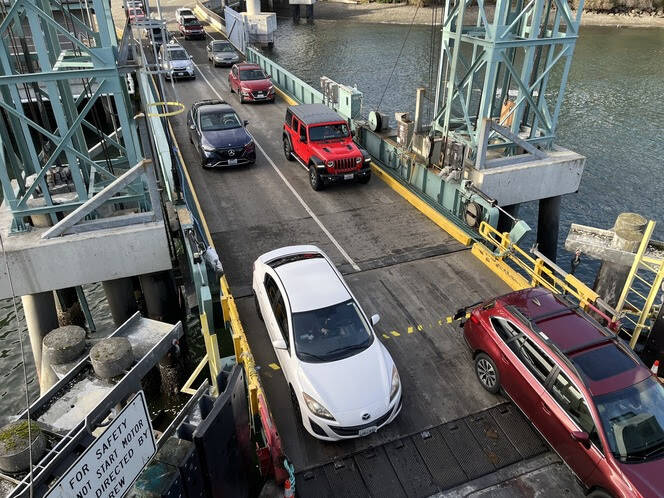
Systemwide, Washington State Ferries showed a strong performance in 2025 — but given what ferry advocates on its busiest route have found, there may still be some room for improvement.
Tony Smallbeck and Richard Velazquez are both longtime Kitsap residents who serve on the Bainbridge Island Ferry Advisory Committee, a volunteer position that serves as a conduit between communities connected to WSF terminals and the state agency.
In January, BIFAC identified on-time performance as the top concern for island ferry riders through a community survey. Out of 47 respondents, 83% selected OTP as the “most important aspect of the ferry system,” followed by frequency of sailings (about 60%) and cost of fare (36%).
Velazquez presented the group’s findings to WSF, and the committee continued to monitor sailings.
BIFAC found that on-time performance fluctuated with the seasons. Between January and October, the BI ferry route’s OTP hovered around 90-93% in January and February, then dipped to about 77-80% between March and May, fell to about 60-63% in June and July, then climbed back up to 87% or so through October.
“We’ve been working with WSF to track on-time performance, specifically for the Bainbridge Island route, since the start of 2025. OTP for the Bainbridge Island ferry route consistently underperforms overall WSF OTP, with the biggest gaps in 2025 occurring in June and July. WSF is aware of this and is performing root cause analysis to identify the determining factors to improve OTP,” wrote the group on its social media page.
The Bainbridge route is an outlier within WSF’s metropolitan service areas. Most of the other routes, including the Seattle to Bremerton route, did not dip below 80% OTP, even through the summertime; the only other ferry route that experienced a similar dip in OTP was the Anacortes to San Juan Islands route, which fell to 50% OTP in July.
However, this summer has seen marked improvements systemwide, said Steve Nevey, head of WSF.
In previous years, WSF’s biggest challenges in addressing the inconsistent reliability of sailings have been labor shortages and lack of vessels, Nevey explained. Improvements in both departments have eased the strain, he said.
“We added lots of sailings this summer, many more than the summer before, and we cancelled less than the summer before. So we’re trending better by every metric, but we still have a lot of work to do […] All the extra service you’ve seen throughout the summer is because our crewing numbers have recovered. And the biggest challenge remains now, which is building new vessels,” Nevey said at WSF’s October community meeting.
Nevey shared some ridership metrics between January and Sept. 30. In total, the ferry system carried 15.5 million riders, including 7.1 million vehicle passengers and 8.3 million walk-ons and bicycles, sailed 603,000 miles, and completed 98.7% of sailings, he said.
“I know there’s a lot of debate about those kinds of metrics — ‘What if they’re late?’” said Nevey. “We’re looking at how many were scheduled, and how many did we complete.”