
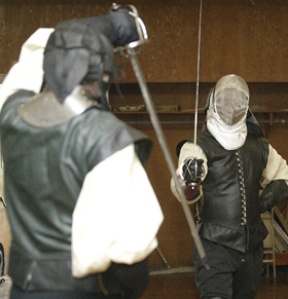
Students learn the art and history of swordplay through classes at the Grange.
Two duelists square off, holding their broadswords before them, tip down and hilt up. The shuffle and firm step of leather boots against the wooden floor is the only sound as they appraise each other.
Then there is a flash and clang of steel; metal slides against metal, and both sides pull back.
The blouses, à la Three Musketeers, leather jerkins and long boots might place the duel in a Renaisssance-era public house, but it’s actually the Bainbridge Island Grange Hall.
“It’s mentally challenging and physical,†Dana Schenefeld said of the swordplay class. “It’s like physical chess. You want to draw your opponent into a position you can exploit.
“The first rule of this discipline is don’t get hit. And number two,†he adds with a grin, “is ‘put the pointy end into the fleshy part.’â€
Schenefeld is one of several students of Nathan Barnett of the Academia della Spada, which researches and teaches 16th-century sword fighting, a study that is part archaeology and part martial arts.
The academy holds classes at the Grange every Monday, teaching historically correct swordmanship with the weapons and clothing of the time: a gorget to protect the throat, a stout leather jerkin for the chest and leather vambraces laced around the forearms.
The archaeology comes into play in puzzling out how dueling with swords or rapiers was done, based on manuals published in 16th century England with a strong influence from Italy.
The difficulty is that the manuals often omit explanation of elements that were common knowledge in the day. Barnett compares it to someone writing about how to drive a car, but neglecting to mention that cars drive on the right side of the road.
“We’re scholars, but then we take it onto the field…and come home with bruises for (our) efforts,†he said.
With a master’s degree in British literature – emphasizing texts from Beowulf to Shakespeare – and a background in Asian martial arts, Barnett found swordplay was a natural combination of the two. He never cared for modern fencing, which he found too much like a game removed from its historical roots.
Students, he finds, are drawn to studying sword from interest in fantasy literature or as a martial art.
A former island resident and “usher†of the academy – “vice president†in modern palance – Barnett teaches the sword, which targets the opponent’s arm to render the foe unable to fight back.
Master of the academy Cecil Longino, who founded the group in 1999, teaches Seattle classes on the rapier, which is more of a thrusting weapon.
In class, Barnett drills the students on various attacks with their weapon, correcting them for position, motion and technique. It takes about a year of study before students can “get out there smacking someone with a sword,†he said.
“The first time, it’s sheer adrenaline,†Schenefeld said.
He had to deal with the “flinch factor†– the reflex action to “a piece of steel aimed at your head (is) coming in faster than you can move.â€
High school sophomore Erin Wood started the class about a year ago. She likes fantasy and the medieval arts, and uses the class to earn physical education credit at her school.
Her friend, 15-year-old Katie Tippie, took up the weapon only recently, and is learning positions while working up the arm strength to hold the sword for long periods. A sword with a 37-inch blade weighs 3½ pounds.
Wood remembers the early lessons, when her arms were so sore she had trouble even brushing her teeth at night.
As each attempt puts one at risk of attack, “it’s not a lot of jumping around and smashing with the sword,†Barnett said. “Smacking the other’s sword is a big waste of energy.â€
An engagment, he says, emphasizes small, efficient motions instead of big, dramatic ones. Duelists make a lot of mental considerations even if there is relatively little motion. If a pass fails, the attacker quickly pulls back.
“If this blade was sharp and this might be your last minutes on earth,†Barnett said, “you’d take your time.â€
* * * * *
Good fencing
Academia della Spada classes for sword, for ages 15 and up, meet from 4-6 p.m. Mondays at the Bainbridge Island Grange Hall on North Madison Avenue.
Class fee is $50-75 a month, which includes equipment rental. Free trial lessons are available for newcomers.
For more information, contact Nathan Barnett at (206) 799-5069 or nathan@academiadellaspada.com, or visit www.academiadellaspada.com