Crime doesn’t pay, but a career in science will
Published 11:00 am Tuesday, March 27, 2007
A forensic scientist opens a new lecture series to promote the love of the laboratory.
Megan Inslee never murdered Barbie. Nor did she witness violence between two stuffed animals and a ceramic penguin.
That’s because Louise Baxter’s forensic science class – during which the above fictional fiascos occur regularly – wasn’t offered while Inslee was in the Bainbridge school system.
Nonetheless, Inslee now works as a forensic scientist at the Washington State Patrol DNA crime lab in Seattle, analyzing data from real crimes.
A career in the crime lab wasn’t a foregone conclusion. But neither was the idea of a life in science equivalent to a nose-full of ammonia, as it is for some students, struggling to take up a scalpel.
“I always liked science when I was younger,” Inslee said.
Knowing that not everyone shares that opinion, island educators and scientists are teaming up to reach students, parents and anyone else who might otherwise leave the pursuit of science to those like Inslee, who are naturally drawn to it.
As part of the effort, Inslee will share stories about her work at 7:30 p.m. tonight at the Bainbridge High School Library. Her talk will kick off a three-part science lecture series that could become a fixture on the island, according to Doug Olson, formerly Inslee’s sixth-grade teacher at Sakai Intermediate School and one of the organizers of the event.
“There are so many people on the island who work in science,” he said. “We want to pull in those resources.”
Presentations by other island scientists are scheduled for April and May, and Olson plans to continue the series in the fall.
He also hopes to create a database of speaker bios and links to their research.
Doing so would allow high school students – who are required to complete community service projects – to connect with working scientists in need of volunteer help.
Along with discussing a specific field of expertise, each speaker will outline his or her journey into science, from school to the workforce.
“That’s just as important as what they do,” said Mette Peters, a cellular molecular biologist and, along with Olson, co-creator of the series.
Inslee always assumed her own journey would end in a white coat, but as a doctor, not a scientist. She earned a degree in biology, and was doing odd jobs after college when she took a tour of the crime lab in which she now works.
“I remember meeting all of these people who loved their jobs,” she said, adding that the experience jolted her onto a new career path.
She worked her way into the lab, where she now spends her days analyzing items from homicides, sexual assaults and myriad other crimes.
Inslee said she’s working part-time for now while she pursues her Master’s degree.
For Baxter, who has taught for 35 years, Inslee’s story will add a dash of reality to her forensic science class at BHS.
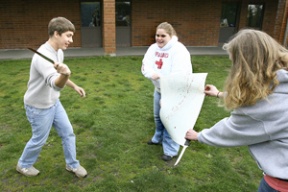
The class, in its second year, requires students to use a variety of skills in analyzing “staged” crime scenes.
Baxter has about 60 forensic science students, all of whom study blood stain patterns, DNA fingerprinting and facial reconstruction, among other crime-solving techniques.
The class is popular, she said, but she would ultimately like to add two more units. She also would like to see the addition of a biotechnology class in the coming years as part of an evolving science education program in Bainbridge schools that educators are hoping will break stereotypes about science.
“It’s more of a public perception problem,” Baxter said, of the position held by science in society’s hierarchy. “There’s way too much emphasis on sports and music. Scientists aren’t held in high esteem.”
Inslee agreed, which is why she’s hoping her talk and those of her fellow island scientists will help energize the local science community.
“You’re not just stuck in a lab in a corner doing boring work,” she said of her job. “I love it.”
***************************************************************
Don the lab coat
The “Science in Our Midst” lecture series begins tonight at 7:30 p.m. at the BHS library. The series continues April 25 at BHS with Marc Stewart on autonomous underwater vehicles, and May 30 at the Woodward Middle School Commons with Bernard Hallet and artist Maria Coryelll-Martin discussing climate change.