
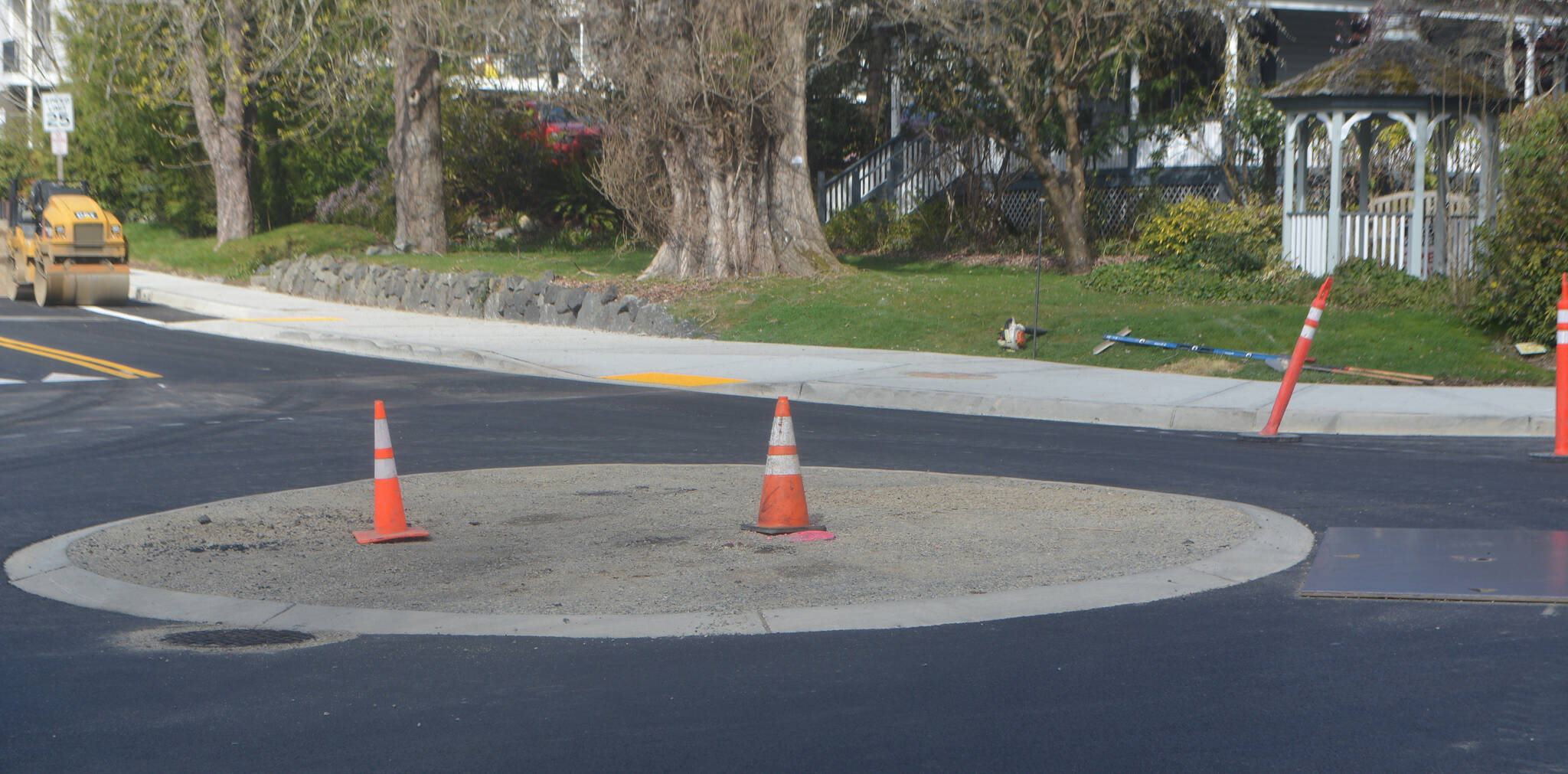
The Bainbridge Island City Council received an update about road infrastructure improvements as part of its Jan. 20 study session, which included a pavement analysis that found up to $5 million will be needed annually to maintain existing roads and work on a backlog of deferred maintenance.
Several options for additional revenue include: car tab increases, a 0.1% sales tax increase, voter levy lid, and voter or council-approved bonds, public works director Chris Wierzbicki said.
COBI is currently conducting a scientifically valid survey to gauge whether islanders would support a levy for roads. “We plan to bring those findings back later in this quarter to give you a little bit more background information about how people are feeling generally about the levy. How they would feel about different levy amounts and how they would feel about the balance between road preservation and road improvements, like non-motorized improvements,” Wierzbicki said.
City manager Blair King said nobody wants to pay taxes. However, city roads will require more money for road maintenance, limited resources, and the council will need to make choices about their intended direction, adding, “the issue of a levy lift did not pop up out of thin air. This was a direction that the council previously provided to find more information to bring back to the council, which is what we’re doing. It’s not a creation of staff. This is something that was brought to the council and options,” he said.
Road conditions
The city uses Pavement Condition Index to rank conditions from 0-100, and PCI scores are used to rank roadways for preservation work.“It’s a simple scoring system from zero to 100, with zero being kind of the worst condition and 100 being a brand new road. And we use these scores to help rank and prioritize how we treat different roads with different types of pavement treatments around the island,” Wierzbicki said.
In 2019, COBI reported a 70 PCI average with a backlog of 8%, and in 2024, the city maintained a PCI average of 70 with a backlog of 12.3%, while the national average is 65%. Backlog is the percentage of roadways needing complete pavement rehabilitation (deferred maintenance), per city documents.
The city has roughly 286 lane miles of paved roads and 5 miles of gravel roads, which are maintained through annual pavement work performed by a contractor. Roughly a third of roads are in fair to poor condition, and about two-thirds are either good or very good condition, Wierzbicki said.
Wierzbicki said over the last two cycles, and including this year, COBI is prioritizing 70% of funds to high-volume roads and 30% into local access roads in poor condition. COBI uses an asset management system to prioritize roads for pavement and treatments, he said.
“We want to keep the roads in good to very good condition, because it costs a lot more to reconstruct a road than it does to apply a surface treatment. You can do a surface treatment like an overlay, a slurry seal, or a chip seal for about $5,000 a block. When you have to reconstruct a road, you’re talking about a quarter million dollars or more per block,” he said. “So the more we spend preserving and maintaining the roads, the less we’ll have to spend on expensive reconstructions.”
Wierzbicki said between 2014 and 2022, COBI averaged $500,000 a year on pavement maintenance. In 2023, council authorized additional funding of roughly $1 million a year, plus inflation, which the city has been spending since then. Wierzbiciki said maintaining $1 million a year would decrease PCI, adding, “ With that level of investment, we do expect our PCI to drop from 70% to 65% over the next 10 to 12 years, and the backlog to grow to 18%,” he said.
Council reaction
Councilmember Mike Nelson said he believes roads are a core government function and he’d like to find savings to cover the cost while keeping in mind the impact taxes can have on fixed-income households.
Councilmember Leslie Schneider said she was under the impression that in years past, the road infrastructure had been in good condition, and the growing backlog is concerning, adding, “As we go into this really important public discussion, we need to be super careful about what the facts are,” she said.
Councilmember Brenda Fantroy-Johnson shared her concerns about roads along coastlines.
“I don’t think it’s a coincidence that we’re talking about emergency management, and we’re talking about these roads that are on the coastline. When we think about what can happen to this, we’re an island, right? And those roads will be impacted more than our inner roads. So it may not be sexy to do, but I’m gonna want to be able to get off the island if something happens,” she said.
Councilmember Ashley Mathews said she’s looking forward to hearing from the community survey and asked where parking tax revenue goes. Wierzbicki said the parking tax goes into the city’s streets fund.
“As long as I’ve been on city council, it has been an issue; unless I’m misremembering, we’ve always had this backlog, and it’s ironic, and it weighs on me, and is one of our primary functions,” Councilmember Kirsten Hytopoulos said. “As uninteresting as it is, it is what the people expect.”
Mayor Clarence Moriwaki shared his support for infrastructure improvements.
“This is why this is important…these are our streets, and these are our roads, and this is what our people are expecting to be able to use safely and predictably. So that’s why it’s really important to really analyze this and to responsibly find a way to pay for it,” he said.

