
Bulkheads foes want to see more chinks in armor
Published 8:00 pm Wednesday, January 31, 2007
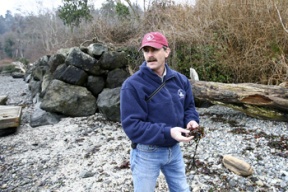
Puget Sound preservationists call for the restoration of a more natural shoreline.
Sound + vision:
This is the second story in a multi-part series examining Gov. Chris Gregoire’s initiative and local efforts to clean and protect Puget Sound. Saturday: stormwater management.
Pavement is perhaps ideal for a downtown stroll, but not for rearing salmon or growing eelgrass.
Yet, large pieces of concrete drape the tidelands of Blakely Harbor’s outer reaches.
Tossed in 15-foot piles to shore up a crumbling portion of Country Club Road, the rip rap bulkhead isn’t doing its job – and it’s one of many armored island shores putting Puget Sound’s health in peril.
“This is bad stuff,” said marine habitat specialist Jim Brennan, standing on a four-foot wide slab still bearing remnants of red patio tile. “This whole bulkhead is unraveling. Now it’s paving the shore.”
But there’s hope for this shoreline, said Brennan, who is working with the city to remove the bulkhead and restore the area’s marine habitat.
While the plan is still in its early stages, many at City Hall are buzzing about the possibility of both fixing a problematic road and returning nearly a third of a mile of shoreline to its natural state.
“This is a big deal,” said city planner Marja Preston, who cautioned that the project will take time, money and the continued support of nearby landowners. “It’s an excellent opportunity to demonstrate how removing bulkheads can restore shoreline to a natural condition. And with 1,800 linear feet, it’s really huge.”
About 48 percent of Bainbridge Island’s nearly 50 miles of shoreline is walled off with boulder rip rap or concrete bulkheads, according to a recent city-led assessment.
About one-third of Puget Sound, or 800 miles, is barricaded with man-made structures, cutting fish off from spawning grounds, hampering the growth of natural habitat and robbing birds and marine mammals of food sources.
“Bulkheads are really a death by a thousand cuts,” said Brennan, an island resident who works for the University of Washington’s Sea Grant Program. “We’ve already reached a point where the sound is in crisis. If we’re going to turn the corner, we’ve got to restore our shorelines.”
Rounding the restorative corner is the motivation behind Gov. Chris Gregoire’s recent $220 million proposal to clean-up the state’s inland sea.
Efforts to breakdown bulkheads and rehabilitate shorelines are poised to receive millions from the governor’s two-year plan.
The city does not yet have cost estimates for the possible road fix between Toe Jam Hill Road and Upper Farms Road or related shore restoration. Plans may include moving a portion of Country Club Road farther inland while the old portion and its bulkhead fringing the harbor would be removed. Brennan and other habitat restorationists would likely then import wood, gravel and other debris to help the shore ease into a more natural state.
City staff said the two adjoining property owners, who did not want to be named in this story, have expressed strong support for the proposal, which could include some public access to the shore.
Preston, who leads the city’s “biodiversity offsets” program, plans to use the proposed habitat restoration project to offset the impact of possible tree removal if the road is rerouted.
City Public Works Director Randy Witt said the plan has merit from both environmental and public infrastructure standpoints.
“We’re always having to patch (the road) up and then we have another storm and it takes out a section,” he said. “Moving the road could solve a lot of that.”
Country Club Road’s shoreline stretch bears the scars and asphalt patches from many years of erosion. A section of the northside lane was closed when large cracks appeared after recent rain storms.
“Look at that baby,” said Brennan, tracing an inch-wide crack with his hand. “It’s the sheer mass of this pulling it down. Look at all these patches and stress fractures and the angle of road. It’s really slumping.”
Brennan said bulkheads often contribute to erosion rather than halting it.
Especially on unprotected stretches of beach, like that of Blakely Harbor’s southeast end, the energy from strong waves bounce off bulkheads and scour away beach sediments.
Brennan finds many ready examples along the harbor’s south shore, where the foundations of numerous bulkheads are exposed and the shore’s height has dropped up to three feet since armoring was installed.
“People see the pictures of waterfront homes in Sunset Magazine and that’s what they want,” he said. “But none of those homes come with a brochure saying ‘you are now a steward’ informing them of their obligation not to hurt our resources.”
Bad news
According to the state Department of Ecology, shore armoring harms the marine environment in a variety of ways.
Bulkheads, over time, scrape natural beaches down to cobbles and large rock.
On Blakely Harbor’s south shore, much of the beach’s silt and gravel has been flushed away, leaving fist-sized stones that neither fish nor marine fauna favor.
At a small spot on the shore where a sandy bluff is unburdened with concrete, Brennan grabs a handful of grit favored by spawning herring and the roots of eelgrass, which provides shelter to juvenile salmon.
“Look at this,” he said, sifting fine gravel, sand, bits of shells, wood fragments and seaweed through his fingers. “This is what you need, but you don’t see much of it here.”
Bulkheads also cut off the marine environment from the terrestrial environment, which are strongly interdependent.
Bluffs feed sediments to beaches while near-shore trees provide shade for fish and recharge beaches with organic matter. The shore also provides insects, a key food source for fish, said Brennan.
According to study Brennan conducted for King County, land-based insects account for about half the diet of Chinook salmon.
“You build a bulkhead and you’ll starve the shore,” he said.
Armoring high bluffs is a failed cause – not just for the environment, but for nearby homeowners.
“A lot of retaining walls or armoring the toe of a vertical bluff doesn’t do much,” he said. “It’s coming down. Gravity happens.”
But some island residents say bulkheads are necessary for the safety of their families and homes.
“We’ve been losing a lot of ground,” said Harvey Road resident Lee Stollar, who is joining four of his neighbors in appealing the state’s denial of bulkhead permits along the island’s northwest shore. “I’ve had to rebuild my stairwell to the beach three times in the last 15 years and I feel that my drain field’s at risk.”
According to Stollar, his home’s septic field was more than 50 feet from the bank six years ago. Now it’s just 35 feet away.
“My concern, not surprisingly, is that I’m going to have septic leeching into the sound,” he said.
Stollar’s case goes before the state Shorelines Hearings Board in June.
While Brennan understands the desire to build bulkheads when a home is poised for a plunge, he said many waterfront homeowners panic when they see the natural signs of erosion.
In most cases, he said, the crumbling shore halts long before residences are actually at risk.
Brennan hopes more island property owners, like the two working with the city along Country Club Road, will let down their guard a bit, and let the sound re-embrace its shores.
“We should try to avoid bulkheads in the first place,” he said.
“But places like this, like on Blakely Harbor– which was ranked as one of the best shorelines on Bainbridge Island, we can turn things around and contribute to the health of Puget Sound.”