
Density is on Winslow’s doorstep — or so it would appear to some residents.
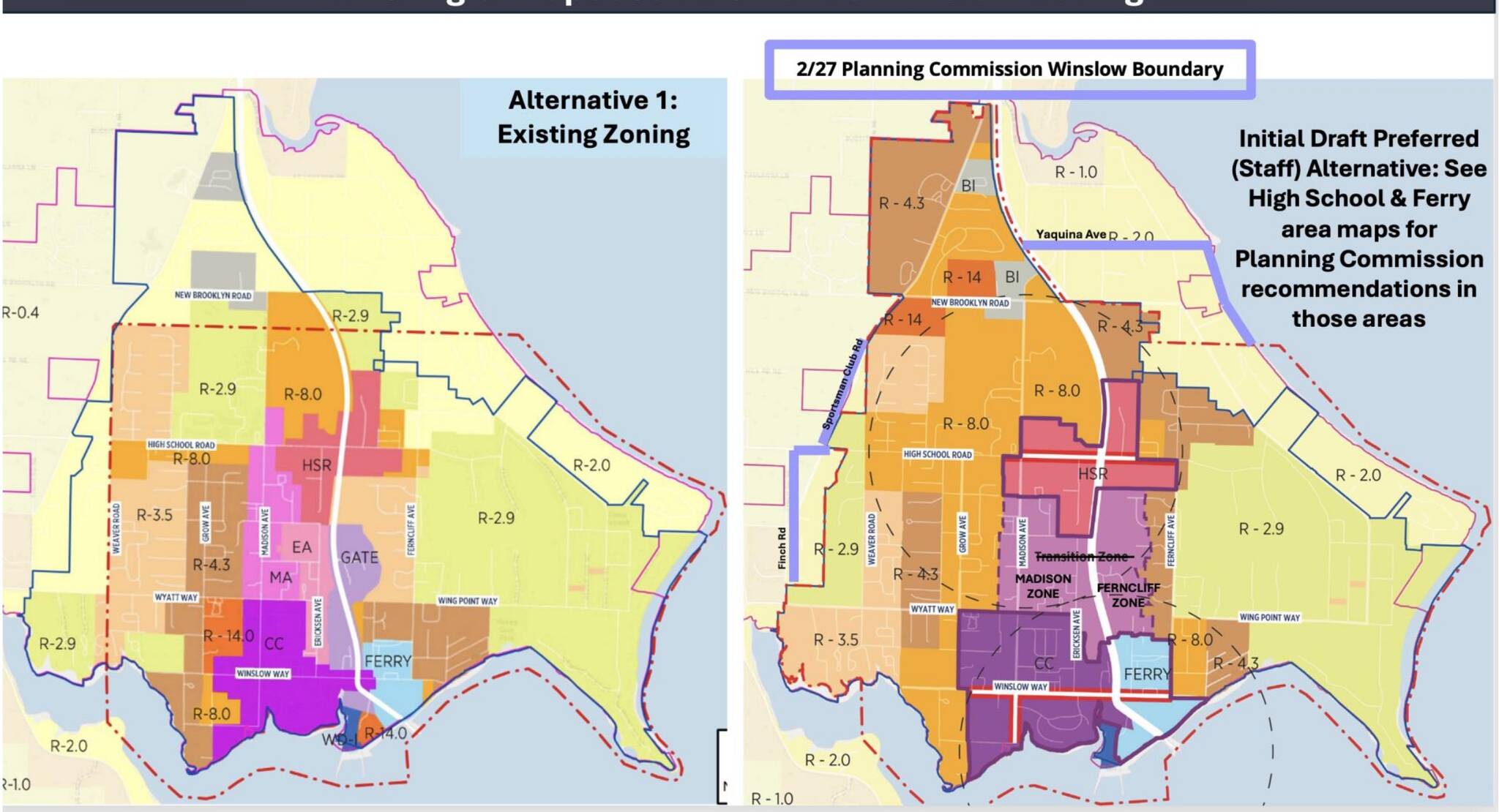
At the July 22 meeting, the Bainbridge Island City Council voted 6-1 to allow the city planning commission to consider all of Winslow for middle housing development, given that two mini-neighborhoods — the High School Road and Ferry districts — can help the city meet the state’s requirements for affordable housing capacity.
“I want to start with what my motion is not,” planning commissioner Sarah Blossom said. “It is not asking the council to adopt our recommendations for the Ferry and High School Road districts…It’s also not meant to suggest that our work is done in those two zones; we still need to address what programs and potential overlays would apply, to ensure that what we’ve created is affordable.”
Her intent, Blossom said, was to ask whether City Council would prefer that the Planning Commission focus on zoning recommendations in the Ferry and High School Road districts for affordable housing, or if they’d prefer that the group continue to look at the entirety of Winslow.
The distinction is key because at the June 24 council meeting, the commission announced that those two zones could feasibly support all 1,977 units of new affordable housing that the city is required to facilitate under the Growth Management Act.
The law requires cities to plan for population and housing growth at all affordability levels, including high-, low- and middle-income residents. Bainbridge’s available housing stock skews high, with few options for lower-income residents — forcing the city to play catch-up to meet GMA requirements.
Some BI residents advocated for incoming housing to be concentrated in Winslow since the start of the review process — but Blossom and fellow commissioner Ben Dynes advised council to think carefully. “I want you to think of this in terms of the capacity of our existing sewer plant. I think it would be a mistake to add capacity beyond what can be handled by the existing plant,” Blossom said.
Blossom said after two upgrades, the city’s sewer and stormwater system can handle about 2,000 additional units of drainage for stormwater and runoff collection. If the city were to concentrate growth in the High School Road and Ferry areas, then nearly all of those connections would be occupied by existing residential users and new multi-family units.
But that leaves only 505 units left to accommodate commercial use, such as a proposed car wash — which would be discharging water into the sewer system — along with any new businesses or homes that are not yet connected to the system.
“That is not a lot of wiggle room … The point I’m trying to make is that there is very little capacity in our existing plant that can be allocated toward any housing beyond our [affordable housing targets]. There’s not a lot left for additional market-rate housing,” Blossom said.
“Building another plant is a pretty big deal; there’s not enough known — where it will be located, how much it’s going to cost, how’s it going to be paid for, will it cause the city to expand the service area to expand the customer base in order to pay for it. If the council does think we should go the route of planning for growth beyond the potential capacity of the existing plant, I think that is a policy decision that [council] needs to make before asking us to go further.”
Deputy mayor Jon Quitslund and Councilmember Clarence Moriwaki voted in favor of the motion. They pointed out that despite Blossom’s concerns about the sewer system, development does not happen overnight — which means it may best be addressed down the road.
“We’re planning 20 years out, and we’re planning for capacity, but filling the capacity is going to be a very slow process … I’m not afraid of creating too much capacity that’s all of a sudden going to be overwhelming the sewer plant. We do need to be concerned about planning for too many people in Winslow, because people want to come to the island as a whole, and we shouldn’t provide only for housing in Winslow. But the housing will happen slower than we want it to,” Quitslund said.
Councilmember Kirsten Hytopolous was the sole dissenting vote. The Planning Commission is running out of time to certify the Comprehensive Plan, she said, and adding middle-housing zoning to the commission’s plate seemed like a recipe for “cramming.”
Councilmember Brenda Fantroy-Johnson disagreed, adding the plans are living documents, and nothing is set in stone.
“What I hear from the community, and from some of you, is that it makes no sense to just have two zones where we’re talking about housing. Why leave that on the table? Why not talk about housing, period?” Fantroy-Johnson said. “It doesn’t feel to me like ‘cramming’ anything. It feels to me like we’re going to take a look at it … It’s not, ‘Let’s never talk about it again.’”
Dynes added that many community members cited the “unique character of Bainbridge Island” in conversations about affordable housing zoning, which many people use to refer to the physical appearance of downtown Winslow, but it’s more than that.
“I grew up on BI, and I think another big part of the character used to be, and to some degree still is, a diverse community where doctors and retail workers and teachers can all live as neighbors in the same community,” Dynes said. “Right now, if we were to pause the work outside of High School Road and Ferry districts, we would leave a lot on the table in terms of being able to provide for that more diverse community, in particular, middle housing.”
Hytopolous disagreed. She believes that when BI residents reject plans for increased density, it’s because “the majority of this community does not want a huge population increase — they never have,” she said. “We’ve always been careful to try to keep our population growth down because of our limited resources, not because of not wanting diversity at all, but because we have a limited carrying capacity.”
That includes sewer capacity, she added. “Please don’t use the argument that we’re not going to grow,” Hytopolous said. “We can’t keep saying out of one side of our mouths, when we’re talking about sewer capacity, that our housing code is broken, and we need to fix it to get the units we want, then we we’re going to turn around and say we’re going to out-zone our sewer capacity because we won’t get the units, because we never do.”