
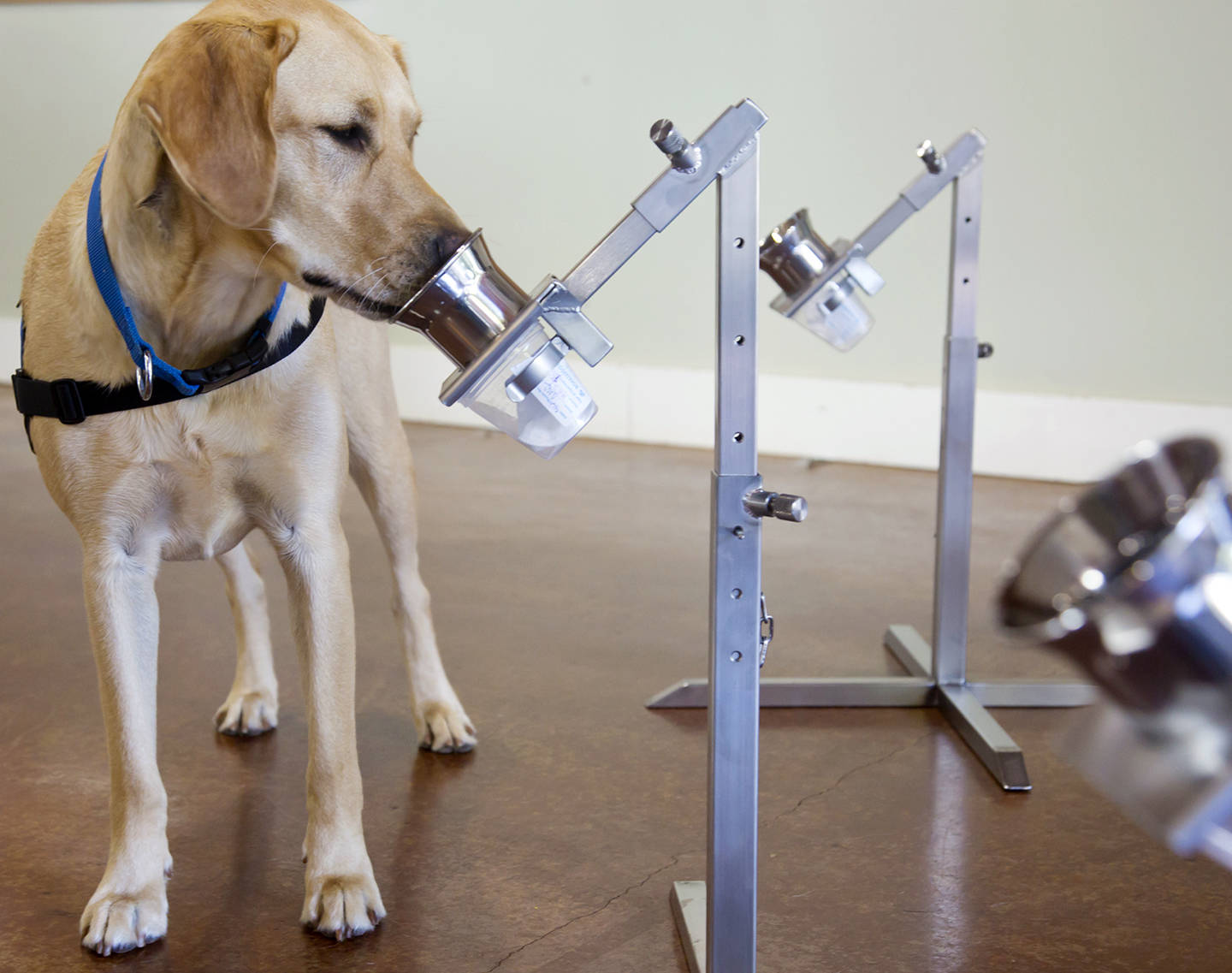
A Bainbridge Island nonprofit using dogs to research COVID-19 is seeking volunteers who may have recently had the coronavirus.
The research team is investigating how early the dogs can detect the virus, which is most contagious days before symptoms appear.
The results show the dogs have the ability to detect the virus in those who are symptomatic, asymptomatic and pre-symptomatic with equal accuracy. Each dog can screen approximately 300 people per day.
Assistance Dogs Northwest initially screened for participation at the Bainbridge Island campus before traveling to Maui a few months ago to work with Assistance Dogs of Hawaii. Four dogs were selected including Labrador Retrievers Sadie, Tess and Yuki, along with Samson, a Golden Retriever. They have screened over 500 people for COVID, including 153 positive samples and 369 negative samples.
“The goal of the study is to show what is possible and help to provide a practical application of this research to help screen people, even those who may be asymptomatic or pre-symptomatic, at places like airports, schools, and hospitals,” said Maureen Maurer, executive director of the BI nonprofit. “We will be meeting with state and county officials and are hoping to share our protocol with other agencies who can scale this program and deploy more dogs.”
The training part of the study, Phase 1, was completed in March. The dogs learned to distinguish the scent of COVID-19 from hundreds of other odors emitted through sweat.
Phase 2, the double-blinded testing phase, was completed last month. Three dogs were presented with hundreds of sweat samples from both inpatients
and outpatients. All dogs performed with an average sensitivity rate (correctly identifying positive samples) of close to 100 percent and an average specificity rate (correctly ignoring negative samples) of over 90 percent.
Phase 3, the implementation phase, is underway at The Queens Medical Center in Honolulu.
Tess, a 3-year-old Lab,, is providing additional screening of patients who are coming in for surgery and receive mandatory PCR tests. She has had 100 percent accuracy thus far.
Participation is voluntary and poses no risk to human participants or the dogs, since the virus is not transmissible through sweat.
Once trained, coronavirus detection dogs can be deployed in a variety of settings, and may provide an inexpensive, real-time screening tool. It is beginning to be used around the world to provide accurate, rapid and non-invasive screening for COVID.
Maurer said this work may prove integral in the fight against the coronavirus and be a method of screening large numbers of individuals quickly. This method may prove to be especially valuable in places like India, where cases are rising and other testing methods are not always available, she added.
The researchers are looking for volunteers who have recently been exposed to the coronavirus or have family members who have recently tested positive. If you would like to participate, call 206-321-0592 or email info@assistancedogsnorthwest.org