
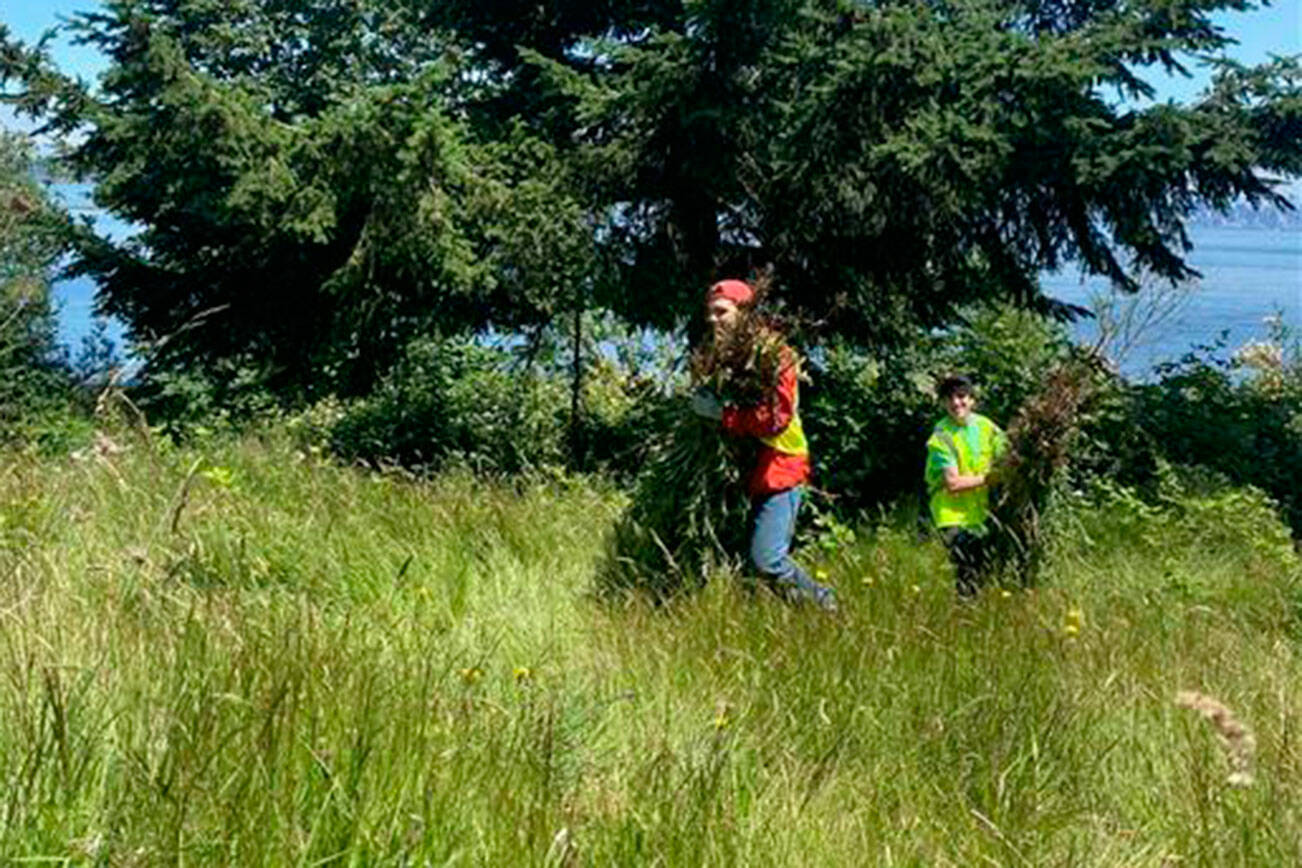
Starting next spring, Battle Point Park is going bee-friendly.
Parks natural resources manager Morgan Houk announced a new policy around mowing at Battle Point Park that will protect pollinating insects and support native species at the July 17 meeting of the Bainbridge Island Metro Parks and Recreation District.
Instead of maintaining a high-and-tight three-inch buzz, staff will allow grasses in four select areas of the north end of the park to grow out, instead opting for a five-inch mow once a year right before July 4. Access trails to the low-mow areas will still be cut down to three inches.
“We mow a lot of grass that doesn’t serve a big ecological purpose, and we wanted to create opportunities to talk about pollinator habitat in our parks,” said Houk. “This will be the first area [on BIMPRD land] that we are transitioning a traditional lawn to a less-landscaped area that is focused on the natural resources in the area.”
Maintenance challenges at the north end of Battle Point made it a strong choice for habitat restoration, Houk explained. The area remains rather wet most of the year, and the 12-foot wide mowers frequently get stuck. By restoring the areas to native grasses, grounds crews will save time and labor, as well as reduce the park district’s carbon footprint.
But it’s not as simple as ripping out the turf and seed-bombing the area. The park district must carefully study the unique characteristics of the site, like sun exposure and soil quality, to assess which native species will succeed there. In order to transition the area, Houk is taking notes from several disciplines dedicated to land maintenance, like rangeland science and ballfield management.
“We’re going to let it happen really slowly. We have been managing invasive species on that half of the park for a long time, so we’re going to start with a two-year observation period to see what is present already,” Houk said. “It will not happen all at once, it will probably take place over the next five years. We have to take a read of what the land wants us to do, and what the community wants to see in that spot.”
With the project, Houk anticipates an opportunity to educate the public about the rich diversity of wild pollinators in Washington beyond domestic honeybees: blue orchard mason bees, bumblebee species, butterflies, moths, flies, birds and even peaceful wasps.
Alterations to mowing schedules are part of a wider environmental movement that aims to improve habitat for pollinators and reduce water use, known as “No Mow May.”
While the notion began as a grassroots choice by individual property owners in the United Kingdom, Bee City USA, founded by invertebrate conservation group The Xerces Society, has taken up the mantle to bring conservation efforts to cities, campuses and park districts around the United States.
“It’s more than long grass and dandelion blooms. It’s a gateway to understanding how we share our lawns with many small creatures,” said Matthew Shepherd, outreach and education director at the Xerces Society. “When we think of habitat loss, we tend to imagine bulldozers and rutted dirt, but acres of manicured lawn are as much a loss of habitat as any development site.”
Lawns cover approximately 40 million acres of land in the U.S., which makes grass the largest irrigated crop in America, Shepherd explained. Lawns demand outsize amounts of water and labor, and the pesticides, fertilizer, fungicides, and herbicides required to maintain the uniform grass make them caustic environments for many animals, especially sensitive creatures like insects.
Climate change has also taken a massive toll on insects. One German study found that almost 75% of the insect biomass in three natural areas was lost between 1989-2016, with no recovery as of a follow-up study in 2024. But in areas that limited mowing in the spring and summer, species richness of pollinators and abundance of bugs increased in both Europe and North America.
“Re-thinking the American lawn can take a variety of forms from mowing less often to converting lawn to a more diverse and natural landscape,” said Laura Rost, Bee City USA national coordinator. “Mowing less in the spring is key; the start of the growing season is a critical time for hungry, newly emerged native bees. Flowers may be hard to find. By allowing grasses to grow longer, and letting flowers bloom, your lawn can provide nectar and pollen to help your bee neighbors thrive.”

