A short, strange trip it’s been
Published 11:00 am Wednesday, December 22, 2004
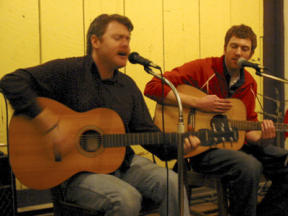
The Lurie brothers descend on Pegasus.
The Grateful Dead sang of “the long, strange trip.”
While the journey undertaken by local band Solyoni was somewhat shorter – planned as 2,500 miles from Akron, Ohio to Seattle, it was abbreviated in Wyoming by irreparable car trouble – they managed to get a few songs out of their trip too.
The band’s debut album “Prairie Monsters” finds 15 off-kilter, folk and country inflected meditations on the failed excursion, the soundtrack to a road movie that ends after the first reel.
“The way it came together was so haphazard, with different musicians, some of whom were never in the same room,” said Dan Lurie, who masterminded the decidedly lo-fi project with his college roommate Dominic Aulisio at various home studios.
“We were pretty ecstatic with how it came out. I think it captures the whole trip, and how we were losing our minds at points on the road.”
While the full band won’t be on hand, islanders can hear three-eighths of the Solyoni collective when Lurie and his brother Robert present their fourth annual holiday performance, 7:30 p.m. Dec. 25 at Pegasus Coffee House. They’ll be joined by Aaron Semer of Seattle indie-rock band the Plains, who also appears on the Solyoni album.
The evening gives the Lurie brothers a rare chance to perform together onstage; Dan (Bainbridge High School class of 1995) resides in Seattle, while Robert (BHS ’92) attends graduate school at the University of North Carolina and is on the island to see the folks for the holidays.
“It’s a shame I don’t live here to do it more often,” Robert said, “but they’ve already got three guitarists in the band.”
The group’s name is drawn from a character in Chekhov’s “Three Sisters,” a gentleman who speaks nonsense; it is apt. Informed by such pop surrealists as Beck and Ween, “Prairie Monsters” largely supports the definition of art as the ability to make ridiculous statements with a straight face.
The songs track Dan and Dominic’s ill-fated trip across the Midwest, a dusty landscape dotted with truck stops, bizarre characters, and the curious commercial artifacts of the American highwayside – giant gophers, giant gorillas, giant prospectors, giant cowboys, and a giant repairman with the unfortunate name of Onan.
Some of the songs are straightforward ballads or rockers; others, like “Wiley Granger and the Town with No Sidewalks” and “Trucker Shoe Polish Shoe Shine Machine” reduce to absurdity the stylistic idioms of the country hoedown and the gospel revival.
“Interlude at Six Flags” is no song at all, but rather the motorists’ half of a phone conversation with AAA, after their car broke down (the first time) across the street from the famed amusement park in Waukegan, Ill. The park itself was closed for the season; that fact inspired another song, “Amusement Park Untitled,” in which the singer muses, “Seems like an awful waste of machinery.”
“It was pretty strange, to see all these roller coasters and nobody else around,” Dan recalls. “The breaking down of the car equated to the non-functioning park.”
Says his brother, “People think Dan’s stuff is all satire, but I think it has a depth to it that’s overlooked.”
A former Review intern and skilled if somewhat eccentric photographer – his images of Rotary Auction toilets are perhaps the finest ever to appear in this newspaper – Dan Lurie came to music late, only taking up the guitar with Aulisio toward the end of their run at Ohio University.
“As soon as we knew two or three chords, we started invading the open-mic scene,” he said. “Somewhere along the line, it got pretty good, I think. It’s definitely evolved pretty quickly.”
A moodier, more serious songwriter, Robert Lurie acceded into pop music through a longer progression – obsessed with the Beatles as a child, moving on to U2 and REM as a teenager, and then finding more obscure corners still.
It was in 1988, when he was 14, that he chanced across the one and only domestic hit by a long-running Australian band known as the Church, a sublime piece of melancholy pop called “Under the Milky Way.” The song, he recalls, “had a hypnotic effect on me. I went out and bought a guitar the week after I heard it.”
The lysergic Church is still a going concern, having evolved into a sort of Pink Floyd for rock fans who went to college. Robert is now writing a biography of Steve Kilbey, the band’s enigmatic singer and lyricist, for whom he once opened a solo show in London and eventually formed an awkward friendship.
While he will get graduate school credit for the book-length project, Robert also foresees a few sales to the small but intense legion of Church acolytes who have coalesced via the Internet.
“If you write a novel,” he said, “you don’t know if anybody will really read it besides your mom.”
This weekend’s Pegasus performance promises original songs from the Solyoni catalog and Semer and Robert Lurie’s solo excursions.
On an island where “local music” usually means some middle-aged white guy playing the blues, the convergence of such unrepentant underground sensibilities should throw things out of alignment, if only for an evening.
Can Bainbridge handle it?
“They’re going to have to be ready,” Dan Lurie said, adding after a pause, “I think people will admire the originality of all the songwriting. If people make it to the show, I think they’ll get into it.
“(And) we still have some friends here who we never see, and I assume they might still be in town.”