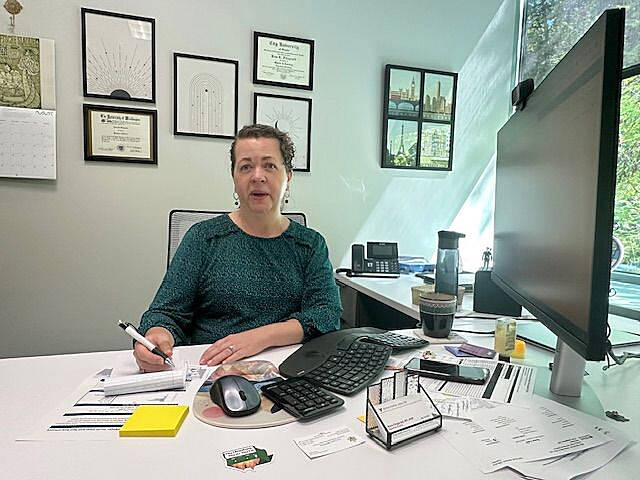
Salish Regional Crisis Line handles calls ranging from a depressed person with a loaded gun in their lap to someone devastated that their dog has cancer.
Most suicide calls are not from individuals on the verge of immediately harming themselves, but many are having suicidal thoughts, said Rena Fitzgerald, executive director of behavioral health at the crisis line, which serves Kitsap County.
“More than 90% of the calls are handled by talking to a crisis counselor. What the person really needs in that moment is somebody to listen to them. To make them feel cared about. To make them feel like there’s hope. That can be accomplished within the phone call the vast majority of the time,” Fitzgerald said.
The importance of the crisis line is apparent. In 2023, there were 52 Kitsap resident suicide deaths, the third-highest annual number since 2000, Siri Kushner, a division director at the Kitsap Public Health District, said. The rate of Kitsap suicides per 100,000 residents is similar to the rate around Washington state, she added.
The county’s suicide death rate over a five year period has been statistically higher among males (26.1 per 100,000) compared to females (9.0 per 100,000). Nearly 52% of Kitsap suicide deaths were due to discharge of firearms, Kushner reported.
“We get calls about everything. A lot of people are experiencing addiction issues, self-harm issues or are feeling a compulsion to engage in a behavior known to not be good for them. There are also a lot of third-party callers saying, ‘I’m really worried about my friend. They said these things and I don’t know what they mean, but they made me scared,’” Fitzgerald said.
“We also have a lot from people having a one-time crisis, like ‘I got laid off today. I don’t think I’m going to qualify for unemployment and I’m freaked out. I don’t know what to do.’ Or, ‘My grandmother just died and I’m overwhelmed with sadness. It’s one in the morning and I don’t have anyone else to talk to,’” Fitzgerald said.
The 24/7 phone line also takes calls from those undergoing mental health issues, some whose lifelong psychiatric conditions lead them to call in daily, she added.
With a suicide call, the first job of the crisis counsellor is to get a read of the situation.
“The immediate need for counselors is to assess whether the risk is imminent. Is there a gun in the house? We want to know if there is a (suicide) attempt in progress. Have they gone to Safeway and bought a bunch of boxes of Tylenol? Have they gathered all the pills in their house together or ingested any pills? Have they consumed more alcohol than is typical for them or used any illicit drugs outside of what their normal recreational use? Have they done any preparatory work?”
An imminent threat likely requires an immediate response by police, fire or medical personnel, she said. Still, the crisis counselor remains on the line to work on “means restriction,” or distancing the caller from the danger – be it pills, poison or a firearm.
“If they’ve already collected things or they have a gun in the home, we want to work on making the environment safe for their immediate safety,” she said.
In circumstances where the threat is not imminent, say for example, someone is having suicidal thoughts but has no means or plan to act on their thoughts, crisis counselors can spend more time problem-solving with the caller, she said.
When assessing a suicide situation, crisis counselors want to know how long the caller has been thinking about suicide and whether they have a specific plan about how they would harm themselves.
When a person is having suicidal thoughts, the goal is to steer them away from the dark thoughts and come up with a safety plan that can be used later if they become suicidal again.
“A big part of what we do in a crisis call is help people come up with a plan of how they’re going to keep themselves safe after the call ends. Everyone should leave the call with the steps that will help them stay stable and safe in the community,” Fitzgerald said.
Ingredients of a safety plan can include drawing up a list of friends and relatives to turn to for help. The counselor can brainstorm with the caller to come up with activities to do when the person is feeling anxious. Some examples: go to a quiet room, listen to a type of music. Other possibilities can be to go to the library or coffee shop or stroll the mall.
In developing a safety plan, crisis counselors look to the caller to come up with ideas that will work best for them.
“We want to help them think of distractions or activities that they can engage in that will increase positive feelings, reduce agitation, anxiety, and stress,” she said.
There are times connection with an individual continues after the telephone call. Crisis line staff can assist with lining up a therapist in the community, if needed. In some cases, staff will arrange to have a mobile crisis outreach team go out and meet face-to-face with the individual.
The Salish Regional Crisis Line (1-888-910-0416) serves Kitsap, Clallam and Jefferson counties. The service receives approximately 1,300 calls each month. Suicide calls can also be made to 911 and the Suicide and Crisis Lifeline at 988.