The art of the subcontinent will be presented to students this week.
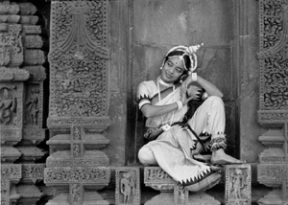
As arms and legs move fluidly to the rhythms of Indian music, a barefoot dancer with flexed feet strikes poses straight from a bas relief temple carving.
Odissi dance brings the styles of India to Bainbridge schools this week.
“The dancers reinforce the rhythm with their feet and the melody and rhythm with their hands,†said Bonnie Showers, program manager for the Bainbridge Island Arts Education Community Consortium. “Indian dance and music are integral to their life passages, religious festivals and secular (ones).â€
Last year, master dancer Sri Manoranjan Pradan of the Odissi tradition performed for middle schoolers on Bainbridge Island. This year the Urvasi Dancers, led by artistic director Ratna Roy, will showcase the Odissi tradition in two matinee shows Nov. 18 for world history students at Woodward and Commodore, and some third-graders studying the Pacific Rim. Some tickets are available to the public.
Showers, with a background in Indian singing, will train teachers on how to parse the music and dance concepts. Students will attend workshops and also experience an Odissi class taught by the dancers as they might in India.
The program is funded by the Harvest Foundation and the BIAECC, which is a program of the Bainbridge Island Arts and Humanities Council.
Historically, classical Indian dancers were highly regarded and trained in 64 branches of learning, including drama, architecture and math, Roy said.
“You couldn’t talk about religious philosophy without performing arts,†said Roy, who learned her art from one of these original dancers.
And unlike other women, dancers could talk with men as equals and own land, and so usually did not marry. They lived together in temples or secular housing.
Her troupe practices the Gotipua tradition of Guru Kelu Charan Mohapatra and the little-known Mahari tradition of Guru Pankaj Charan Das. A more fluid style than that of Pradan’s, the upper torso moves at half or one-quarter of the tempo of the feet, which may be quite quick.
Classical Indian dance was suppressed by the British colonizers in the early 1900s, with some forms revived in the 1930s and ’40s. Odissi was revived after 1954, but mostly from a male dance tradition.
Roy learned from a female dancer, her mentor, whose style is stamped with the feminist viewpoint in stories the dances tell.
Roy started dancing at age 4, and was performing on stage a year later; she sees reviving and spreading this dance tradition as her life’s work. She has been teaching dance at The Evergreen State College since the 1970s and the Urvasi Dancers include some of her students.
The Odissi dance positions are prescribed in incredible detail in the book “Natyasastra†– dating back to perhaps 4 B.C. – down to the position of the upper lip and lower lip in some cases.
One storytelling type of dance has the performer seated, using only the upper body and arms to express the story.
The discipline
How long does it take to become an Odissi dancer?
Roy said one member of the troupe has been taking daily lessons from her for two-and-a-half years and is ready to perform two dances.
Rhythm is an essential component of the dance and the music. Unlike Western classical music, in which melody is accompanied by harmony, Indian music has a very strong emphasis on rhythm and a drone that complements the melody, Showers said.
Given a steady pulse, the rhythm may fit one, two, three…up to 10 spoken syllables in one pulse.
Three syllables in one pulse, a triplet by Western music, are voiced as “TA KI TA,†whereas four syllables in a pulse are voiced as “TA KE DHI MI,†making the rhythm pattern identifiable from both the length of the syllable and its voiced sounds.
Whereas Western music has just two flavors of scales, major and minor, Indian music has 12, which may be strongly associated with the mood of certain times of the day.
One mode is used for music played a dawn, because its style is thought to harmonize with life at dawn.
“(Indians) are aurally much more attuned,†Showers said, and learning about their music “is a way to open up American ears.â€
Last year, when Pradan visited Bainbridge Island, about 50 students were able to attend workshops about the music and dance, which helped them better appreciate the performance, somewhat analogous to appreciating figure skating because you have skated before. This time, all the students will be able to participate.
“Those who attended the workshop enjoyed working out the (rhythmic) puzzle pieces,†Showers said. They were “exposed to another way of being.â€
“The rhythm gives them a lot more to be an active audience; it’s an active appreciation, but that’s the purpose of training, isn’t it? The goal is to understand a culture and appreciate the arts.â€
* * * * *
The Odissi
The Urvasi Dancers perform classical Indian Odissi dance at 11 a.m. and 1:30 p.m. Nov. 18 at the Playhouse. A previously scheduled 7:30 p.m. show has been cancelled. Families with children are welcome. Reservations are required; reserve tickets for $5 each at the Playhouse, by calling 842-8569 or at www.theplayhouse.org. For information about the dancers, see www.olywa.net/ratna-david/.