
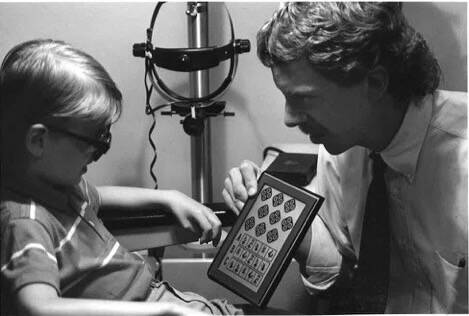
David Kirscher, an optometrist at Island Family Eyecare, is retiring in February, bringing to a close a roughly 40-year career in eye care.
Kirscher grew up in Salem, Oregon, and graduated from Pacific University in 1986 with a Doctor of Optometry (DO) before later working at a practice in Tacoma for roughly two years under a handshake agreement, after which he would purchase the practice. After the agreement fell through, Kirscher left Tacoma and worked as an optometrist at various Seattle-area practices.
An optometrist at a Lynwood LensCrafters knew the owners of a practice hiring on Bainbridge Island called Vision Connection, now called Island Family Eyecare, and recommended he apply. Kirscher hadn’t been to Bainbridge Island before and agreed to interview for a job towards the end of 1988. He soon was offered a job and described his experience as having jumped headfirst into the role, describing Bainbridge as a lovely place to be with access to good schools and Seattle. On April 1, 1991, Kirscher took over the practice, and he often worked six days a week during the 1990s into the early 2000s, he said.
Prior to optometry school, Kirscher debated going into photography or optometry school. “The way I played it out in my head is to do photography was going to take a four -year undergraduate, two-year master’s course, and then a couple years of apprenticing somewhere, and then, if I’m really, really good at it, I might actually make money and converse,” he said. “I figured, well, if I do optometry, I can get it done in eight years, and I’ll be able to afford photography,” he said.
In the early 2000s, Kirscher brought optometrist Scott Brase on as an associate, before later becoming partners, and in 2024, Brase bought the business from Kirscher.
“I’ve been working two days a week as an employee, and not having to deal with business, taxes, payroll and hiring. I just go to work. I just go do what I love, which is seeing people, doing optometry stuff,” he said.
Kirscher said he’s going to miss the community relationships he’s built with his patients over the years.
“There’s certain things, for instance, glaucoma is a disease you have to see people every three or four months. And so I’ve got a bunch of patients that I’ve been seeing a lot for over the last (few) decades or so. I’m going to miss that part of just having the people that I know so much. So for the last few weeks, last month or so, I’ve been getting lots and lots of hugs from patients, which is really kind of good and sad at the same time,” he said.
Kirscher said he enjoys providing personalized service to each of his patients.“ I do one at a time, so I get my half-hour or 40-minute time slot and get to discover and find out about every person. My first question with a new patient is, what do you do? They always look at me funny…I try to figure out what I call the visual demands, and then I try to set up my exam so that I’m going to try to make that process, whatever they do, easier. So I’m big on what I call easy vision. There’s clear vision and there’s easy vision,” he said.
The longtime optometrist estimates he sees roughly 10-15 patients over the course of an average day. One notable patient interaction surprised him, adding, “I had a patient come in…and she insisted her husband come in, and her husband walked in, and everybody in the office just stopped. It was the professor from Gilligan’s Island, Russell Johnson, and so I got to know him really well over the years, until he passed away,” he said.
Kirscher said retiring carries a bittersweet feeling, adding, “It’s all about relationships. So that’s the part I’ll miss. But making decisions for people, I think I’m done doing that,” he said.