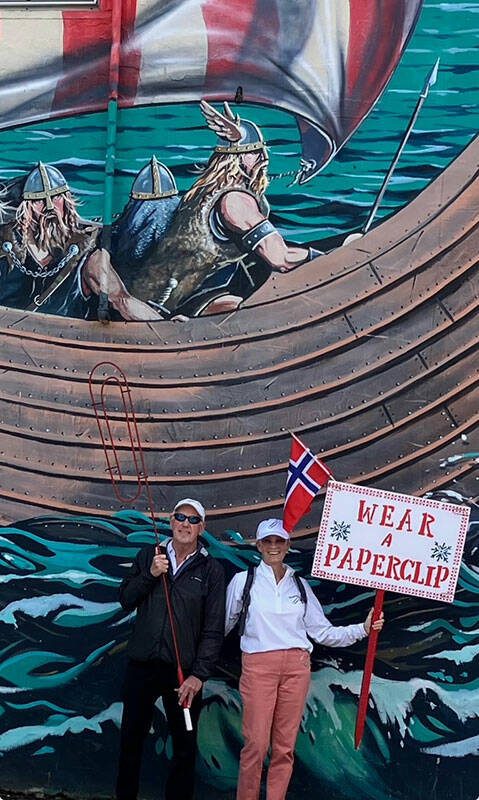
It’s a simple symbol for a simple message: no hate, and no kings.
Bainbridge Island residents Janice and Ollie Pedersen, founders of Hazel Creek Montessori School, have taken inspiration from teachers who stood up to the Nazi occupation of Norway and revived the humble paperclip as a symbol of resistance to fascism.
At the upcoming pro-democracy protests around the country Jan. 6, they want to “Paperclip the Nation” — to see people participating in those protests sporting a paper clip.
“That day has the stigma of division, and we want to replace that with the idea of coming together — Republicans, Independents, Democrats, non-believers, believers,” said Janice Pedersen. “The paper clip certainly symbolizes binding us together so that we can restore and rebuild a better democracy.”
The couple is of Norwegian descent and remains culturally connected to the country. They have visited many times, and were married at Poulsbo’s Sons of Norway hall in traditional Norwegian dress. Ollie Pedersen has also long been an active protestor of government overreach, including teaching transcendental meditation to Vietnam War veterans.
The Pedersens’ vision of the revamped Paperclip Resistance is one of a grassroots effort focused on rejecting authoritarianism globally, they explained. They’ve heard from Paperclip Resistance groups formed in Paris, France; Florence, Italy; Australia, Portugal, Canada, and in the movement’s country of origin, Norway, said Janice Pedersen.
However, it’s key to demonstrate unity at the state level, they added.
To do that, part of their Jan. 6 “Paperclip the Nation” effort will include a video of 50 people from each state, each holding signs featuring the outline of their state with a paperclip, captioned with the name of their state and the word “resists,” explained Janice Pedersen.
Locally, they already have several people who were not born in Washington registered to represent their home states, Janice Pedersen added.
“We find that anytime we knock on a door and there’s a crack, we try to get through the door, but if we can’t, we just go around it, and we just keep marching, because the feedback that we get from this act of wearing a paper clip makes people cry,” said Janice Pedersen. “It gives the elders something they can join in on without participating in a protest; it’s just unbelievable, the thousands of messages we get from around the country, from people that are doing this. It’s joyful. It is such a kick in the pants, because people wear them in such funny ways.”
The origin of the paperclip as a symbol of anti-fascist resistance came from the Nazi occupation of Norway during World War II. In 1942, Nazi-aligned prime minister of Norway Vidkun Quisling attempted to force the nation’s teachers to pledge fealty to the German occupation and include pro-fascist dogma in their lesson plans.
About 90% of the 14,000 teachers nationwide refused, choosing to continue teaching from home or in private lessons. In response, the Norwegian government began to put pressure on the teachers; it withheld the salaries of about 10,000 educators and arrested about 10% in an attempt to force them to return to work. If the teachers refused, they were sent to concentration camps.
“These teachers were rounded up into freezing cattle cars and sent to concentration camps, where they were denied food and forced to crawl through snow, march miles in darkness while being beaten, and perform hard labor,” wrote the United States Holocaust Museum on its website. “People rallied behind the teachers, despite the danger of public shows of support. As the train cars carried teachers toward torture, local residents gathered along the railroad tracks to lift their spirits with songs and gifts of food.”
To demonstrate solidarity in the face of fascism, teachers and students would wear paper clips on their lapels or link together to form necklaces and bracelets.
As teachers with Norwegian and Jewish roots themselves, this resonated deeply with the Pedersens, the couple explained.
“The biggest reason for starting the Paperclip Resistance for me was, when they started to describe what they were going to do to the Department of Education and banning books and such, and how they were treating people, I thought, ‘This is a total annihilation of what I have stood for my entire life,’” said Janice Pedersen. “My entire life’s work in teaching children about being kind, empathetic, inclusive, and so that was my biggest impetus to stand up.”
Ollie Pedersen agreed.
“It is such a different political environment than what I grew up with […] and [Trump] just represents something that is just so contrary to everything that I believe in and that I strive for in my own life, and try to teach others to follow,” said Ollie. “This was a very simple thing for me to formulate in my own heart and mind, that we were going to come out strong.”
So far, the Pedersens have connected with other anti-authoritarian groups like Indivisible Bainbridge and the Kitsap branch of 50501, as well as institutions like the Children’s Holocaust Museum in Tennessee and influential individuals like journalist E. Jean Carroll.
The visibility of the movement has led to some touching moments: people sometimes weep when they share the story of the Norwegian teachers, the Pedersens said, and many embrace the symbol wholeheartedly when they encounter the couple at protests. But their work is ultimately about motivating people to stand up in their communities and at the ballot box, the Pedersens explained.
“We’re hopefully going to reach 50 to 100 million people, and encourage them to start to participate in whatever way — even the silent people, even the apathetic people — to don a paper clip and psychologically engage them in this whole democratic process,” said Ollie Pedersen. “Obviously, the end result that we’re looking for is for people to engage to the point where they cast their vote, because that’s what really is going to make the final difference here.”