
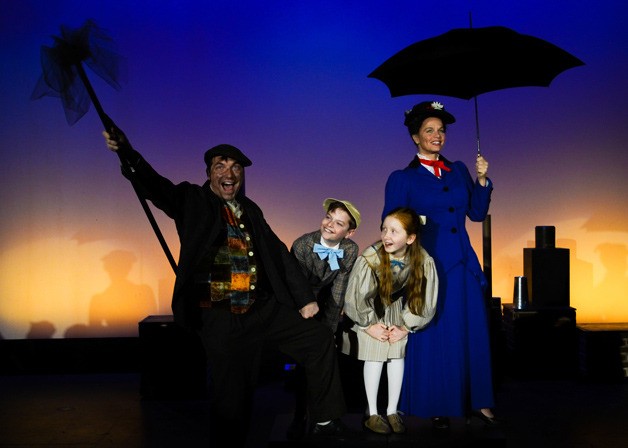
One of the most recognizable silhouettes of the 20th century is set to step under the lights of the stage next month at Bainbridge Performing Arts: a slim woman in a sensible hat and heeled boots, umbrella and large handbag in tow.
She just flew into town.
The heart-warming holiday production of “Mary Poppins” will run 7:30 p.m. Fridays and Saturdays and 3 p.m. Sundays from Friday, Dec. 4 through Sunday, Dec. 20 (except Saturday, Dec. 5, which will be a matinée). A special Pay-What-You-Can Preview will be held at 7:30 p.m. Thursday, Dec. 3, and the opening night reception will run from 6:30 p.m. Friday, Dec. 4.
Portraying the “practically perfect” titular nanny is Lisa Mandlekorn, who leads a cast showcasing the talents of both BPA newcomers and returning favorites, including Luke Walker, playing the role of lovable chimney sweep Bert (the character originally made famous by Dick Van Dyke in the classic Disney movie version); Shannon Dowling and Matt Eldridge as the troubled Mr. and Mrs. Banks; and Sophie Eldridge and Quinn Liebling as their notoriously difficult children.
 Based on the book series by the creative curmudgeon P.L. Travers and the classic Walt Disney film, Disney and Cameron Mackintosh’s original musical stage version of the story delighted Broadway audiences for more than 2,500 performances and ultimately received nominations for multiple awards.
The BPA version is helmed by director Ken Michels, known to island audiences for his past productions of “Monty Python’s Spamalot,” “Avenue Q,” “The Full Monty,” “The 25th Annual Putnam County Spelling Bee,” “Shrek: The Musical” and “The Santaland Diaries.”
The story has become so much a part of our pop culture subconscious, Michels said, that many people often “take it for granted” and forget some of the more serious undertones of the story behind all the exciting dance numbers and beloved songs.
“It’s the story of a family realizing that it’s [family] that matters in life,” he explained. “What drew me to it was the story of the family, of the rediscovery of their love.”
It’s ironic, the director said, that such well-known and cheerful material has come to be what we all think of when thinking of “Mary Poppins,” when, in truth, the original source material was a bit edgier.
“It’s interesting because this version of it tends to go back to the books more and tells more of the story of the family,” he said. “The reason why Travers didn’t like the [Disney] movie was because it kind of made everything bright and happy and silly.”
Travers — whose rocky relationship with Walt Disney was well-chronicled in the film “Saving Mr. Banks” — was not a warm person, Michels said.
“Her life was dark,” he said. “Her life was hard.
“It took [Disney] like 15 years to get her to agree to the movie because she knew it would be all color and Disney-fied,” he said.
The stage version, Michels said, instead focuses more on the actual, relatable troubles of the family and also more on the character of Poppins herself.
“The kids are just doing whatever they want and the father’s in his own world because he’s got the weight of the world on his shoulders and it’s more of his redemption story than anything,” Michels said.
Mandlekorn, with her operatic background, was able to perfectly mix Poppins’ prim poise and demanding diva-like attitude, Michels said.
“Not only is she wonderful for the role, but she’s very well-liked in the community, too,” he said.
Walker’s depiction of Bert, meanwhile, is an extremely physical role, constantly in motion, he added.
“Luke’s wonderful,” he laughed. “Luke is a natural, no-holds barred actor.”
Alongside such a colorful cast, one might think it easy to lose the Banks kids in the shuffle, but Michels said that Eldridge and Liebling were more than holding their own on stage.
“The kids are brilliant,” he said. “This is their show. I needed two very strong kids to carry the show.”
The story famously straddles two ages, BPA musical director Josh Anderson explained, and takes place in the transitional time between the Victorian age in which Mr. and Mrs. Banks grew up, and the quickly-arriving (and significantly lighter-hearted) Edwardian age. It’s a transition perfectly exemplified by Poppins’ introduction of Bert to the children. Bert’s a colorful, working-class everyman who the kids would never have deemed appropriate to socialize with before, and even the musical changes which accompany Bert’s dealings with the children, Anderson said, subtly imply change and freedom.
“There’s this constant interplay between the structure and rigidity of that colonial way of thinking with this new, fun world,” he said. “Anytime that Bert’s on stage, the piano starts doing this almost ragtime stuff. That’s sort of giving a premonition of what’s to come, this idea that the modern is really fun and the traditional is not fun, I think that’s the focus and the reason that it continues to be appealing to people.
“I think the appeal of ‘Mary Poppins’ has continued because we’re constantly struggling with that idea of changing and adapting to a new way of interacting with each other,” he added. “We take great comfort in the structure and rigidity, but we have to open ourselves up to this idea of magic or something new in the end.”
Up, up and away
What: Bainbridge Performing Arts’ holiday production of “Mary Poppins.”
When: 7:30 p.m. Fridays and Saturdays and 3 p.m. Sundays Friday, Dec. 4 through Sunday, Dec. 20.
Where: BPA (200 Madison Ave. North).
Admission: Tickets — $27 for adults, $22 for seniors and $19 for students, youth, military and teachers — may be purchased online at www.bainbridgeperformingarts.org, by phone at 206-842-8569 or in person at BPA.
