Wee sheets to the wind
Published 8:00 am Saturday, February 12, 2005
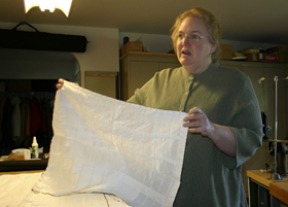
A model of the Discovery boasts sails crafted by Susan Goodwin.
The project took good eyesight, steady hands, strong thread and lots of patience.
For three years now, islander Susan Goodwin has been making the sails for a 14-foot, museum-quality model of Capt. George Vancouver’s famed ship, Discovery.
After hundreds of hours of meticulous sewing, the 11 sails she made – crafted from 16th century blueprints – are now being rigged aboard the miniature vessel at its Seattle display.
“For 22 years, I worked on great big sails,†said Goodwin, former owner of Port Madison Canvas Company. “And now I am finishing work on these tiny ones.â€
The model ship is being built at the Discovery Modelers Education Center, inside the Armory building at South Lake Union Park. Goodwin and the team that built it hope that it will become a key exhibit in a future maritime museum planned in Seattle.
The completed model of Discovery, rigged and ready for display, will be unveiled during the 27th Annual Lake Union Wooden Boat Festival on the July 4th weekend.
Goodwin’s labor on the Discovery – hundreds and hundreds of hours of work – was filled with many smaller discoveries about the intricacies of sailmaking three hundred years ago.
Fabric back in Vancouver’s day was woven to only 24 inches wide, which required considerable patchwork to make sails big enough to catch the wind.
Goodwin simulated that look by making a checkerboard of tiny seams on the sails, not an easy feat on the linen fabric.
The work was so intricate that the big commercial sewing machines in her workroom proved worthless. However, she discovered that the 1940s-era sewing machine she inherited from her mother was ideally suited to the task.
“Even with all the industrial machines in here, it still has its place,†she said of the vintage Singer.
She choose linen rather than cotton for the sails with longevity in mind, since the Discovery model is intended to last 100 years or more.
After breaking lots of thread, she found a strong variety used for binding archival books, which had to be imported from Belgium.
Big sails have big grommets to hold the ropes for rigging. But the Discovery model’s little sails required tiny grommets – an eighth of an inch wide – which were glued and then hand-sewn onto the fabric.
And then there was the matter of color.
The white linen looked too pristine for as hardy a vessel as Vancouver’s British Royal Navy ship, which sailed from 1791-95, surveying the Pacific Coast from Monterey, Calif., to Cook’s Inlet, Alaska.
Goodwin dyed the sail fabric tan, discovering that the black thread along the edges bled; she had to bleach the fabric and start over. The tan she ended up with has a nicely aged look.
Goodwin, who has sailing in her blood, became a member of the Discovery team serendipitously. She met one of the model builders when she sought his help with the repair of several ship models made by her father decades earlier.
“I found a man in Black Diamond to do the restoration, and he told me about his work on the Discovery,†she said. “He was doing the rigging, and he had no one to make the sails. I mentioned that I used to work as a sailmaker, and his eyes lit up.
“He had done such a wonderful job for us, I decided to volunteer.â€
The job took far longer than Goodwin thought, but she believes that the finished result will be well worth the effort.
She hopes that Bainbridge residents will go see the ship, and support the efforts to start a maritime museum in the area, particularly since Capt. Vancouver’s voyage brought him to Bainbridge Island.
The British Royal Navy officer sailed into Puget Sound in 1792, and anchored on the tip of Bainbridge Island. He named the spot Restoration Point for King Charles, who had been “restored†to the throne of England, according to the Kitsap County Historical Museum.
“Amazingly, we don’t have a maritime museum here yet,†Goodwin said. “I’d like to try and generate some excitement for the idea.â€