
Future may ride on big magnets
Published 9:00 am Wednesday, December 13, 2006
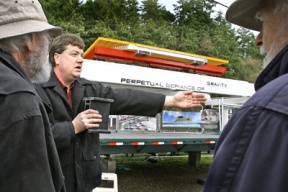
New LEVX train technology is touted for the cross-island corridor.
After 26 years in the magnet business, Jerry Lamb knows well the laws of resistance.
Resistance, after all, is mechanically integral to LEVX, an emerging magnetic train system developed by Lamb that – as he will freely tell you – could one day revolutionize mass transit, or slide silently into obscurity.
But vital as it’s been to LEVX’s development, resistance has also stymied its progress. At the thought harnessing a force more commonly at work on the average refrigerator door, some are wont to snicker.
“It’s tough when you’re trying to push something new,†said Lamb to a small assembly of curious onlookers at a LEVX demonstration alongside state Route 305 near the Clearwater Casino this week. “People are afraid of change.â€
Whether such fears will ultimately derail the future of LEVX remains to be seen. Propelled by any number of energy sources, but most likely battery, LEVX was developed by Lamb five years ago in his Port Angeles laboratory to be a cheaper, more energy efficient form of mass transit.
Magnets embedded in the rails enable train carriages to levitate as they move across a fixed guideway toward their destination.
The ride – enabled by the resistance of opposing polarities – is designed to be smooth, quiet and vibration-free.
Though LEVX hasn’t yet been implemented anywhere and thus hasn’t endured prolonged testing or everyday commuter use, it has been targeted by transportation planners as a possible solution to traffic woes on a route that has seen increasing traffic volumes in recent years, highway 305.
At a recent series of meetings, a group tasked with easing congestion along the corridor cited LEVX, along with bus rapid transit, light rail and reversible transit lanes, as an option.
The group will make its final recommendation next spring, at which time discussion would turn to funding and logistics.
If LEVX is able to overcome numerous hurdles – foremost among them public and political skepticism – some fourteen miles of elevated track could one day cast shadows on passing islanders below.
The still-evolving route would connect the ferry terminal to Poulsbo, stopping at Day Road, the Clearwater Casino, downtown Poulsbo and Olhava, with future options to splinter out into the surrounding landscape.
Carriages would run frequently, shuttling 25 to 30 passengers at a time at speeds of 40 miles per hour some 20 feet above the ground along the line.
The tracks – there would be two, each able to accommodate travel in either direction – would require a footprint about 20 feet wide that could be turned into a non-motorized trail.
At an estimated $12 million a mile, the tracks alone would cost about $172 million after installation. Carriages, of which 25 or 30, would cost an additional $22.5 million. That’s a bargain, says Lamb, adding that similar technologies elsewhere can cost upwards of $80 million per mile.
“Cost is everything,†he said. “People can look at the technology and say ‘wow that’s really cool,’ but what it really comes down to is money. What people want to know most is can they afford it?â€
Lamb believes they can, saying the relative simplicity of the technology allows him to minimize costs. Tracks are made of a plastic fiber composite that is cheaper than steel or aluminum, and more flexible. Parts are designed “like Legos,†to allow for quick installation while avoiding the expense of customizing the system to fit specific terrains.
Ideally, Lamb said, it would take about a year to lay track along the 305 corridor.
“Once this gets going, I want to build about a thousand miles a year,†he said.
Lamb was quick to point out that LEVX isn’t new; it’s been hovering in the background for some time. But with its continued development and inclusion in the 305 corridor study, buzz surrounding the idea as a local option has steadily grown.
An important consideration for some is how a transit system that aims to quickly move passengers off the island might impact local businesses, many of which could be bypassed by tourists in favor of those in Poulsbo or elsewhere.
“ConcepÂtually, it’s an alternative worth considering,†said Bainbridge Island Chamber of Commerce director Kevin Dwyer. “But there are so many ifs right now. I’d have to see what it would really look like to know how it might impact local business. I do think it’s important to improve ferry traffic.â€
Though skeptical at first, Bainbridge City Councilman Bill Knobloch has since become one of LEVX’s staunchest supporters, working with Lamb to promote it.
“It’s passed every test so far,†Knobloch said. “Our biggest interest is in providing an alternate means of mass transit for local residents while also improving the movement of ferry traffic off the island.â€
He acknowledged the skepticism surrounding LEVX.
“The claims need to be thoroughly investigated to make sure it’s viable,†he said. “But this technology is beginning to take off and we don’t want to get left behind.â€
Public education, he said, will be a must if LEVX is to overcome the skeptics. Equally vital is the construction of the first LEVX system, set to break ground next year at a resort in Mississippi.
Before the 9.2 mile track can be built, LEVX must undergo its most rigorous safety tests.
If it passes, two different systems would be built on the property. One line would shuttle passengers at about 20 mph to destinations within the resort; the other would move at 70 mph between the resort and the airport.
Lamb said LEVX is drawing interest internationally, including from groups in Asia and the Middle East, who he says have been more open to the technology than their American counterparts.
“It’s funny because they really seem to get it even though they’re the ones selling us all the oil,†he said. “But a lot of people in this country are apprehensive. I have no fears about it. I know it works.â€
Following Monday’s rain-soaked, blustery demonstration at the portable LEVX display near the casino, some were less than impressed.
Heads swerved slowly from side to side, mimicking the contraption as it glided back and forth across the track to the accompaniment of Lamb’s enthusiastic explanation.
“Who are you,†said one man. “Why are you doing this? And who’s paying for it?â€
With a smile, Lamb replied that the technology has thus far been funded privately, to the tune of $3 million.
Another man whipped out a small device to measure the magnetic field created by the track, arguing that it could damage electronic devices, like computers.
“It’s harmless to computers,†Lamb said.
The man smirked.
“You have to be careful with things like this,†he said.
Some were more receptive, like Jim Nardo Jr., a machinist from Poulsbo, who said he heard about LEVX through a Poulsbo City Council member and has followed the technology ever since.
“I’m into this big time,†he said. “I’m ga-ga over it. People just need to give it a chance.â€



Best of Bainbridge
