
Council gives up $450K for Grow Ave.
Published 6:00 pm Saturday, October 28, 2006
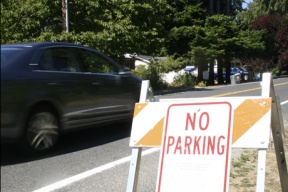
Public Works is told to return a state grant, after neighbors reject the project.
A half-million dollars in street upgrades, for free.
It’s a pretty enticing offer – but not enticing enough for the Bainbridge Island City Council and the residents of Grow Avenue.
The council on Wednesday rejected a $450,000 federal transportation grant earmarked for Grow Avenue pedestrian and bicycle improvements.
The grant, as part of a larger $605,000 project, would have built a non-motorized pathway separated from auto traffic, funded a new drainage system and a widened a shoulder through the west Winslow neighborhood.
But many Grow residents say the project, as presented by city engineers, wouldn’t do enough.
The plan fails to slow traffic and restrict on-street parking and does not meet the neighborhood’s standards for environmentally-sensitive drainage or tree retention, according to residents.
Members of the city’s Non-Motorized Transportation Advisory Committee, who also opposed the project, doubted whether the project met nationally recognized transportation standards.
“The question you should ask is not, ‘can we afford to give up this money,’ but ‘can we afford to accept it,’†Grow resident Kathryn Hjerrild told the council on Wednesday.
Had the council accepted the grant, Grow residents said, the city would have steamrolled a neighborhood vision crafted through a two-year collaborative process.
“There would be a huge cost to goodwill,†Hjerrild said. “You’d take years of community work and flush it down the toilet.â€
But City Engineer Bob Earl said that the plan “was entirely compatible with the community’s vision†and was “the best (the city) can do at this time.â€
The grant was “project-specific†and can not be transferred to other non-motorized transportation efforts by the city.
Public Works staff say the project plan cannot not be reworked in time to meet the grant’s mandated March 2007 construction start date.
Over the last two years, the city spent about $105,000 on consultants who designed the Grow Avenue project and helped lead the public involvement process. The city also spent the equivalent of $10,000 in staff time overseeing the project, according to city records.
Responding to criticisms of the plan, Earl stressed that the project would mesh easily with future traffic upgrades and would not “degrade†drainage systems or water quality.
Public Works Director Randy Witt, also responding to concerns, bristled at the suggestion that the project fails to meet government and American Association of State Highway and Transportation Officials (AASHTO) standards.
“We are using AASHTO standards,†he said. “There’s no ifs, ands or buts about it. Period.â€
But the council sided with Grow residents, opting to not force a project on a neighborhood clearly opposed to it.
“It’s not an easy decision,†said Councilman Kjell Stoknes, referring to the loss of the grant. “But it’s not hard either. I’m not going to destroy your neighborhood for $450,000.â€
Councilwoman Debbie Vancil said the grant was the third the council recently faced that “they clearly were not jolly about.â€
The council in 2004 rejected a grant for Winslow Way upgrades, when the project funding was judged incompatible with a Winslow Tomorrow timeline.
Councilman Bob Scales, who joined Chris Snow in supporting the grant, said he doubts Grow residents will get a better deal in the future.
“All the bells and whistles are great if you’ve got the money,†he said. “But I don’t see the city spending $2 million (to make) Grow a model street.â€
Sending the money back puts improvements on Grow back to square one, according to Witt.
“We were marching down with what the council and the community wanted,†he said. “All that work stops.â€
Grow residents have complained to City Hall about traffic on their street since at least 2000, when several residents monitored speeds from the roadside with a radar detector. The street was first identified for work by the non-motorized committee in early 2004. The council funded the proposed upgrades, with money from city and federal sources, in the 2006 city budget.
Sending the grant back may put future federally-sponsored efforts at risk, officials said.
The federal government “would rather give grants to cities that actually use them,†Scales said. “Our credibility is at stake because we keep returning grant money.â€



Best of Bainbridge
