Pretty on the plate, tasty on the palate
Published 6:00 pm Saturday, August 5, 2006
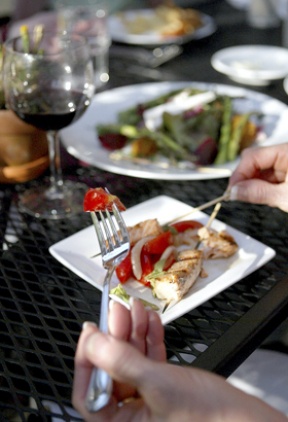
Organic, locally grown produce reaches its final destination: your dinner table.
◠This is the third and final installment of the “Earth to Plate†series, following the path of local produce from the island’s fields to the island’s consumers.
Justin Coleman pushes up his white linen sleeves, grabs a tomato, a knife and begins a play-by-play of the action on his cutting board.
“First, I add some organic, local oregano that I took from my garden this morning,†the said, sprinkling the finely chopped herb over sliced tomato. “Then, some sweet onion that really complements the tomato…I put that in the bowl…then a little extra virgin olive oil…and then aged balsamic vinegar, which is very, very nice. And then I throw in a pinch of salt and some pepper.â€
He spins the bowl around.
“Really nice.â€
The simple salad is just one way the Cafe Nola chef puts Butler Green Farms’ produce to work.
“Whatever I need, I give a phone call and I get it that day,†he said of his daily relationship with grower Brian MacWhorter and his Lovgreen Road farm. “I get their English cucumbers, their green beans. Their organic greens are amazing. People go crazy over it.â€
On this evening’s menu, a small box of tomatoes – plucked from the vine just hours before – tops the Winslow Way restaurant’s menu.
He’ll cut a handful of red “stupice†tomatoes, a Czech variety, to surround the special of the day: grilled and skewered Alaskan salmon.
“I use the tomatoes all kinds of ways. But my favorite is like this,†he said, slicing off a generous wedge and shoving it into his mouth. “That’s the best.â€
Over a year, the Butler Green Farm typically sends over a thousand pounds of tomatoes to Cafe Nola, where odd heirlooms such as the stupice, the bulky “brandywine†and the exotic “green zebra†are served up for hungry islanders.
Nearly all of the 23-year-old farm’s produce stays within the island’s shores, forming a “closed circuit†between producer and consumer. While the farm’s tomatoes doesn’t travel far from the field, the fruit seems to transport taste buds to a distant place.
“It takes me back,†said Wendy Northcutt during her weekly produce pickup at Butler Green Farms. “I was raised in the Midwest on a dairy farm. My family had an incredible garden. Since I moved from home, I’ve never gotten to taste tomatoes like I had then. But I get that taste here.â€
Asked to describe the taste, Northcutt is quick with her answer: “It tastes like a tomato.â€
It’s not for lack of imagination that Northcutt says this. It’s more that the majority of tomatoes available today lack flavor, body and character, she said.
“It’s fresh, and you can tell the difference,†she said. “It hasn’t spent a few days shipping, and then sat forever on a shelf.â€
Town & Country Market produce manager Bob Luttrell, who lines his aisles with a variety of Butler Green’s goods, echoes Northcutt.
“What do the tomatoes taste like? Well, they taste like tomatoes used to taste,†he said. “There’s something about them. They’re not hard, not mushy but they have a crunch and a sweet taste. They’re hard to describe, but I get nostalgic when I eat them.â€
Butler Green’s tomatoes harken back to a day when produce was bred more for pleasure on the palate than storage on pallet boards, according to many of the farm’s customers.
“The tomatoes in stores don’t look like tomatoes and the flavor is totally different,†said Carolyn Appleton as she perused the offerings in Butler Green’s produce shed. “You take a bite of these and it’s a flavor explosion.â€
It’s also better for you, said MacWhorter who greets each of his regulars at the shed’s entry.
“More vitamins, more minerals,†he said. “That’s why it’s good for you and why it has flavor.â€
His customers nod in agreement.
Veggie fans
These are not Butler Green’s occasional shoppers or farmers market browsers. They are the farm’s faithful, who buy “shares†in MacWhorter’s annual harvest.
More than 130 of them drop by each Thursday to stock up on a week’s worth of tomatoes, vegetables and fresh eggs.
The shed’s a far cry from the brightly lit aisles and pyramid stacks of produce typical at supermarkets. The Cars’ “My Best Friend’s Girl†rattles out of an old radio while Butler Green’s interns restock produce arranged in bins and wood shelves.
A blackberry bramble creeping through the door frame occasionally catches MacWhorter’s baseball cap as he paces the shed, checking his supply and welcoming the recently-arrived.
Butler Green’s farm share customers are drawn from a cross section of the island’s population: a municipal court judge, a candidate for the state Legislature, a city councilwoman, an actor, a nurse, a baker, school teachers, landscapers, real estate agents and construction workers stop by every week to load up.
They chip in a sizable sum: $500 for a 25-week supply. Purchased one at a time, Butler Green’s tomatoes can run from between 50 cents for a tennis ball-sized “slicer†to $8 for a large heirloom. But for MacWhorter, these are the “true†costs for quality food.
The price of organic produce has dropped in recent years, as larger companies buy in to the organic market. Some small-scale, pesticide-free growers, like MacWhorter, have sold out to the large food corporations in recent years.
The Skagit Valley-based Cascadian Farms, which was picked up by the $18 billion food giant General Mills, is now featured in supermarkets across the country.
Cascadian Farms’ founder has heralded his company’s growth – and the in-turn cost reduction to consumers – as moving “organic†beyond the confines of “yuppie food.â€
MacWhorter bristles at such talk.
“That touches a nerve, because you’re talking about the destruction of the family farm,†he said.
The number of American farms fell dramatically after its peak of nearly 7 million in 1935, according to the U.S. Department of Agriculture. By 1997, only 1.9 million farms remained.
The amount of farmland, however, did not decline as agribusinesses consolidated and automated farms, using industrialized techniques to produce on an epic scale with fewer farmers.
MacWhorter says “scaled-up†organic food produced in the industrialized model may meet a government-approved standard, but falls far short of the “organic movement†he was a part of in the late 1970s. It was then that a farm’s size, location and ethic were just as important as eschewing pesticides and chemical fertilizers.
MacWhorter’s customers appear to buy into this philosophy as much as the taste of his tomatoes.
“It’s nice to see somebody on this island making a living from farming,†said farm share customer Tammy Melby as she walked to her car with a brown bag full of beets, carrots, peppers and fennel. “Obviously, (MacWhorter) does it because he loves it.â€
Longtime customer Katy Wing, who has been slicing Butler Green tomatoes on toast for years, said the cost of island produce helps pay for much more than the fruits of MacWhorter’s labor.
“I like having agriculture on the island,†she said. “It’s more than having fresh food to take home. It’s the ambiance, being able to go to the farms and pick berries every year. I love that. That’s the main thing for me. The island’s grown a lot over the last 20 years. If I don’t shop here, I know they won’t be here. The farms will be torn out and they’ll shut it all down.â€