
A Pavilion of Remembrance
Published 3:00 pm Saturday, September 30, 2006
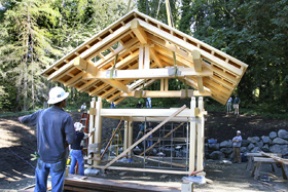
Master craftsmen lend their skills to the internment memori al project.
From a glistening beam, streams of cedar confetti fluttered to the blue tarp below. They gathered in the shoes and beards of the workers and in piles, like shredded cheese, around the legs of sawhorses arranged neatly beneath the work tent.
Through the flurries, members of the Timber Framers Guild worked on mostly in silence, save for the occasional chuckle or mumbled direction. They hammered and planed and lugged timber across freshly turned earth.
And though not oppressive, the atmosphere was mostly stern as workers from across the continent descended on Pritchard Park to be a part of early construction at the Japanese InternÂment Memorial.
“This is a great project,†said Armistead Lucas Coleman II, a fourth-generation islander. “This is big, not just for our community but for all Japanese-Americans.â€
Some 30 craftsmen over the past two weeks lent their talents to the first phase of the “Nidoto Nai Yoni – Let it not Happen Again,†memorial. Sixty-four years ago, on the same shady hillside where the guilders now practiced with precision their ancient craft, 227 Bainbridge Islanders were the first of more than 120,000 Japanese Americans to be exiled from the West Coast during World War II.
In remembrance, the workers last week erected two ornamental gates as part of a workshop in which guild members got a chance to hone their Japanese carpentry techniques.
The gates resemble the memorial entry gate – previously designed, built and donated by the guild – that is now located outside the Winslow Post Office. This week, the guild’s focus turned to a 15-foot-tall informational pavilion that now adorns the center of the property.
The guild became involved with the memorial after master timber framer John Buday was introduced to Japanese carpentry during a conference in Monterrey, Calif., two and a half years ago. Afterward, Buday wanted an opportunity to use Japanese skills.
“It’s a good deal more refined,†he said of the differences between Japanese and Western woodworking. “Western stuff tends to be a bit more prosaic and practical.â€
Serendipitously, the Bainbridge Island Japanese American Community was still in the early stages of planning the memorial. Buday contacted the organization and the partnership was born. Consistent with Japanese techniques, the gates were pieced together using a minimal number fasteners. The pavilion, on the other hand, intentionally avoids a traditional Japanese look.
“We don’t want the message to be lost that these were Americans,†he said of those who were forced from their homes.
Buday said the guild members not only enjoy the work but have a great deal of respect for the purpose behind their labors.
Allan Peoples, a retired phone company employee and longtime woodworker from San Francisco, was among those who traveled to the island to help. He said he admired the cause and was grateful for the chance to learn.
“They’re teaching us things you can’t read in books,†he said as hammer met chisel with a thud.
Meanwhile, as guild members worked in tribute on what has already become a revered island monument, Fumiko Hayashida stepped into and equally hallowed building across the country in hopes of emboldening their efforts.
Hayashida, 95, is the oldest surviving Japanese American taken from Bainbridge to Manzanar Relocation Center in March of 1942. On Thursday she told her story to Congress in support of legislation introduced by Congressman Jay Inslee, a Bainbridge Democrat, that would include the new memorial in the national park system.
“I hope to live long enough to see the Bainbridge Island Japanese American Memorial earn the honor and recognition from our federal government and become a unit of the national parks service,†she said.
“Please act quickly so that Americans can learn from and remember the meaning of the memorial’s name: “Nidoto Nai Yoni – Let it not happen again.â€
At the hearing, Inslee thanked Hayashida for making the trip from Seattle to Washington, D.C. to describe her experiences and explain the importance of passing the legislation immediately.
He said, “This is a story that needs to resonate throughout the decades. We need to ensure the power of fear never again overcomes the promise of liberty.â€
Clarence Moriwaki, chair of the island’s WWII Nikkei Internment and Exclusion Memorial Committee, traveled with Hayashida to Washington, and said her words were meaningful.
“She was great,†Moriwaki said. “She spoke from the heart and there’s hardly a person who can speak with more moral authority than her.â€
Moriwaki said Hayashida was nervous, but ultimately glad she made the trip, particularly if the legislation ends up passing.
“She had butterflies up to the moment,†he said. “But I think it finally hit her how important it was. It took a lot of courage for her to do what she did.â€
In July, Inslee and Mike Simpson (R-Idaho) filed legislation that would codify into law the results of a Department of the Interior study released this May by making the Bainbridge memorial a satellite site of the Minidoka Internment National Monument in Jerome County, Idaho.
Morawaki said he was grateful, both for Hayashida’s testimony and the efforts of craftsmen hewing history beneath a canopy of trees in Pritchard Park.
“It’s beyond description how beautiful their work is,†he said. “I think they’ve exceeded all expectations, even their own.â€
He also extended a thank you to the community for offering guild members meals and shelter during their stay on the island.
“The community really came forward,†he said. “In a way it’s a reflection of what happened during the internment. People fought for and stood by their neighbors.â€

Best of Bainbridge
