Freestyle bullfighting joins 2016 rodeo | KITSAP COUNTY FAIR
Published 11:07 am Wednesday, August 24, 2016
BY ALLISON TRUNKEY
Get ready for another big year of rodeo.
This year’s Professional Rodeo Cowboys Association (PRCA) Rodeo takes place Aug. 24-27, starting at 6:30 p.m. each night.
And despite the fact that the all-volunteer crew wasn’t allowed to start prepping the arena for the rodeo until two weeks prior, they began readying their equipment in late July.
What’s more, the list of contestants will be unknown until around the same time. Registration stays open for just 24 hours, though local rodeo director Joe Drouin says he can almost guarantee a quality pool of contestants for Kitsap.
“We’re lucky that we’re sandwiched with Puyallup and Pendleton, so the big names will be here,” he said. “Fans will see many of the top riders in the PRCA because they’re trying to qualify for the NFR [National Finals Rodeo] in December.”
To qualify for the NFR, riders must rack up prize money by entering and placing well in rodeos throughout the year. The top 15 riders in each event (the top earners) compete for the title of World Champion.
Kitsap can’t offer huge prize money, but its strategic timing and respectable purse size draw top riders who need a boost as the season draws to a close.
 It will be an exciting year for another reason – they’ve added a bonus event, freestyle bullfighting, which will take place for a maximum of half an hour on Friday only, before the regularly scheduled events.
Drouin describes freestyle bullfighting as “a timed event whose goal is to maintain control and interaction with the bull and entertain the crowd.”
But bullfighting must be dangerous, right? Drouin agrees, but says the contestants understand the danger.
“For most of these guys, this is the lifestyle they’ve grown up in,” he said.
It’s more performative than other events, even bull riding, but by nature of increased interaction with the high-powered animals, it relies on an elevated level of danger.
Freestyle bullfighting and standard bull riding come from the same tradition, but freestyle uses “rank” or “mean” Mexican bulls who will, as Drouin said, go after anyone – their temperaments are notoriously volatile.
You might think that significant training goes into a contestant’s preparation for the rodeo. And in a way, that’s true: riders often spend their entire lives training.
“But very few of them are gonna train. What it really looks like is fitness – you’ll see that many of these professional guys are talented athletes,” Drouin said.
That means, too, that many professional riders start out watching and then participating in Junior Rodeo. Youth riders compete year-round, and many practice for two to three hours a day, every day. In places where rodeo is popular, like Eastern Washington, high schools and colleges might have teams. In other cases, individuals will have private arenas where they can practice riding and roping.
Here is your guide to the rodeo’s main events:
Bareback riding (BB):
A physically demanding event for the rider, who sits directly on a bucking horse for up to eight seconds. The rider is awarded up to 25 points by each of the two judges, based on the rider’s “exposure” to the strength of the horse and his spurring technique, and up to another 25 points each for the horse’s bucking strength and moves (the rider spurs the horse on each jump, trying to balance control with style).
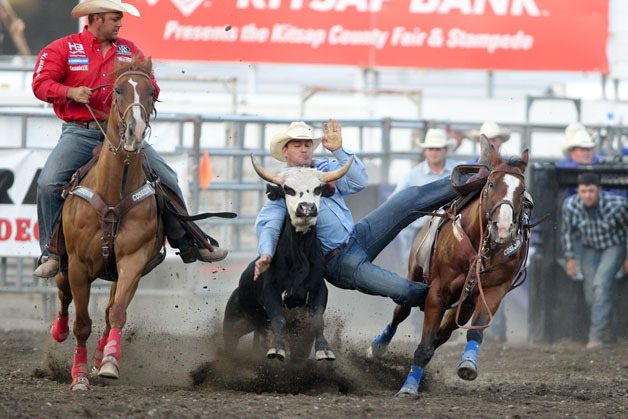
Steer wrestling (SW):
A timed event (meaning the fastest time wins) that depends on coordination between two mounted riders and their horses. The contestant and a hazer, who controls the steer’s direction, begin the event by backing their horses into boxes on either side of the steer – the contestant nods to indicate he’s ready to begin, the chute opens, and the steer charges forward, prompted by the hazer. When the contestant draws even with the steer, he dismounts his horse (moving at upwards of 30 miles per hour) and attempts to slow down the steer (usually 500-600 pounds) by grasping its horns. The contestant must force the steer onto its side and align all four of its legs in the same direction.
Team Roping (TR):
A timed event, dependent upon the precise coordination of a “header” who ropes the steer’s head or horns and a “heeler” who ropes the steer’s hind legs. This is the only event where men and women compete equally, in the same professionally sanctioned event. As in steer wrestling, the two riders begin by backing into boxes on either side of the steer – the header nods, the chute opens, and the header ropes the steer. He must “dally,” or wrap his rope around his saddle horn, and pull the rope taut to reroute the steer in his chosen direction. Then the heeler repeats the header’s process, but with the steer’s hind legs. The event ends when the ropes are taut in each direction and the mounted riders face the steer.
Saddle bronc riding (SB):
This is perhaps the best known rodeo event – the rider must maintain control of his horse for eight seconds to be scored for up to 100 points: the two judges may award 25 points each for the rider’s and then the horse’s performance. The rider begins in the chute, mounted on his horse on a specialized saddle – it has no horn and the stirrups are set forward – and nothing but a braided rope for a handhold for one hand. The chute opens, and the rider must spur in sync with the horse’s jumps, his legs kept straight as the horse comes down and kept toward the back of the saddle at the peak of the horse’s jumps.
Tie-down roping (TD, CR):
As in other events, the rider begins by backing his horse into a box beside the chute. The rider nods to indicate he’s ready, the chute opens, and the calf jumps out – the rider holds a rope in one hand and a “piggin’ string” in his mouth. He throws a loop of the rope over the calf’s head, dismounts, and attaches the other end of the rope to his horse, which stops to pull the rope taut. The rider gets control of the calf, lays it on its side, and uses the “piggin’ string” to tie together any of its three legs. Once he’s satisfied the calf is secure, he throws up his hands up and his time is flagged – he moves the horse forward to slacken the rope, and if he calf’s legs stay tied for six seconds, his time stands.
Barrel Racing:
A race in which a mounted contestant races in a cloverleaf pattern around three barrels. The rider may choose to go around the barrels in either direction, and the goal is to achieve the fastest time possible – riders are tracked to the hundredth of a second, and if a barrel tips over, a five-second penalty is applied. This is the only event where women are the primary contestants, and is administered by the Women’s Professional Rodeo Association.
Bull riding (BR):
The rodeo’s most dangerous event (beside freestyle bullfighting). The rider begins by sitting on the bull’s back, wrapping his braided rope around the bull’s girth, and looping the rope around his hand for a firm grip. He nods, the chute opens, and the bull charges out, bucking. For eight seconds, the rider must not touch any part of his equipment, the bull, or himself with his free hand. The two judges assess difficulty (the bull’s spinning, jumping, kicking, lunging, rearing, dropping, and side-to-side motion), and the rider’s degree of control; up to 100 points are awarded, based on the rider and the animal’s performance.