
CRIME, COHORTS AND RARE COINS: ‘American Buffalo’ charges into Rolling Bay Hall
Published 4:26 pm Friday, May 1, 2015
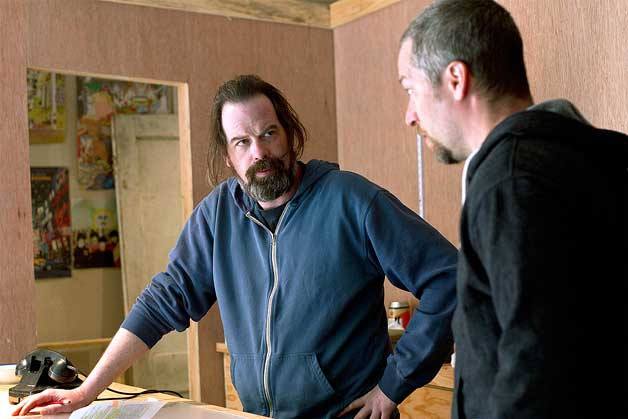
David Mamet’s “American Buffalo” begins with a failure.
The play then proceeds to spiral its trio of colorful characters into one of the most pressure-packed Friday nights in theater history.
The failure is young Bobby’s, a wannabe tough guy who does not properly keep an eye on the mark for a planned robbery at the order of Don, a junk shop owner who suspects he has been cheated when he recently sold the mark a buffalo nickel for much less than it is probably worth.
It is then that Don’s poker buddy Teach, an antagonistic schemer, enters the shop, learns about Don and Bobby’s plan to steal the coin back, and persuades Don that there’s more money to be made if they take the guy’s whole coin collection.
And maybe steal everything else he has, too, while they’re at it.
The entire play, which opens Friday, May 1 at Rolling Bay Hall, takes place in the dim, grimy setting of Don’s shop in the terse, graphic speech that is Mamet’s trademark.
Long before there was Quentin Tarantino there was David Mamet, and his deceptively simple dialogue weaves a naturalistic, instinctive tapestry of insinuation and profanity around the intimate set, which forces the audience to become complicit in the proceedings, and allows a character to speak volumes with a few well-chosen vulgarities and a shrug.
Tom Challinor, founder of the Bainbridge Performing Arts Shakespeare Society, is directing the island production of Mamet’s classic, which is being produced by Swinging Hammer Productions and staged in the Spacecraft performance space in Rolling Bay Hall (10598 NE Valley Road) from Friday, May 1 through Saturday, May 16 with shows at 7:30 p.m. on Thursdays, Fridays, Saturdays and Sundays.
Tickets are on sale now through Brown Paper Tickets; the cost is $25. Visit www.brownpapertickets.com/event/1331018 to purchase.
The would-be criminal cast is being portrayed by some faces familiar to island audiences, as well as one newcomer.
Chris Soldevilla, renowned acting coach and regular cast member of BPA’s improv group The Edge, is playing Teach and Ted Dowling, BPA regular and frontman of last year’s acclaimed production of “The Kentucky Cycle,” is Don.
Playing the part of Bobby is Jonathan Shue, a recent University of Washington M.F.A. graduate.
The play spawned a motion picture version in 1996 starring Dennis Franz and Dustin Hoffman, which the cast said they enjoyed, but did not rely on much during the planning of this production.
“Obviously, you can’t not like Hoffman and Franz,” Soldevilla laughed. “[But] I was having a hard time comparing it to the movie one.
“Mamet’s language is so specific — almost like a modern day Shakespeare thing — that, with a camera, you have the ability to break it down into bits and really perfect those moments,” he explained. “Whereas, on stage, once that ball’s rolling it’s rolling for the whole time.”
Lengthy bits of intricate dialogue and the confined space have forced an especially great emphasis on blocking and movement throughout rehearsals, both Soldevilla and Dowling agreed, all of it done, of course, to support the language for which the play is so famous.
“I think he writes men [well] in particular,” Dowling said. “The language is so natural. I think I say ‘yeah’ maybe nine times in a row at one point, but they all can mean different things.
“It sounds corny, but it’s almost like poetry at times,” he added.
Challinor said he had been reading the script with Soldevilla and Dowling off-and-on for more than a year before finally deciding to put a production together. The last piece in the puzzle was deciding who would play Bobby, who is much younger than the other characters.
Neither he nor the two leads can play a character in their early 20s anymore, Challinor laughed, and the production was lucky to find a young actor of Shue’s ability.
“He’s a giver,” Challinor said. “He’s always offering stuff.”
The more veteran actors both concurred that he was the right choice to round out the cast.
“Jonathan’s been great,” Dowling agreed.
“I actually give him credit,” Soldevilla added. “It’s like being cast in a TV show in the second season, and the whole cast knows each other and you’re coming in as the new guy, but he slipped right in prepared, ready to work.”
Though both his work and his personal politics have earned controversy, the importance of Mamet’s influence, perhaps especially in this play, can’t be overstated, Challinor said.
“It’s a new mold,” he said. “When this play came out, it wasn’t like anything else. To go mainstream with this kind of dialogue was a real shocker.”
More so even than the style, he added, the substance of the play was an indicator of things then yet to come, but which our culture is dealing with now.
“This play seems to me very prescient, 40 years ahead of its time, in dealing with the decline of the white male in society,” Challinor said. “I think he’s kind of predicted the future and that’s what good artists do.”
Dowling agreed that Mamet’s world was a unique place to inhabit as an actor, but worth the trip.
“I don’t know if he’s a modern day Shakespeare, but, as a male actor, when you get an opportunity to do Mamet it is extraordinarily challenging but extraordinarily exciting to do.”
Even today, four decades after its premiere, “American Buffalo” continues to be known as a staple of American theater and the cast of the Bainbridge production intend to revel in the show’s gritty realism and it’s delightfully shady aesthetic, Soldevilla added.
“If someone’s work in the art world isn’t creating some kind of a stir then it isn’t doing its job,” he said.
‘American Buffalo’
What: Swinging Hammer Productions’ “American Buffalo.”
When: Friday, May 1 through Saturday, May 16 with shows at 7:30 p.m. on Thursdays, Fridays, Saturdays and Sundays.
Where: Rolling Bay Hall (10598 NE Valley Road).
Admission: $25 per ticket, available at www.brownpapertickets.com/event/1331018.


Best of Bainbridge
