
PUBLIC ART CHOSEN FOR WAYPOINT: Putting out the welcome baskets
Published 11:23 am Saturday, April 9, 2016
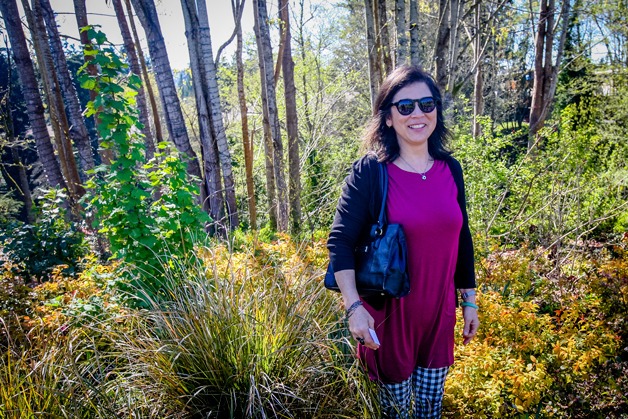
Christine Clark hadn’t been to Bainbridge but once, 10 or 15 years ago.
“I did take a ferry over, but I don’t remember why I was there,” said the Portland-based artist.
Next time, she’s not likely to forget. She’s left two massive marks behind: metal basket works, which were selected by Arts and Humanities Bainbridge to be installed at the Waypoint this autumn, as part of the city’s reinstated public art program.
Though she didn’t know it, Clark had been studying up for the job for years, reading fiction and non-fiction books about Native American culture.
“When I researched the Suquamish people, I fell in love with their fishing and gathering basketry,” Clark said.
Two stacked steel “woven” vessels are the crux of her design, staggering at 12 and 14½ feet.
“I wanted there to be something very unusual there, that caused a quick initial head-turning,” she said.
 After a site visit, she revised her design to incorporate architectural elements from the art museum — “If you stand at Waypoint and look across, it’s the first bit of civilization you see,” she explained.
On closer inspection, the baskets’ double walls will come into focus, with the inside layer displaying traditional patterns. “Indirectly, it can remind visitors that they are entering an area rich in history as well as current Suquamish tribal lands,” she wrote in her application.
The committee was pleased with Clark’s vision, her attention to the island’s “ethnic heritage,” said Sandy Fischer, the chair of AHB’s Public Art Committee.
But several pieces of that heritage were missing. Could she add other ethnic motifs?
Clark didn’t want to focus on the internment, she decided: “There’s so much of that on the island already.”
Instead, she wanted to emphasize the successful lives of the Japanese. She poured through oral history accounts and visited the memorial before picking the phrase, “Summer time we helped in the strawberry fields.”
For the Filipino element, she looked to skin and ink.
“Centuries ago, these people donned full-body tattoos, which were thought to provide magical qualities, protection and power, as well as social status in the community,” Clark explained. The practice became nearly extinct after the Spanish invaded in 1521, but, recently, it’s reemerging, she said.
The artist struggled to select a fourth group — “there were Italians, English… I just couldn’t address them all,” she said — before settling on the Scandinavians. The symbol she discovered, the Vegvisir, is a runic compass, a magical device used to aid in sea navigation.
“I like this one because Bainbridge is on the water,” she explained.
The patterning, which will go in the inside of the baskets, will be the hardest part of the project, Clark said. Especially because she doesn’t know Japanese. She’ll have to make each character out of wire, then weld it to the structure.
Because of the size of the installation — 10 to 14 feet — and her $42,000 budget, Clark will work with a fabricator to create the vertical pieces. She’s meeting with an engineer this week to discuss materials and anticipates that the bulk of her work will happen in May, June and July.
The contract, which is funded by the city’s public art fund and administered by Arts & Humanities Bainbridge, was approved at the city council’s March 22 meeting. Additional funds are being sought to enhance the installation with lighting and to cover the cost of hosting community events there.
The Waypoint, at the southwest corner of Winslow Way and Highway 305, was created in 2013 with funding from Bainbridge Island Rotary, the city and numerous private contributors.
Best of Bainbridge
