
Out of Africa, into the classroom
Published 11:12 am Friday, September 26, 2014
 Last year, Bainbridge High School teachers Brad Lewis and Jason Uitvlugt came back from their research trip to South Africa with stories, pictures and a few new teaching ideas.
This year, they returned with 14 students.
Which is good, considering that they left with 14 students.
Lewis, who teaches Advanced Placement Statistics, and Uitvlugt, who teaches Advanced Placement Environmental Science, first traveled to the Lajuma Research Center in South Africa to work with the noted Earthwatch organization as part of the Primate and Predator Project out of Durham University two years ago.
They worked closely with volunteers and scientists from the conservation group to study the effects of humans on the endangered species, including leopards, around the Lajuma Research Centre. The two spent their trip assisting scientists and visiting student researchers with predator tracking, measuring and cataloging vegetation plots, camera trapping, primate movement study and the improvement of local environmental education.
Uitvlugt said that first trip was actually quite a learning experience for himself and Lewis, and they were surprised to find how much the subjects they teach were truly applied in the field. Treating that trip as “reconnaissance,” the teachers began to work out the feasibility of returning with some students.
“I can say ‘Oh yeah, they use this out there all the time,’ but to know exactly the real world applications of what we teach is very important for me as a teacher,” Lewis said during the pair’s return presentation last year.
A plan was made, accommodations arranged, and applications filed by interested students.
Too many interested students, in fact. The 2014 trip’s roster filled up so quickly, many students had to settle for a possible spot on the planned trip next year.
So it was, finally, in late July that 14 interested, lucky, students found themselves saying goodbye to their parents inside the international terminal of the SeaTac Airport, and setting out for the far side of the world.
“Most of them had never traveled so far and were excited and uncertain about what to expect,” Uitvlugt said. “Getting to the research site involved two lengthy flights with a long layover in the middle — a total of over 30 hours. With some of the students operating on little sleep, they eventually stepped off a bus in Soweto, a township in Johannesburg.”
The group’s first stop was the Kliptown Youth Program, where local people offer meals and education to the children of Soweto.
Next, they visited the Nelson Mandela Museum in West Orlando, the place where the South African leader lived before his 27 years in prison.
The following day, they traveled to the Soutpansburg Mountains, about 60 kilometers northeast of Johannesburg, ready to help the researchers at Lajuma Research Center.
The students learned there all about camera traps, motion sensors, vegetation plot sampling, how to observe wild animals and how such data is professionally categorized and stored.
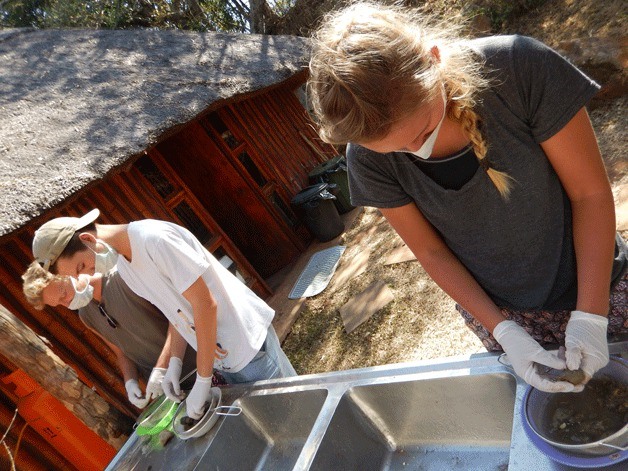
“Students also learned that research includes some less glamorous tasks as well,” Uitvlugt said. “For example, they spent hours washing the fecal matter out of leopard scats so that only hair and bone remained. These efforts will help researchers determine the species that make up the diet of leopards in the area.”
The students’ favorite excursion, Uitvlugt remembered, was to a local school where they were able to share some things about the United States and an environmental education activity with sixth- and seventh-grade students.
The trip culminated with a four day excursion to Kruger National Park.
“Part of the wonder and value in bringing students to the other side of the world is also sharing the beauty of that area with them,” Uitvlugt said.
The teachers are already beginning preparations for next year’s trip.
Next summer, they hope to extend the experiential learning with a visit to Mogalkwena Research Center — another site focused on conservation in the area, Uitvlugt explained.
“This extension will include working with local people in a craft center and a trip to Mapungubwe National Park, a World Heritage Site,” he said.
The pair are also researching the possibility of creating a nonprofit organization to help with the cost of future trips, and are looking into whether the students can receive high school or college credit for their experience. Currently they cannot.
The teachers advise any students interested in a possible future trip to take both AP classes before then to verify an interest and aptitude in those areas.

Best of Bainbridge
