Getting off the fence: A grass-roots effort fuels public art
Published 12:11 pm Saturday, April 26, 2008
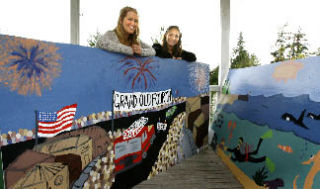
Reaching the finish line of a year-long school project has taught Laurel Curran and Isabel Williams that while passion may spark community action, skilled project management fuels it.
As does the ability to roll with the punches upon hearing the word “no.”
“It was cool to be rejected,” Curran said.
To be fair, these periodic “not interested” responses were part of a far larger process that took Bainbridge High seniors Curran and Williams from the start of Kaycee Taylor’s Political Action seminar to the culmination of their final project. And while the pair also got plenty of “yes’s,” their philosophical perspective helped them soldier through an endeavor whose all-consuming nature they didn’t anticipate at the outset.
This past Saturday, passers-by may have noticed the two young women executing their project’s final phase, which was to replace the aging murals at the Olympic Drive entrance to the ferry terminal with a series of fresh new ones, all painted with the help of Bainbridge fourth graders.
Curran and Williams, both raised on the island and close friends for years, arranged their fall schedules around the political action seminar because, as they described in their final project report, they were interested both in what was going on in the world and what they could do to make an impact in their own back yards.
“Basically, the whole class was about getting involved in your community. And that’s the direction we took it,” Curran said.
Kathleen Thorne, of the Bainbridge Arts and Humanities Council, drove the installation of the original set of panels at the intersection of Olympic Drive and Winslow Way. The site once housed a gas station that she recalled was torn down in the late 1980s when traffic began to make station access difficult.
Now vacant and steeped in a cocktail of toxic chemicals, the lot sat sad and unadorned for nearly a decade. In 1998, Thorne began casting about for improvement options.
She first contacted the property owner, Unocal, who jokingly offered to sell the property to BIAHC for $1 if it would handle the cleanup. With a $100,000 price tag attached to that effort, the purchase wasn’t a viable option.
What Thorne could do was try to redirect focus away from the lot with some cheerful banners and public art.
“Seemed like a no-brainer,” Thorne said via email, “but Unocal’s California lawyers were particularly concerned about liability issues, such as who would be blamed if an errant mural dislodged itself from the fence and clobbered an unsuspecting ferry rider.”
Eventually, Thorne’s husband David, a property attorney, facilitated the procurement of a license, and the City of Bainbridge Island footed the bill for some initial fence repair. Thorne then coordinated the mounting of 12 murals that had been made in 1998 by Sherry Chandler’s third grade class at Ordway Elementary school.
These, which had originally been created to hide the construction of the Washington Mutual bank on Winslow Way, were later joined by a mural donated by the Bainbridge Island Teen Center and five murals contributed by the Bainbridge Island Boys & Girls Club, a project managed by art teacher M.J. Linford of Sakai Intermediate School. Local non-profit organizations such as Bainbridge Performing Arts also regularly used the space for banners advertising upcoming events.
The Thornes stepped up once a year or so to try to wash the grime off the murals, but 10 years had taken its toll. Not to mention, Thorne added, that some of the pictured icons like the King Dome, were no longer in existence.
Who better to take the beautification reins than a pair of energetic students?
With project outline in hand, the students met with Zon Eastes, executive director of BIAHC, to get the city’s blessing for the project.
They then began the illuminating process of procuring local sponsors to foot the bill for the materials needed to create each panel.
That, incidentally, was where the “no’s” came in, as some local businesses weren’t interested in fronting the $104 that Williams calculated would be necessary for boards, primer and paints. Eight businesses eventually came through.