
Hall Brothers house placed on state, national historic registers
Published 1:30 am Friday, May 1, 2026
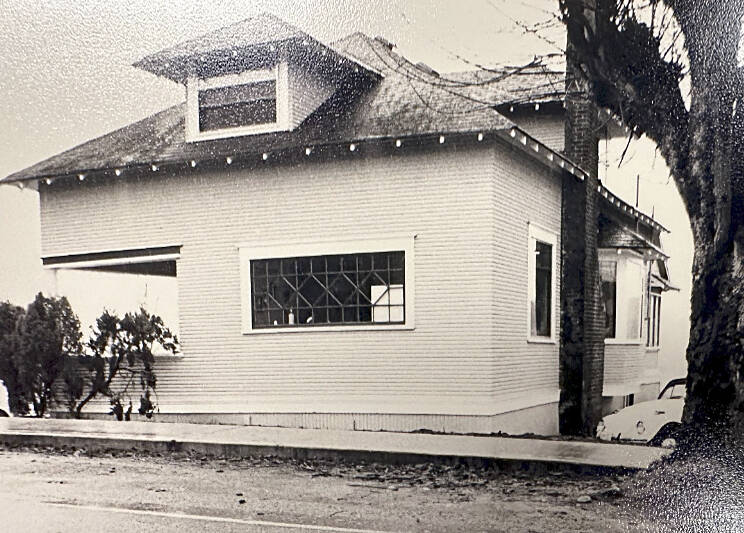
The Washington State Advisory Council of Historic Preservation voted April 1 to place the Hall Brothers Marine Railway & Shipbuilding Company House on both the Washington State Historic Register and the National Register of Historic Places.
Its significance lies in its contribution to the Hall Brothers Shipyard, which played a prominent role in regional maritime history, and the fact that the house is the last surviving structure on the former 77-acre shipyard in Winslow. Denise Harris, a local artist, has owned the house since 1979.
The Hall brothers—Winslow, Henry, and Isaac—established a shipbuilding operation at Port Ludlow in 1873. In 1880, the operation was transferred to Port Blakely on Bainbridge Island. From 1881 until 1903, the shipyard launched 77 vessels of every size and rig. Henry Hall, the last surviving brother, sought to expand the business and purchased 77 acres on the Eagle Harbor waterfront between what is now Ferncliff and Madison Avenues. Construction was completed on the shipyard in 1903, with most of the facilities concentrated in a 15-acre area along the waterfront. The facilities included a marine railway, machine shops, powerhouse, sawmill, joiner shop, gridiron, and warehouse. Two company houses were built on the hill above the shipyard. Henry and his wife built a 20-room home on a 5-acre parcel at the base of Ericksen Avenue.
“The Hall Brothers Marine Railway and Shipbuilding Company was noted for building some of the finest lumber and freight carriers in the Pacific Northwest. Their vessels were distinguished by exceptional workmanship, and their business developed and expanded the Pacific Northwest lumber industry throughout the Pacific Rim area, a news release says.
Winslow Hall, a master shipwright, designed a specialized 5-masted lumber schooner, the “Hall Model” for hauling lumber, a design that was adopted by other companies. The shipyard was instrumental in the growth of the town of Winslow, which was later named after Winslow Hall. The shipyard brought many families to the island, who remained and contributed to the growth and development of the island. Their names now label streets and other features scattered across the island.
In 1916, the Hall family sold the business to Captain James Griffiths, a colorful Seattle character who owned other commercial enterprises in the region. The market for new ships was declining, but Griffiths kept the Winslow shipyard afloat, servicing and repairing his own vessels as well as those serving the Alaskan cannery trade. In 1939, the shipyard converted to building steel-hulled ships, with many of the old facilities removed. In the lead-up to World War II, Griffiths contracted with the U.S. Government to build minesweepers. Throughout the course of the war, 16 minesweepers and 12 steel Navy tugs were built with the shipyard employing up to 2,300 workers.
After the war, the Winslow Marine Railway and Shipbuilding Company ceased operations, with its operational area sold to Commercial Ship Repair. In 1951, Griffiths sold off his parcels along Winslow Way, including the two company houses and the site of the former fire station, when the Agate Pass Bridge and the state highway across Bainbridge Island to the ferry terminal were completed. Harris bought the eastern company house in 1979. Six years later, the second company house, owned by John Rudolph, was moved to build the Solarmarine Office Complex.
Harris approached Daniel Reisfeld, owner of the Solarmarine Building, seeking help in preserving the house. Reisfeld, in turn, contacted Susan Hughes, a local archaeologist and former member of the Historic Preservation Commission, for assistance. The first step in preserving a significant historical property is to place it on the National Register for Historic Places, where it has certain protections and is eligible for preservation grants and tax breaks. While the house was recognized by local historians as being historically significant (it was identified as National Register eligible by the BI Historic Preservation Commission in 2018), it had not been formally evaluated for eligibility. This process requires completing a detailed nomination form that includes maps, photographs, and supporting historical materials with references.
Once completed, the nomination was submitted to the Washington State Department of Archaeology and Historic Preservation (DAHP) where it was reviewed and finalized. DAHP then submitted it to the Washington State Advisory Council on Historic Preservation for review and a formal determination of its historic significance. The Advisory Council voted to place the house on the State Historic Register and the National Register of Historic Places. Harris hopes to preserve this precious Bainbridge resource for generations to come.



Best of Bainbridge