
COBI priorities not included in recent legislative budget
Published 1:30 am Tuesday, May 5, 2026
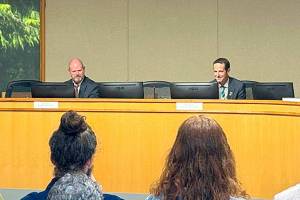
Lobbyist Briahna Murray gave a presentation to the Bainbridge Island City Council at its April 28 meeting, reviewing the recent Washington State legislative session that concluded March 12.
It was a short legislative session, lasting 60 days with 1,238 bills introduced and 268 passed into law, which is the lowest number of new bills to be approved at a session in the last five years. Murray shared that Democrats held strong majorities throughout the session.
There were three main priorities for the City of Bainbridge Island at the session, none of which were included in any state budgets. However, $4 million in funding for ferry preservation and maintenance was awarded. That funding will likely be used at the Eagle Harbor Maintenance Facility, shared Murray.
The priorities that received no approval or funding from the state included a $3.5 million request for the Highway 305/Day Road Roundabout. Amendments were offered at the session, but appropriations were not. “We elevated community concerns around the High School Road roundabout and requested that the funding that’s been allocated to the High School Road roundabout instead be allocated to the Day Road roundabout,” said Murray. “But it was not included in the final transportation budget.”
The second denied priority was a request of $50,000 for WSF service and line management. The funding was included in both the House and Senate proposals, but not in the final budget. This request was mainly due to the anticipated increase in ferry ridership during the World Cup this summer, which has games in Seattle. “This would help mitigate any issues with the ferries during that time,” said Murray. “But the transportation committee chairs focused on preservation and maintenance and not new investments, so it was not in the final budget.”
The third and final priority was Public Records Act amendments for city news subscribers, which were first introduced during the first year of the biennium in 2025, but had no action at the recent legislative session.
“Some of these priorities were two-year efforts,” said Murray. “I am disappointed to share with you that we did not get any of them across the finish line this year, and I look forward to working with you all to develop a strategy going into the next biennial cycle so that we can bring about more success.”
There was also funding allocated to ensure continued efforts to bring hybrid ferries on board by 2030. $750,000 was allocated for the study on alternatives for hybrid ferries to look at different ways of bringing new ferries into the state to support the ferry system, shared Murray. Rep. Greg Nance was a large advocate for legislation to establish the Mosquito Fleet Act, with a desire to continue to bring it forward in future sessions.
At the legislative session, there was also an approved increase in taxes, which will be in effect Jan. 1, 2028. A 9.9% tax on incomes over one million was approved after the longest floor debate in state history, which lasted nearly 24 hours, shared Murray. There were also approved sales tax exemptions on baby products, hygiene, over-the-counter medicine and other services. An expansion of Business & Occupation tax credit, Working Families tax credit, and free lunch for all K-12 students was approved as well. Estate taxes were, however, reduced to 2025 levels.
Overall, the state budgets have increased in recent years due to rising maintenance costs. There was a $2.4 billion increase in the operating budget for the state, which is now $80.2 billion. The transportation budget is now at $16.6 billion after a $1.2 billion increase, and the capital budget is $8.5 billion following an $889 million increase.
The state passed House Bill 2266, which requires cities to allow shelter, transitional housing, and permanent supportive housing in residential and hotel zones. There was, however, a lot of city pushback on House Bill 2489, which was not passed. HB 2489 would have limited the authority to regulate or remove individuals who occupy public spaces or encampments.
After the legislative session, automated license plate readers now need to comply with a new state regulatory framework as well, Murray shared.
The 2027 legislative session begins Jan. 11.
Best of Bainbridge