New bicycle traffic improvements coming to Winslow Way
Published 1:30 am Tuesday, March 17, 2026
Another traffic flow update is coming to the busiest intersection in Winslow. There could be more where that came from.
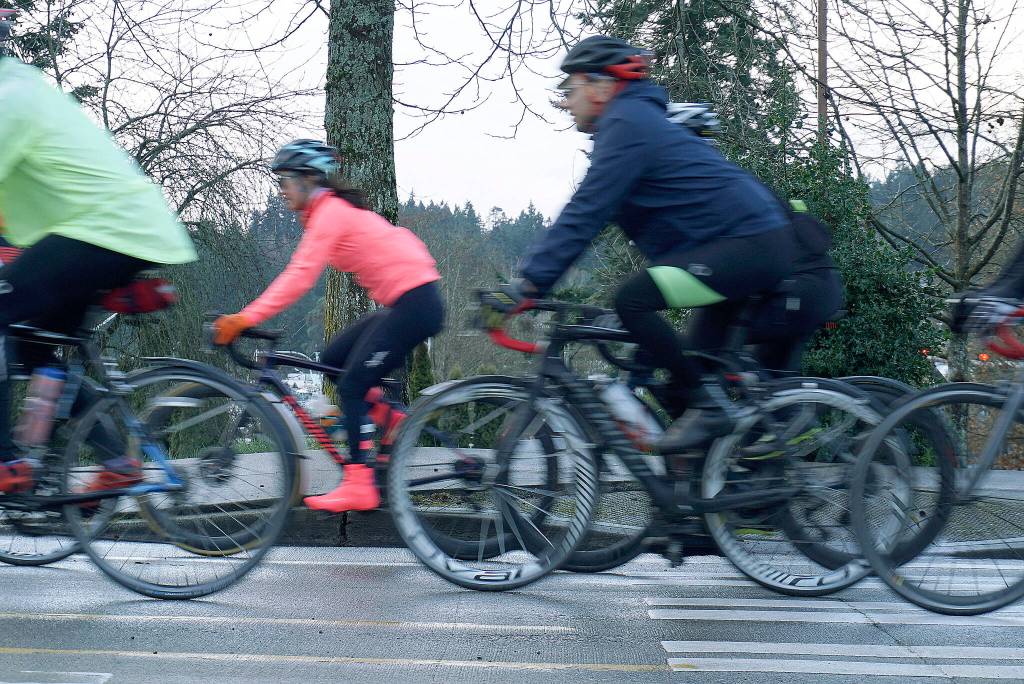
At its March 1o meeting, the Bainbridge Island City Council unanimously approved funding for two new pieces of bicycle infrastructure at the corner of Winslow Way and Highway 305: the conversion of the former right-turn only lane to a bike lane, and the addition of a bike-box between the crosswalk and the red-light line in the vehicle traffic lanes.
Chris Wierzbicki, city public works director, explained that the design of the updates will be “fairly simple.”
“It would involve adding some surface-mountable curbs, similar to the ones that we just installed on the Madison Avenue project, to separate bikes from the center right turn lane there, and add some green bike paint and a bike box at the front [of the traffic lanes], so that the bikes can ride up to the front and enter the box and make any of their turning movements safely from there in front of vehicles,” said Wierzbicki.
The project estimate is about $25,000, the public works director added, and should be completed before large crowds from the Fourth of July and the upcoming FIFA World Cup arrive in the region.
Deputy Mayor Kirsten Hytopoulos and Councilmember Mike Nelson both spoke in favor of the project.
“I’m hoping that the bike box, in itself, may be self-explanatory, but having some kind of signage about ‘Keep it clear,’ so that maybe people won’t continue to stick themselves out in traffic through multiple light cycles — anyway, wholly endorse this, on this terrible intersection,” said Hytopoulos.
More traffic updates could be in Bainbridge’s future, as city leaders gather and digest public opinion about the state of transportation infrastructure on the island, in preparation for a potential levy initiative that would fund transportation safety improvements and modernization projects around the city.
Council agreed to punt on levy discussions until after budget review, but still heard a presentation by consulting group EMC Research exploring whether islanders may support the effort, based on the results of a poll of 300 residents.
About 58% of poll respondents indicated they would support such a levy, including about 25% of respondents who said they would strongly support a potential initiative; 41% said they would oppose a levy, with 19% strongly against one. 1% were undecided.
The poll also asked respondents to rank the importance of each type of infrastructure update on a scale of 1-7. Overall, the greatest number of respondents ranked the maintenance and repair of Bainbridge’s existing major roads and neighborhood streets, filling potholes on arterials, and making the transportation system safer for pedestrians and students getting to school as “very high priorities,” per the poll results. Fewer respondents gave improvements for pedestrians, bicyclists, and reducing congestion the same urgency, and adding sidewalks and reducing the need for car transportation saw the lowest number of high-priority rankings.
“As you move down this list, all of these items are priorities for a majority, with the exception of the last item: adding more sidewalks. We’re just under half who consider that a priority,” explained consultant Jessica Polsky-Sanchez.
Councilmembers Nelson and Leslie Schneider expressed opposite opinions about the language presented in the potential levy, which both construed as too vague for the public to get on board with.
Nelson, a proponent of a road maintenance-forward approach, said that rolling the development of bicycle infrastructure into “road maintenance” is not an effective indicator of public opinion.
“I continue to believe that road maintenance is priority number one. We are out there spending a lot of money on some pretty elaborate bike lanes, when I think we should be prioritizing road maintenance first,” said Nelson. “I guess I’m just a little bit leery of merging the ideas here, and not making it clear for what it’s for.”
Schneider, on the other hand, agreed that road maintenance costs had ballooned over the past several years, but noted that many of the improvements promised to bicycle infrastructure on the island had never materialized, or were piecemeal. By including bicycle and pedestrian infrastructure updates with a road maintenance package, council could “give something to everybody,” she said, but it should be more than just “pennies found in the couch.”
“Counting children, counting seniors who can no longer drive, counting people who don’t want to drive — there’s, depending on how you look at it, about 25 to 30% of all people who don’t drive, in a city. So, having the vast majority of spending like this focused on roads that are only used by cars could be considered misappropriated,” said Schneider. “I’m just of a belief, that is not shared by everyone, that our future, the future of cities, is that we have to create more efficiency. We have to not focus so much on the scale of cars in our cities, and focus more on the scale of humans in our cities.”