Winslow Subarea Plan up for council approval this spring
Published 1:30 am Monday, December 22, 2025
After about a year, the plan for the future of Winslow is almost done, and a draft will be in the hands of the City Council this spring, in May or June. If approved, the city will have tackled one of the biggest hurdles facing its Comprehensive Plan.
The Planning Commission finalized its recommendations for the Winslow Subarea Plan at its Dec. 11 meeting, a set of code that will regulate development in the densest area of the island until the next city Comprehensive Plan cycle in 2040.
Their changes — shaped by housing requirements dictated by the Growth Management Act (HB 1220); the island’s water resources, as outlined by the Groundwater Management Plan; Kitsap County’s transportation infrastructure; and public discourse as to what defines Bainbridge Island — will outline how and where new people will live on the island in the coming decades, if council approves the plan.
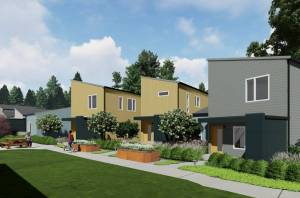
The commission decided to expand the boundaries of the Winslow area, raise the maximum height limit of buildings in certain sub-neighborhoods, adjust parking requirements and incentivize the inclusion of affordable units in new buildings.
If council rejects the Winslow Subarea Plan in spring of 2026, that could throw a wrench into the expedited Comprehensive Plan schedule outlined by city consultant Joe Tovar. In order to meet Tovar’s recommended Comp Plan submission deadline of June 30 (at the very latest), city planning staff would have to incorporate any changes council requested within a few weeks.
Buildings
The High School Road, Central Core and Ferry districts — encompassing the commercial corridors on Winslow Way and High School Road, mostly west of Highway 305 — all saw the same updates: any new buildings may be three stories tall, but can go up to about five stories, or 55 feet, if developers include below-building parking and earmark about a quarter of the planned units as affordable to people making 80% of the Area Median Income.
For these buildings, the floor area ratio (FAR), a measurement that determines the shape and mass of a building, will be a maximum of 4.0, meaning their total square footage may be up to four times the area of their lot.
“I think FAR does more than just provide density,” said Ariel Birtley, Planning Commission chair, during the Dec. 11 meeting. “Another area that we have not really addressed is that there’s not a lot of rental locations for local businesses, and having a higher FAR with a commercial first story would allow more residents and more people that could support these businesses. It’s part of good planning.”
However, commissioners noted, it’s unlikely any proposed building on BI could actually achieve 4.0 FAR. There are few places on BI where buildings are able to cover the entirety of their lot; most sub-neighborhoods in Winslow allow up to about 75-80% lot coverage, with the commercial corridor of downtown Winslow being an exception, permitting 100% lot coverage. Any developer seeking to achieve the maximum FAR for their lot would multiply their building’s square footage by a large portion of the lot’s total area, but not the entire lot — meaning no new building can be fully four times its lot size.
FAR is only one element of zoning that determines a building’s shape and its relationship to a street.
In the Central Core sub-neighborhood, which covers the downtown area of Bainbridge and adjacent residential streets, commissioners created a five- to 15-foot “step-back” requirement for new construction along Winslow in the Central Core area that applies to every story above the second floor. The FAR for this area would be 3.0.
The Planning Commission’s new regulations are not out of step with existing zoning in these areas; the current maximum height limit for new buildings in all three sub-neighborhoods is 35 feet, or about three stories. By adding requirements that developers must include if they want to build beyond the new vanilla height standards, the Planning Commission hopes to discourage sprawl and accommodate many diverse needs.
“I do not want to see a giant surface parking lot, 10-20 years from now, in the Ferry district,” said commissioner Peter Schaab. “I want to see a lot of diverse housing options and other activities.”
Parking
In addition to updating structure regulations, the commissioners drafted some recommendations to amend parking requirements in the Winslow Subarea to disincentivize the use of cars as a mode of transportation for potential residents.
For new residential construction, commissioners reduced parking requirements by half, but not below half a parking space per unit of housing — meaning, for example, where once residential buildings were required to have at least two parking spaces per unit, new units would only be required to have one.
Commissioner Sarah Blossom noted that most of the parking in the downtown area is privately managed, and any potential overflow parking from residents or visitors competing for parking spaces could create challenges for businesses in the area.
“I don’t think Winslow is a sea of parking. I have driven through and not found parking — I didn’t drive around and around and around, but as someone who drives to Poulsbo for work, I’m not going to be riding my bike to Winslow to grab something at Town & Country on the way to Poulsbo; I’m going to be in my car. I’m not going to ride a bus; I’m going to be in my car, because I live out there,” Blossom said. “When you have housing built that doesn’t have adequate parking for its residents, they seek parking elsewhere. It might be different if in our city, most of our parking was public, but I believe most of our parking is private.”
Public reception
The city of Bainbridge Island decided to concentrate its growth in the Winslow area after the public rejected suggestions drafted by planning staff that would have added smaller-scale density in neighborhood centers, like Rolling Bay and Lynwood Center.
It took over 12 months for the Planning Commission to come to a consensus, largely because certain parts of the plan have become contentious, as the city and its residents grapple with the impact of growth on the community.
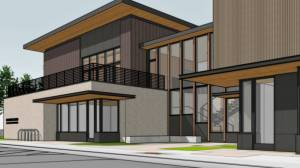
The city’s proposed affordable housing project at the corner of Hwy 305 and Winslow Way, colloquially known as 625 Winslow, has become a flashpoint for discourse, with many members of the community offering passionate opinions both in favor of and against the project.
In October, park district Commissioner Dawn Janow filed an appeal to the city hearing examiner for an ordinance that would allow new buildings in the Ferry district (east of 305) with 100% affordable units to have flexible standards related to parking requirements, FAR and maximum building height. The appeal challenges the environmental impact study of the ordinance, which received a “determination of non-significance.”
“Let me be clear, we are for affordable housing […] Our objection to the city’s ‘625’ project, and the work to fast track code updates, are made because they are being done hastily, outside of the Comprehensive Plan update and Winslow Subarea plan update process, without proper impact studies, and while ignoring red flags such as parking, overwhelming public objection and proper process for the code,” said architect Henry Zimmerman during public comment, who explained that he has been working with a property owner to develop a parcel in Winslow since 2017.
“The code is being designed backwards from the ‘625’ project up, not from the codified public process of the Comprehensive Plan downwards. This is not professional, and you will end up harming the community for generations to come if you continue to ignore this in the spirit of following the correct process. The focus today should not be on development regulations or parking standards, but on the Comprehensive Plan and the Winslow Subarea,” Zimmerman added.
The hearing will take place Jan. 28, with an extra day of proceedings scheduled on Jan. 30, if needed.