
BI looking into implementing speed cameras around the island
Published 1:30 am Friday, December 5, 2025
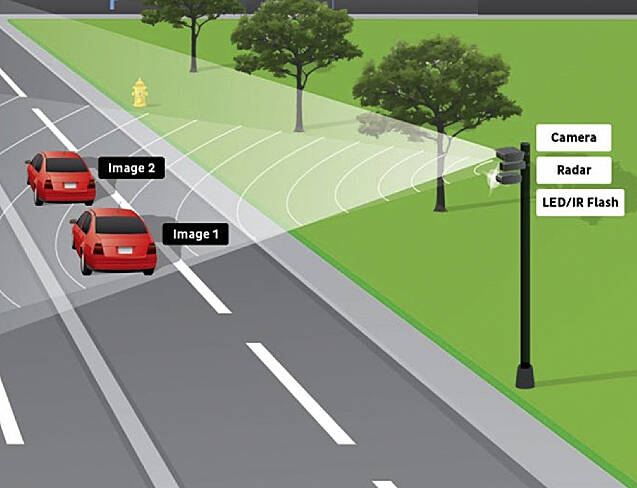
The Bainbridge Island City Council is exploring the implementation of automated traffic safety cameras on the island to curb speeding.
Council, at its Dec. 2 study session, directed the city manager to present a public engagement plan for feedback from the community on photo speed limit enforcement for consideration at a future meeting.
BI police Sgt. Joseph Fastaia provided the council with an overview of the department’s intentions surrounding the proposal. Bainbridge Island Police Department has, on averag,e three officers per shift who are busy responding to 911 calls, vacation home checks, vehicle unlocks, in addition to conducting speed enforcement duties, adding, “being able to task everybody to one area just to enforce speed is taking resources away from other higher priorities,” he said. “Speeding is the number one complaint we received from the community. We are a community policing organization, responding to the news of the community is paramount to our mission.”
On average Fastaia said BIPD can only issue around five to six citations an hour while an automated camera can more reliably capture speeders adding, “We could, of course, stop speeding on Bainbridge Island by putting a series of speed bumps on every single road every 10 feet, but destroying the suspension of every car driving on Bainbridge is just not going to be a feasible thing for us to do,” he said.
The proposal listed several possible locations for future cameras to be installed, including: 9343 Sportsman Club Road NE (Sakai Intermediate and Woodward Middle School Zone), 4704 Blakely Avenue NE (Blakely Elementary School Zone), and 12000 Miller Road NE.
In October, BIPD collected speed data during school hours, finding the average speed was 24 miles per hour on Sportsman Club Road, 27 mph on Blakely Avenue, and 37-40 mph on Miller Road, per city documents. BIPD estimates the frequency of potential infractions in both directions at 1,000 per day on Miller Road, 850-950 per day on Blakely Avenue, and 500 per day on Sportsman Club Road.
COBI has identified other cities, including Kirkland, Seattle, and Poulsbo, which all saw decreases in speeding infractions or collisions after implementing traffic cameras, per city documents.
“State law is great, but we’re a great community, we want to do better than the minimum required by law. COBI is going to look to post additional notices on official city media and make sure that’s accessible for people to be able to hear,” Fastaia said.
The National Transportation Safety Board also recommends traffic cameras as an effective tool in reducing collisions, and the U.S. Federal Highway Administration data demonstrated a 54% reduction in collisions and 48% reduction in injury collisions where cameras were installed, per city documents.
Fastaia said the camera vendor does not receive revenue as part of violations, and revenue generated from traffic cameras can only be used for specific traffic enforcement measures. Fastaia said, unlike flock cameras, which are connected to network databases including the National Criminal Information Center, and can generate hit lists for certain offenses, flag license plates, and record information about drivers or passengers, proposed BI traffic cameras don’t connect to a database, he said.
BI traffic cameras will be locally managed, and camera vendors won’t be able to access the data. Additionally, a member of BIPD will review infractions as well as the BI Municipal Court. Regarding equity, Fastaia said BIPD intends to offer reduced fines to accommodate low-income households without adding an undue burden on those who cannot afford to pay the fines.
“The cameras are impartial and eliminate potential bias towards the drivers and occupants. It is only assessing the vehicle speed and what the vehicle is doing without reference to anybody inside, and the camera vendor does not collect a percentage of the fines,” he said. “They do not make more money if we catch more violators on cameras; we pay for the speed camera units, and that’s what they get. And the images of the vehicles and plates can only be used for speed enforcement, and they’re exempt from disclosure to further protect privacy under the law.”
Councilmember Clarence Moriwaki shared his support for the proposal and how he wants the community to be informed about improved road safety.
“I do agree with my colleagues, the people should be informed about why they were doing this and why it’s so important for our public safety. Your neighbors deserve to have a safe neighborhood to walk in, and we have to do what we can to make sure that we keep those roads safe for them,” he said.
Councilmember Kirsten Hytopoulos said she wanted to ensure the public has ample opportunity to provide public comment before the council takes formal action.
“If we’re going to do outreach to the community…lead with those stats, ” she said. “That’s just a blatant violation of a very clearly understood speed limitation.”
Councilmember Joe Deets said privacy concerns need to be taken seriously and he’d like to see discussions with the city of Poulsbo to learn how to implement best practices into COBI planning efforts.
“Clearly, education is hugely important to make sure that people are aware of the reason for this. Also that this is not a money-making initiative. All revenues will go to traffic safety, but also privacy, and the fact that we’re doing problem solving,” he said.
BI Mayor Ashley Mathews said she’d like to revisit the conversation at a regular business meeting to allow the public an opportunity to share their perspectives. Mathews also said she would want to include local business perspectives in public outreach efforts.
“I think back to when I moved here, Miller (Road) was 40 (mph), something like that. And folks still consider it that. It’s sort of the wild wild west out there,” she said.