Environmental appeal temporarily pauses Winslow project
Published 1:30 am Wednesday, October 1, 2025
The public will have to wait for a chance to make their voices heard before one of the city council’s biggest decisions of the year.
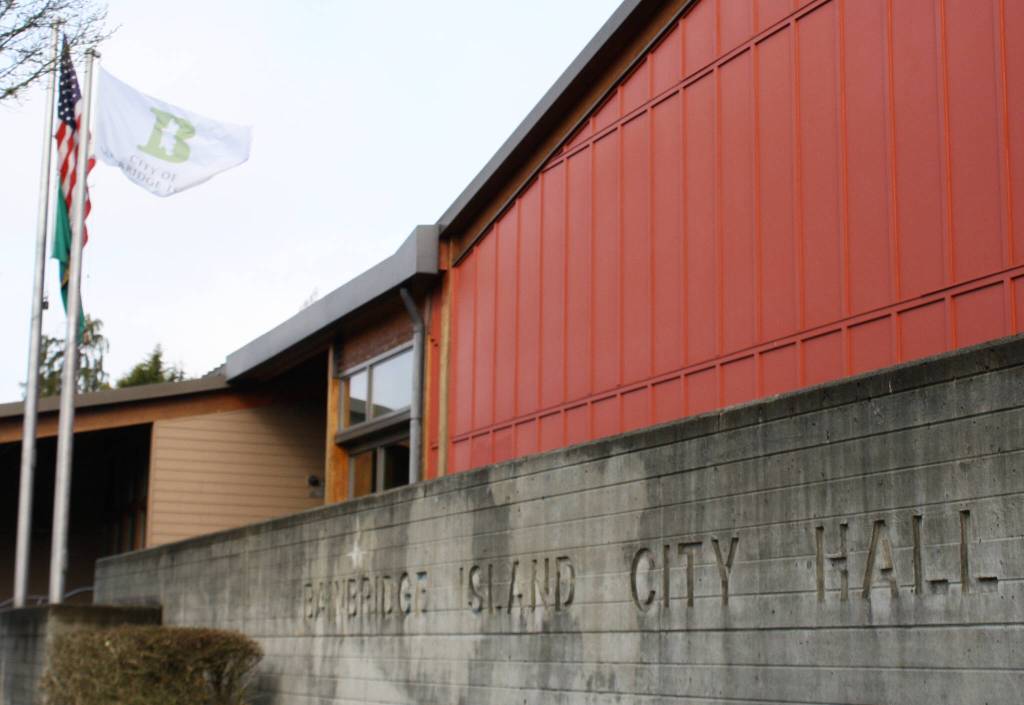
At the Sept. 23 council meeting, the Bainbridge Island City Council voted to hold a public hearing Oct. 14 for an ordinance that would conditionally allow affordable housing developments like 625 Winslow Way in two neighborhoods near the ferry terminal, prior to the certification of the Comprehensive Plan.
But on Sept. 26, BI Parks Commissioner Dawn Janow filed an appeal for an environmental review by the state, which will temporarily put the project on hold.
“There’s been a process for changing the zoning on Bainbridge Island that’s happening not quite in alignment with the Comprehensive Plan, and this has been going on for quite some time. I’m sorry that this project is caught in the crosshairs of it,” said Janow. “But there’s been many public meetings, a lot of public inquiry about traffic, the environmental impacts, costs, feasibility, that folks have been asking questions of the city, and the response has just been, ‘Well, we just have to do this project.’”
The State Environmental Protection Act requires government agencies to consider how policies or projects may impact the local environment, including humans, and to mitigate potential issues — one of the state’s most powerful legal tools for protecting the environment. Elements the state considers include traffic, water quality, noise, wildlife habitat, and community resources.
When the city’s policy governing the development of 625 Winslow Way, ordinance No. 2025-21, was first reviewed through SEPA, it received a “Determination of Nonsignificance” from the city planning department. That meant the project was unlikely to have adverse environmental impacts, and that the city was not required to conduct an Environmental Impact Statement for the site.
But that process felt “rushed,” Janow said, and many community members felt their concerns were going unheard, particularly regarding groundwater management. It’s unclear how long the appeal process will take; it’s up to the Bainbridge Island Hearing Examiner to establish a schedule.
Hearings are a part of local governance where the public is invited to give input on specific issues before decision makers. The events are often required by law ahead of major land use changes or development projects. They typically include an information session followed by a period of public comment.
The over 8-hour city Planning Commission meeting Sept. 11 was similar, but because lawmakers were not hosting the event, it was considered a “public participation meeting,” not a hearing.
One specific sticking point from the public that city council hoped to clarify with the hearing were allegations of “spot zoning” with the ordinance.
“Spot zoning” is the creation of a special zoning code that applies specifically to one parcel within a larger zoned area, particularly when the spot is at odds with a city’s master plan and current zoning restrictions. The defining characteristic of a spot zone is one that benefits the property owner to the detriment of public goals and land use plans. It’s not generally considered good planning practice in the U.S.
City attorney Jim Haney explained at the Sept. 23 council meeting that because the ordinance could feasibly apply to other locations east of Highway 305, it’s not technically spot zoning.
“My understanding from speaking to staff is that there are other properties within the area east of 305 that are within these zoning districts which could take advantage of this,” said Haney. “It’s one of the reasons why we removed all of the language in the ordinance that all referred to the [Low Income Housing Institute] project, because it goes beyond the LIHI project. It goes to other properties within those zoning districts east of 305.”
Part of the spot zoning allegations stem from growing calls to relocate the project. In the last few weeks, architect Matthew Coates has brought public attention to several alternative locations for the project; among them, a spot just down the street at 251 Winslow Way.
But zoning for affordable housing anywhere in the Winslow area isn’t easy, explained LIHI chief strategy officer John Grant during public comment Sept 23.
Grant pointed out key similarities and differences to the sites, and noted that an ordinance would still be necessary. Both are within downtown Winslow, both would require about 20 feet of grading to accommodate 90 units, and both would require council to raise the building height limit for multi-family housing that is 100% affordable.
“The proposed ordinance helps both sites,” Grant said.
However, he added, one major issue with the site at 251 is that it’s privately owned, with an assessed value of $5.6 million — a price outside of the city’s budget. Despite talk of a “land swap,” the owner of 251 Winslow Way isn’t interested in the 625 site, Grant said, which means the city would have to sell the land to a private developer to pay for the new location. That means a loss of control over whatever structure is built on the land, and the risk that both 251 and 625 are sold to other bidders.
“For folks who do not want a large building on the corner, this doesn’t solve that problem. To get the maximum market value, you would have to sell the land to be developed into a large, commercial, multi-family or private hotel. In other words, you would still wind up with a building on the corner,” Grant said. “But let’s assume it does work out: city sells the land and buys the alternative site. We would need to start from scratch […] To seriously consider this option, it is very possible that by the time the city cuts the ribbon on an alternative site, it might be eight to ten years from now. However, if we stay the course on 625 Winslow Way, the building could open as soon as spring 2028.”
This project has begun to represent a larger discussion about affordable housing and the culture of Bainbridge Island. At nearly every step of the process, city councilmembers, planning commissioners, development partners, tribal members, architects, scientists, economic professionals and more have all weighed in on what 625 Winslow says about the city’s values.
For Kirsten Hytopoulos, one of the only members of the city council who vocally opposes the project, it’s become a manifestation of the divide between the priorities of constituents and of city leaders.
“This is becoming a square peg in a round hole. I’ve supported this project up until the last couple of months. It is becoming extremely depressing to have the level of shaming and pressure on this council to say that we don’t believe in affordable housing. If any of us, our planning commissioners, or anybody in this community, doesn’t believe that this is the right site for this project at this point, that’s sad. What’s happened in this community is sad,” said Hytopoulos at the Sept. 23 meeting. “We all know that we have a dire need for affordable housing […] The idea that we can’t reconsider this location, given the mass of the project that we’re looking at, at this point, and other issues, is sad. I think that we’re going to regret this in the long run, if we build this massive building on the site.”
In the same meeting, deputy mayor Jon Quitslund proposed that city council talk about reframing “affordable housing” to “income-qualified” housing, in order to include households making up to 120% of the Area Median Income, a bracket considered “moderate” by the federal Department of Housing and Urban Development.
Quitslund argued that by redefining the requirements for affordability, developers could build mixed-income housing that helps subsidize residents with lower incomes while still offering housing for people at different income levels.
“I won’t call it a no brainer, but I don’t believe it’s a controversial proposition. I do think it should be submitted to public comment, and my version of the motion moves the discussion and the action forward to another meeting beyond this one,” Quitslund said.
While other councilmembers saw benefits to the idea, the motion ultimately failed 4-3.
“Not that the idea doesn’t have merit — because missing middle is a huge idea and a huge part of our housing problem on the island, and we should find ways to incentivize developers to try to do low income and affordable housing — but this is not the time for the Planning Commission to have one more thing on their plate,” Councilmember Clarence Moriwaki said.